Compass, MARINER'S, is a magnetic instrument used by mariners to indicate the direction of the ship with respect to the magnetic north and south line, or, in other words, to give the azimuth of the ship with respect to the magnetic meridian. That the mariner may know his direction with respect to the geographical meridian, he must know the angle between the magnetic and geographical meridians (see DECLINATION), and as this angle is different in different years and at different places on the surface of the globe, the mariner must be able at any time to determine his position, when his charts will give him the necessary data to supplement his compass reading.
The directive property of the magnet seems to have been unknown in Europe till the 12th century. It appears, however, on very good authority that it was known in China and throughout the East generally at a very remote period. The Chinese annals assign its discovery to the year 2634 B.C., when they say an instrument for indicating the south was constructed by the Emperor Ho-ang-ti. The earliest reference to the making of magnets is in a Chinese dictionary of 121 A.D., where lodestone is defined as 'a stone with which an attraction can be given to the needle;' but this property of the lodestone could not fail to have been observed at a very much earlier time. At first the Chinese would appear to have used the compass exclusively for guidance in travelling by land, and we hear of their using it by sea only somewhere about 300 A.D. According to one account, a knowledge of the compass was brought to Europe by Marco Polo on his return from his travels in Cathay; but as against this, the late Mr William Chappell, in a letter to Nature (June 15, 1876), produced evidence to show that we owe the appearance of the compass in Europe in the 12th century to independent discovery, and not to importation from China.
The ordinary mariner's compass is made up as follows: The needle is a magnetised strip of steel, or in the better compasses a number of thin strips magnetised separately and then bound together. This is balanced so as to swing horizontally on a fine pivot. Fastened to the upper surface of the needle and swinging with it is a circular card marked with the thirty-two 'points,' and having the point marked N immediately over the end of the needle that is attracted to the north. The pivot on which the needle swings stands up from the bottom of a copper bowl, which has a glass covering to protect the contents from wind and weather. The compass-bowl is made of copper (a good conductor of electricity) in order to damp the vibrations of the needle. For the needle in moving induces currents of electricity in the pass-bowl is sometimes filled with spirit, but the additional friction of the liquid interferes with the sensitiveness of the needle. The bowl is supported in Gimballs (q.v.) so as to remain horizontal in all positions of the ship. The whole arrangement is placed in the binnacle, situated when possible in the fore and aft line, and having provision for the placing of lamps to illuminate the compass-card by night.
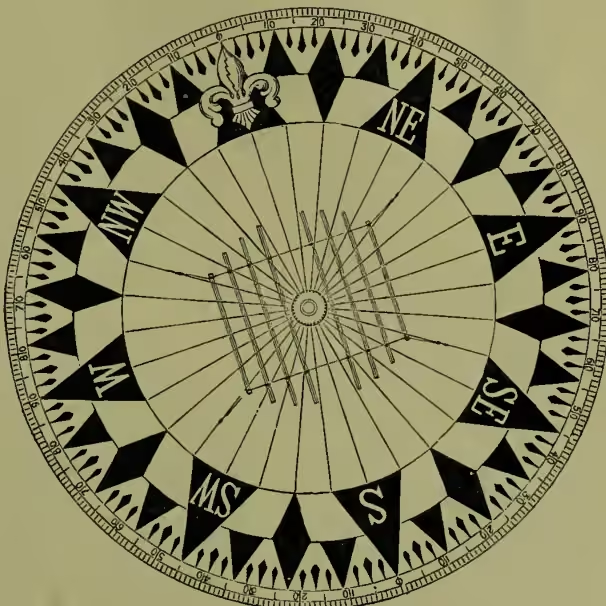
The compass-card is represented in fig. 1. The four cardinal directions or 'points' are marked N. E. S. W., and there is a convenient notation for intermediate points. Thus the point midway be- tween N. and E. is called NE., that again between N. and NE. is called NNE. (read north-north-east), and so on. The remaining sixteen points, such as NE. (read north by east), are named on a plan which will be readily made out by an examination of the figure. These thirty-two points are often further subdivided into halves, quarters, and even eighths, and then we have NE., and so on. When the ship lies in the magnetic meridian, and points to the north, the N. point on the card is directed towards a black line, called the lubber's line, marked on the inside of the compass-bowl. Boxing the compass means reading off from memory the thirty-two points in order going round either way.
Modified forms of the compass are in use on land by surveyors and miners, and need not be further alluded to here.
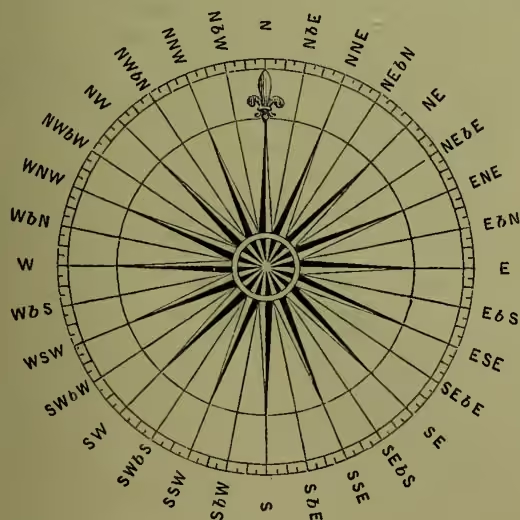
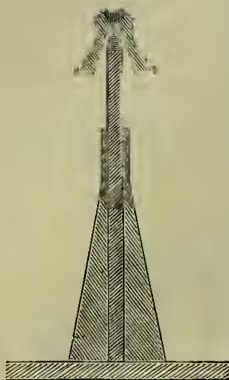
By way of summarising the qualifications of a good compass, we shall describe the best compass in use—Sir William Thomson's, patented in 1876: A thin aluminium ring (fig. 2) is connected by silk threads with an aluminium boss, which rests on an aluminium cup having a centre piece of sapphire poised on an iridium point (fig. 3). Instead of a single needle there are eight thin strips of steel fastened to the silk threads as shown in the figure. The thin paper rim bearing the points is divided at intervals so that the contractions and expansions due to change of temperature may not produce warping of the aluminium. The whole arrangement weighs only 200 grains or so, and thus there is very little tendency to flatten the point of the copper bowl, the electro-magnetic forces of which tend (according to Lenz's Law) to oppose the motion producing them. For the same purpose also the com- supporting needle. Hence the 'friction error' can be made very small—in fact, if it is found that a card can be made to rest even half a degree out of the magnetic meridian, the supporting point is rejected for a sharper one. The weight, such as it is, being mostly in the rim, the period of vibration of the card is long (40 seconds, or so), which makes the card very steady. The bowl is saved from violent oscillation by having in the bottom a quantity of castor-oil. The gimbals are supported on knife edges, and their being made of brass wire-rope dispenses with the not very durable india-rubber pads otherwise used. A simple device prevents the card from jumping off the pivot when heavy guns are fired—a matter of some importance in an engagement. The binacle has complete provision for stowing away the magnets, soft iron bars, and spheres used to counteract the magnetism of the iron of the ship.
Along with Thomson's compass is supplied a piece of apparatus for converting it into an azimuth compass, which is a compass for finding the angle subtended at the observer's eye by the projections of two objects on the horizontal plane.
For the earth's action on a magnetised needle suspended free to move horizontally and vertically, see the articles MAGNETISM, DECLINATION. The great difficulty connected with the use of the compass arises from the disturbing influence of the ship's magnetism, of which part is considered permanent, and part—due to the soft iron—is temporary, and varies with the position of the ship. Various methods are in use to regulate this difficulty, which in iron vessels is sometimes so great as to make an ordinary compass almost useless. The principal are (1) counteracting the permanent induced magnetism by properly placed permanent bar magnets; and (2) supplying about the compass soft iron masses in such a way that, however the ship turns, the transient induced magnetism on the left of the compass shall be exactly equivalent to that on the right. Many of the best ships carry a standard compass placed as far as possible from the iron of the ship, especially from vertical masses like iron masts and funnels. When it is mentioned that an error of one point () in steering means an error of about one mile in five, the necessity for the various precautions will be readily recognised. For details on this subject, see the Admiralty Manual on the Deviations of the Compass, and the references there given.