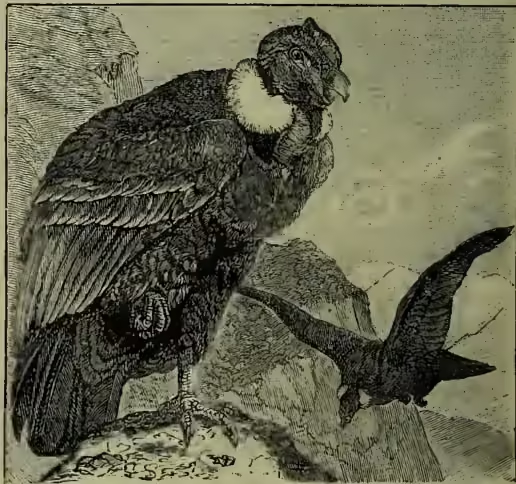
Condor (Sarcorhamphus condor or gryphus), the great vulture of the Andes, one of the largest and most remarkable birds. Among the wide order of Accipitres, or Birds of Prey, the condor is the grandest representative of the family Cathartidae, or New-World Vultures. These may be at once distinguished from Old-World forms by the incompleteness of the partition between the nostrils, by having, to put it more plainly, 'a hole through their nose.' The beak is also constricted at the end of the 'cere,' and the feathers have no 'after-shaft.'
Among these New-World vultures, the condor is chief. Though its size and strength have been often exaggerated, this magnificent bird is probably the largest of the vultures. The only rival which could dispute this claim is the famous Lämmmergeier (Gypæus barbatus) of the Alps. The male condor may measure about 3½ feet in length, the female is slightly smaller. The expanse of each wing (said to be 15 feet from tip to tip) is more than twice the length. The general colour is black with a steel-blue sheen, and some of the feathers verge into gray; there is a downy white ruff round the dull-red naked neck. The young birds are covered with whitish down. The beak is long, hooked at the apex, black at the root, yellow at the point and on the sides. The head is naked, and in the male bird bears a large fleshy comb. The eyes look sideways; the 'perforated' nose is characteristic of the family. The voice is limited to a weak sort of snorting. The feet are not well suited for grasping, the hind-toe being very small and hardly reaching the ground. The stories about condors lifting their prey in their feet from the ground are mythical. These birds have their central home in the Andes, but extend to some other mountainous parts of South America. They breed on the heights, laying their two eggs on bare ledges in the months of November and December; the young are unable to fly for a whole year. They descend to the plains to feed on carrion, tearing carcasses with their strong bills; they may also attack lambs and calves, or several together may venture on an adult animal. Their boldness and voracity seem to have been exaggerated. Their voracity is, however, great: Tschudi mentions one in confinement at Valparaiso, which ate 18 lb. of meat in a single day, and seemed on the morrow to have as good an appetite as usual. The condors have great powers of flight, and can soar to immense heights, till, in fact, they are lost in or far above the clouds. They are readily kept in confinement, and may be seen in many zoological gardens.
In the same genus is the rarer King of the Vultures (S. papa), inhabiting the wooded plains of South and Central America. It is a smaller bird, reddish-yellow above, white beneath, with bluish-gray ruff, black quills and tail. Its head and neck are covered with variously coloured roughnesses. It owes its name to the way in which it bullies other vultures. Closely allied is the Turkey Vulture (Cathartes aura) of North America. This bird, useful as a carrion destroyer, is about 2½ feet in length, black in colour with a purplish sheen, well marked by its carmine and bluish-red head, fleshy neck, and white feet. C. atratus is another species from South America.