Cone. In general, the term cone is applied to any surface described by the motion of a straight line which always passes through a fixed point and also intersects some curve in space. But more particularly, the word is used to denote a right circular cone—i.e. the solid produced by the revolution of a right-angled triangle round one of the sides containing the right angle. Thus (see fig.), let ODC be a triangle with a right angle at D; if it revolve round OD, then in moving through successive positions, OC will trace out the cone, OABC. The point,
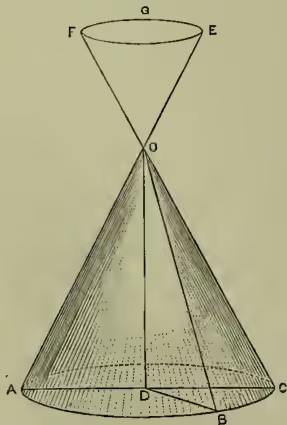
O, is termed the vertex; the height, OD, the altitude; the line, OD, the axis; and the circle, ABC, the base of the cone. The line, OC, by whose motion the cone is produced, is termed a generating line, or generator. In the oblique cone, the axis is inclined to the base at an angle other than a right angle. A truncated cone is the lower part of a cone cut by a plane parallel to the base.
The lateral surface of a right circular cone is obtained by multiplying half the circumference of the base into the slant height of the cone; the solid content, or volume, is equal to one-third of the area of the base multiplied by the altitude.
In considering the different possible sections of a cone by a plane, it is necessary to remember (as is indicated in the figure) that a cone is really produced in duplicate; that the generators, after passing through the fixed point, O, form another cone, such as OEGF. Different positions of the sectional plane produce different curves, according as it is parallel to the base, a generator, the axis, or parallel to none of these; so, consequently, we have a circle, parabola, hyperbola or ellipse, respectively. For the conic sections, see CIRCLE, ELLIPSE, HYPERBOLA, PARABOLA.