Confucius, the name by which the great Chinese sage is known, is a Latinised form of the Chinese K'ung Fú-tsze (孔夫子) or ‘the Master K'ung,’ K'ung being his clan or family name, and Fú-tsze the denomination applied to him by his disciples after he had become a teacher, and gathered around him a school of ardent and inquiring spirits, to whom he communicated his views on the ancient literature and history of their country, and on the principles of human duty. As a child, he received the postnomen Ch'ih, and when grown up he was called Chung-ni, marking his place in the household. His birth took place, according to the most authoritative account, in 551 B.C., in the village of Ch'üeh, in the state of Lú, a part of the present province of Shantung.
The K'ung family had migrated to Lú from the dukedom of Sung, and were a branch of the ruling house of Sung. The lineage of Confucius is thus traced through the dukes of Sung to the kings of the Shang or Yin dynasty, and through them again, up among the mists of antiquity, to the sovereign Hwang Ti, whose reign is said to have commenced in 2697 B.C. His father, known to us by the name of Shú Liang-heh, was commandant of Tsáu, and a soldier distinguished for his strength and daring. In his old age he contracted a second marriage with a young lady of the Yen family, and of her was born the sage in 551.
Liang-heh died in the child's third year, leaving his mother and him in straitened circumstances. He has described his own mental growth till he was seventy, when he ‘could do whatever his heart prompted, without transgressing what was right,’ and tells us that ‘at fifteen his mind was set on learning, and at thirty he stood firm in his convictions.’
At nineteen he married, going for his wife to the Chien-kwan family in his ancestral state of Sung, and in the year after, his son Lí was born. Besides this son Lí, Confucius had two daughters.
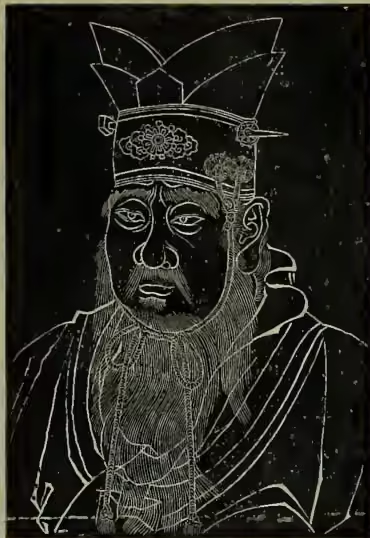
(Reduced fac-simile of a rubbing from a marble slab behind his temple at Kio-foo-hien).
About the time of his marriage we find him in humble offices, in charge of the public stores of grain, and of the public herds, performing efficiently his functions, and allowing nothing beyond or higher than them to occupy his attention. In 531 B.C., when he was in his twenty-second year, he commenced in Ch'üeh-lí his career as a teacher. He continued in his native state till 517 B.C., with the exception of a short visit to the capital at Loh, where he is said to have met with Láo-tsze (q.v.). In 517 Lú fell into great disorder. The Duke Cháo being worsted in the struggle, fled to the neighbouring state of Ch'í, and thither Confucius also for a time repaired.
Returning to Lú, he remained there for sixteen more years without being called to any official employment. Duke Cháo died in exile in 510 B.C.; and his younger brother and successor, Duke Ting, in 501 B.C. appointed Confucius governor of the town of Chung-tú, where a marvellous reformation in the manners of the people speedily took place. The next year saw him first minister of works for the state, and next minister of crime. The government was now conducted for three years according to his counsel. ‘He strengthened,’ we are told, ‘the ruling house, and weakened the ministers and chiefs. A transforming government went abroad. Dishonesty and dissoluteness were ashamed, and hid their heads. Loyalty and good faith became the characteristics of the men, and chastity and docility those of the women. Strangers flocked to Lú from other states.’ Confucius was the idol of the people.
But this success did not last long. The prosperity of the state awakened the jealousy and fears of its neighbours. The marquis of Ch'í cunningly sent to Duke Ting a present of beautiful courtesans and fine horses, and a breach was made between Confucius and his ruler. His counsels were no longer sought. He determined to leave Lú and visit other states. Accordingly in 497 B.C., when he was now in his fifty-fifth year, he went forth from Lû, nor did he return to it till 485 or 484 B.C.
During this long period he visited many states, attended always by a company of his disciples. His fame had gone before him, and many of the princes would have received and supported him, but he would not settle where he could not obtain free course in carrying out his principles. Repeatedly he and his companions were in straits, and even in peril of their lives. Once they were assailed by a mob, who mistook him for an officer by whom they had been oppressed. But while the others were alarmed, he calmly said: 'After the death of king Wân, was not the cause of the right way lodged in me? While Heaven does not wish this cause to perish, what can the people of K'wang do for me?' Another time, in somewhat similar circumstances, he said: 'Heaven has produced the virtue that is in me; what can any man do to me?' Such was his belief concerning himself and his mission. He never pretended to be anything more than man, but he knew the right way, the way for the individual to perfect himself, and the way for the highest ruler to rule, so as to make men happy and good. One of the princelets through whose territory they passed asked his disciple Tsze-lû how he would describe the Master, and the disciple gave him no reply. When he told the Master of the question, Confucius said: 'Why did you not tell him that I am a man who in his eager pursuit of knowledge forgets his food, and in the joy of its attainment forgets his sorrows, and who does not perceive that old age is coming on?' He was then probably in his sixty-fifth year.
Duke Ting of Lû died in 495 B.C., and was succeeded by his son Duke Âi, who in his tenth year sent a message of recall to the sage in Wei. The ruler and his ministers received him respectfully, but he can hardly be said to have re-entered political life. Only a few more years remained to him, during which he is said to have put the finishing hand to his labours on the ancient writings, and been specially assiduous in the study of the Yî-king. He tells us himself that he reformed the music to which the ancient odes were sung, and digested the odes themselves, giving to the pieces in the principal parts of the collection their proper places. He must have occupied himself also with the composition of the only classical work which is assigned to his own pencil—the Ch'ün Ch'ü, embracing the events in the history of Lû from 722–481 B.C. The latest entry in the work is that in Duke Âi's fourteenth year (481 B.C.). He died on the 11th day of the 4th month in 479 B.C.
In the Confucian Analects, or memorabilia compiled soon after his death from the reminiscences of his disciples, we have abundant information of the Master's Sayings and Doings, and they can be added to from the supplements to the Ch'ün Ch'ü, the Narratives of the School, portions of the Books of Ritual Usages, and the memoir by Sze-ma Ch'ien. There are other works about him, but all containing more or less of the legendary element, evidently introduced after the Buddhistic literature became known to the Chinese. Of no ancient personage do we have fuller information than we possess of Confucius, and no other can we fashion more completely to ourselves. One whole book of the Analects is occupied with his personal characteristics, his deportment, his eating, his dress. It shows him to us at his ruler's court, in his intercourse with his disciples, in his carriage, at his table, in his bed. The disciples tell us that there were four things from which he was free—foregone conclusions, arbitrary determinations, obstinacy, and egoism; that there were four subjects which he avoided in talking with them—extraordinary things, feats of strength, rebellious disorder, and spirits; that there were four things which he taught them—letters, ethics, leal-heartedness, and truthfulness; that there were three things of which he seldom spoke—profitableness, the appointments (of Heaven), and perfect virtue; and that there were three things in regard to which he thought the greatest caution should be exercised—fasting (as preliminary to sacrifice), (going to) war, and (the treatment of) disease.
It is often said that Confucianism is a system of morality without religion. That he was emphatically a moral teacher is indeed true; and his greatest achievement as such was his formulating the golden rule, 'What you do not wish done to yourself, do not do to others.' He acknowledges in one passage that he himself failed in taking the initiative in obeying it. But this high morality was not without a religious sanction. If it be the requirement of man's nature on a correct analysis, yet that nature is the distinguishing endowment conferred on man by Heaven or God, and obedience to its requirements is obedience to the will of God. The first sentence of the Chung Yung, the treatise written by Confucius' grandson, is this: 'What Heaven has conferred is the Nature; an accordance with this nature is what is called the Path; the regulation of this path is what is called the Teaching.'
But how is it that we do not find in the utterances of Confucius the expressions of a fervent piety, and that in his many exhibitions of the character of the Chün-tsze, his superior, model, or ideal man, he does not show him to us communing with God, confessing his own unworthiness, and imploring his forgiveness? These defects in his teaching we must admit. The explanation of them lies probably in this, that the direct worship of God was confined in the ancient religion of China, as it still is, to the sovereign as the parent and priest of the people. Speaking of the greatest religious services of the ancient sovereigns, Confucius, as is recorded also by his grandson, delivered the important judgment that in those services, 'in the ceremonies of the sacrifices to heaven and earth, they served God.' He probably thought that it was not for him as a subject to be taking on his lips the Great Name; he was, as he said, merely a 'transmitter and not a maker.'
It has been said that Confucius discountenanced prayer; but the passage referred to in support of the charge is not sufficient to bear it out. Equally reticent and enigmatic were his replies to the well-known question of the same disciple about the services offered to the spirits of the departed, and about death itself. He did not rise to the acknowledgment of the principle enunciated by Láo-tsze, that kindness is to be returned for injury, and evil overcome with good, but laid down to his disciples the dictum that they should 'recompense injury with justice, and return good for good.' And his own special work, the Ch'ün Ch'ü, is evasive and deceptive; according to Kung-yang it often 'conceals (the true nature of events) out of regard to the high in rank, to kinship, and to men of worth.' The person in the past to whom he looked back with the greatest reverence was the Duke of Cháu, the legislator and consolidator of the dynasty of Chau (died 1105 B.C.).
He died lamenting the failure of his life; but he was hardly gone when his merit began to be acknowledged. Duke Âi, who had been unable to follow his counsels, caused a temple to be built, where sacrifices, or offerings, should be presented to the sage from generation to generation. In one aspect of it, the brief reign of Shih Hwang-Ti, the first imperial sovereign of China, was a contest between him and Confucius, in which the latter prevailed. The first emperor of the Han dynasty, in 197 B.C., in passing through Lû presented to him 'a great offering.' Succeeding dynasties have done honour to him by titles and offerings; and by none has this been done so much as by the present Manchù-Tartar dynasty, intending thereby, it is believed, to reconcile the Chinese people to their sway. The Khang-hsi emperor, the greatest of its monarchs, after visiting his temple, and presenting the offerings, prostrated himself three times before the sage's image, bowing his head each time thrice to the ground. The law requires that there shall be a temple to Confucius in every prefecture, sub-prefecture, district, and market-town in the empire. These temples are not to Confucius alone. They are not pantheons, for he has never been deified; but the worship paid to him in them is extended to several of his disciples and a crowd of his most distinguished followers, amounting to more than one hundred and fifty names in all, selected by imperial decree from the literati and officers in all the course of time.
Twice a year, on a certain fixed day, the emperor goes to the imperial college in Pekin, and does homage to Confucius. The words of the principal prayer or address on the occasion are the following: 'On this month of this year, I, the emperor, offer sacrifice to the philosopher K'ung, the ancient Teacher, the Perfect Sage, and say, O Teacher, in virtue equal to heaven and earth, whose doctrines embrace both time past and present, thou didst digest and transmit the six classics, and didst hand down lessons for all generations! Now in the second month of spring (or autumn), in reverent observance of the old statutes, with victims, silks, spirits, and fruits, I offer sacrifice to thee. With thee are associated the philosopher Yen, Continuator of thee; the philosopher Tsäng, Exhibitor of thy fundamental principles; the philosopher Tsze-sze, Transmitter of thee; and the philosopher Mäng, second to thee. Mayest thou enjoy the offerings!' Confucius' descendants are many. His lineal representative has the title of kung or duke, and large landed property—his by imperial grant—and is considered next in rank to the members of the imperial house. So is the Sage's honour perpetuated.
See Mémoires concernant l'Histoire et les Sciences des Chinois (Paris, 1776-1814); Legge's Chinese Classics, vol. i. (1861), and Confucius' Life and Teaching (6th ed. 1887); Plath's Confucius und seine Schüler (1867); and Alexander's Confucius the Great Teacher (1891).