Constantinople, 49° N. lat., 28° 59' E. long., the capital of the Ottoman empire, was founded in 330 A.D. by Constantine the Great, from whom it derives its name, on a site partly occupied by the ancient Byzantium. The Turks call it Istanbul or Stambol, which they pretend is a corruption of Islambol ('Islam abounding'), a name which was formerly engraved upon the coinage in lieu of Kustantiniya, the Arabic form of Constantinopolis. European writers have fancifully derived Istanbul from the Greek expression εἰς τὴν πόλιν, 'up to town,' but a more probable derivation makes it simply a Turkish mispronunciation of Constantinopolis. The original Byzantium was a colony (about 658 B.C.) from Megara, with an Argive mixture, however, to which the worship of Hera, and the introduction of the myth of Io, represented upon the earliest coins, may probably be ascribed. It was built on the apex of the triangular peninsula which juts out towards Asia on the southern side of the Golden Horn, where the present Eski Serai or 'Old Seraglio' stands, and its commanding position made it an object of strife among the nations—Persians, Gauls, and Greeks. In the middle of the 4th century B.C., the Athenians under Demosthenes, coming to the assistance of the Byzantines, repelled the siege of Philip of Macedon, aided, according to the legend, by the supernatural appearance of a crescent in the sky, which revealed the presence of the invaders, and was forthwith adopted as the badge or crest of the city, as it is to this day. After its submission, the Roman emperors long recognised its virtual independence, and in 330 A.D., impressed by its magnificent site, Constantine the Great abandoned the old capital on the Tiber, and founded in the place of Byzantium a new metropolis on the Bosphorus, which he called Constantinople. Its walls and public buildings were enlarged and beautified by Justinian in 527–65. Since then it has undergone many sieges by Sassanians, Persians, Avars, Saracens (six times), Russians (in 9th to 11th century), Latins, and Turks; and of its twenty-six sieges and eight captures, that of the Latins under Baldwin and Dandolo in 1204 was by far the most disastrous, barbarous, and spoiling. The chief adornments of the city, the treasures of the churches, and even the bodies of the great dead, were not respected by these vandel 'crusaders.' In comparison, the Turkish sieges were humane and chivalrous: the first took place in 1356; Murad II. made the attempt again in 1422; and Mohammed II. carried the city against the resolute resistance of Constantine Palaeologus and Giustiniani in 1453. Since then, such has been the renown of the Turks or the jealousy of the Powers, that the imperial city has witnessed no fresh siege (see TURKEY).
Constantinople consists of two distinct parts, besides more distant suburbs—Constantinople proper or Stambol, and what may be termed Christian Constantinople (Pera, Galata, Top-hana), because it is there that the Christian colonies chiefly congregate. The two are separated by the Golden Horn, a creek about five miles long and half a mile wide at the entrance, so called probably from its famous fisheries, a veritable horn of plenty to the ancient inhabitants; in the present day a safe harbour, capable of accommodating 1200 sail, and so deep that the largest ironclads of the Turkish navy, which may be seen there during a great part of the year, find enough water for their draught quite close to the shore. Stambol or Turkish Constantinople lies on the southern side of the Golden Horn, and Christian Constantinople lies on the north side: the two are connected by a couple of rude but convenient bridges, from the larger of which steamers start for various points on the Bosphorus and Sea of Marmora. Stambol is on the site of Byzantium, and the old walls, in courses of stone and red brick, which Constantine built and Theodosius and others restored, show that the modern Turkish city occupies much the same area as the capital of the first Christian emperor. The walls run a circuit of 14 miles from the grim but now ruined and disused castle of the Seven Towers—where many sultans met their deaths at the hands of their mutinous soldiery, and where foreign ambassadors were imprisoned upon declaration of war—to the Golden Horn, then along its southern shore to Seraglio Point, and so back to the Seven Towers close along the margin of the Propontis. Within these walls the city rises, like Rome, upon seven low hills, crowned by noble mosques, with a wilderness of picturesque, tumble-down, filthy, wooden houses, and lane upon lane of even more picturesque and scarcely less dirty bazaars, climbing up their sides from the Golden Horn to the Hippodrome. Years ago Stambol was more beautiful and more filthy, but fire, the great purifier of the East, has so repeatedly laid low its thousands of dwellings, that the old streets are becoming few, and their place is being taken by more sanitary but not equally pleasing thoroughfares and brick or stone houses. In the bazaars and some of the less reformed byways there is quite enough of the old Mussulman leaven to make one's eye and one's nose aware of the charms and the drawbacks of an oriental city. Very few of the goods, however, which the admiring tourist carries away from the bazaars are made there; many come from Vienna, and not a few from Manchester, whither they are faithfully brought back by the travelled citizen.
In Stambol are nearly all the monuments and antiquities worth seeing in Constantinople. In the row of some half-dozen mosques, whose conglomeration of domes, like a clustered jelly-mould, and tall and exceedingly slender minarets, crown the summits of the hills, we see some of the most famous and magnificent monuments of Christian and Saracenic art. First, next the Seraglio, stands Agia Sophia, Saint Sophia, the church dedicated by Constantine to 'Eternal Wisdom,' and rebuilt with added splendour by Theodosius (415) and by Justinian (538-568), and now converted into a cathedral mosque. Outside it is not worth a second glance; but within, the airy grace of its stupendous dome, and the beauty of its marbles and mosaics, despite all the ravages of Moslem, and, worse than Moslem, tourists' descractions, fascinate and amaze the vision (see BYZANTINE ARCHITECTURE). Next, but not less beautiful, is the Suleymaniya, the mosque which the Great Suleyman and his architect Sinan erected in 1550-5 on the model of St Sophia, but with Saracenic ornament and a loftier though not quite so expansive dome. Some of the monolithic columns are remarkable for their size and beauty, and the general effect is even more imposing than that of St Sophia. Scarcely less stately is the mosque of Sultan Ahmed I. in the Hippodrome; distinguished without by its six minarets (instead of the usual four), and within by the four gigantic columns, 36 yards round, which support the dome: here the official celebrations and formal processions take place at the great festivals. The mosque of the conqueror Mohammed II. is also worth seeing, though it has been greatly altered in restoration. There are over two hundred other mosques in Constantinople, and an even larger number of chapels (besides hundreds of medreses or mosque colleges, and mektebs or elementary schools); but very few of them present features of special interest, except sometimes in the beauty of their wall tiles, of the Rhodian style, for the manufacture of which the suburb of Eyyûb was famous.
The remains of the Greek churches are more interesting, and the Fanar, or Greek quarter of Stambol, recall the memories of many distinguished Fanariote statesmen; but among the relics of ancient Constantinople none is more striking than the Hippodrome (now called At-Meydân, or 'Horse Manège'), originally a circus surrounded by marble seats, long since removed, but still showing remains of antiquity, such as the famous column of the Three Serpents which once stood at the Temple of Delphi, and supported a gold tripod made out of the spoils taken by the Greeks at the battle of Plataea, but was removed to his new capital by Constantine. The serpents' heads are broken off; one was said to have been struck off by the scimitar of Mohammed the Conqueror, and one is still preserved in the museum of antiquities. In the Hippodrome also stands an obelisk brought from On (Heliopolis) in Egypt, and re-erected by Proclus the Prætor in the reign of Theodosius; hard by are the Burnt Column, the column of Theodosius, and the Seraskier's Tower, whence watchmen survey the city and give warning of conflagrations. Among the remains of Mohammedan splendour the Old Seraglio (Eski Serai) is the most important, though it has not been a royal residence since the days of Mahmûd II. Its first gate, Bab-i-Humayûn or 'Sublime Porte,' has given its name to the Turkish government in its foreign relations. Within its three spacious courts, full of beautiful trees and picturesque in their gray decay, are various stables and offices of the court, the old council chamber, the armoury (once the Church of St Irene), the museum, mint, and the celebrated treasury, where uncut jewels, gold-embroidered vestments, and gorgeously mounted arms are preserved in fabulous value. In the neglected gardens overlooking Seraglio Point, whence a lovely view is gained of the Bosphorus, the Asiatic shore, and the Sea of Marmora, are various kiosks, one of which, called that of Baghdad or Murâd IV., is lined with exquisite tiles, another contains the imperial library, and a third is the ominous Kafes or 'cage' where the unhappy princes who menaced the peace of sultans were immured for all their lives.
Christian Constantinople, on the north side of the Golden Horn, comprises Galata, Pera, and Top-hâna. Galata is pre-eminently the merchant quarter, the seat of customs, and the steam companies' agencies; it was founded by a colony of Genoese merchants in 1216, and originally was inclosed by walls of 4 miles' circuit, now destroyed. Traces of Genoese architecture may still be found in the narrow dirty streets, and in the Tower of Galata, a Genoese erection, which serves the same purpose as the Seraskier's Tower on the opposite side in giving alarms of fires. Of late years Galata has been considerably improved; stone and brick houses have superseded the dangerous wooden constructions of the past; a good thoroughfare provided with a tramway extends for a mile to Beshiktâsh, and a tunnelled railway drags passengers up the steep ascent to Pera. Pera is the aristocratic quarter; here are all the embassies and legations and consulates, and here every one of position has his town-house. Two-thirds of this quarter were burned down in 1870, including the English embassy, and 40,000 persons were left homeless. The result was a considerable improvement in the architecture and ventilation of Pera. The steep and badly paved Grande Rue, which traverses the whole quarter, and is continued along the shore of the Bosphorus for many miles, is, however, still in parts little better than a lane; but it is lined with fair if expensive shops, and boasts a rude opera-house, many cafés and restaurants, besides most of the principal hotels, and probably the worst morals in Europe. In Pera is the English Memorial Church, erected in honour of those who fell in the Crimean war. Turks preponderate at Top-hâna, which is so named from its cannon-foundry, and is chiefly famous for its market, its Circassian slave-dealers, its caïque-building, and its beautiful marble fountain. Close by is the magnificent palace of Dolmabahçé, on the brink of the Bosphorus.
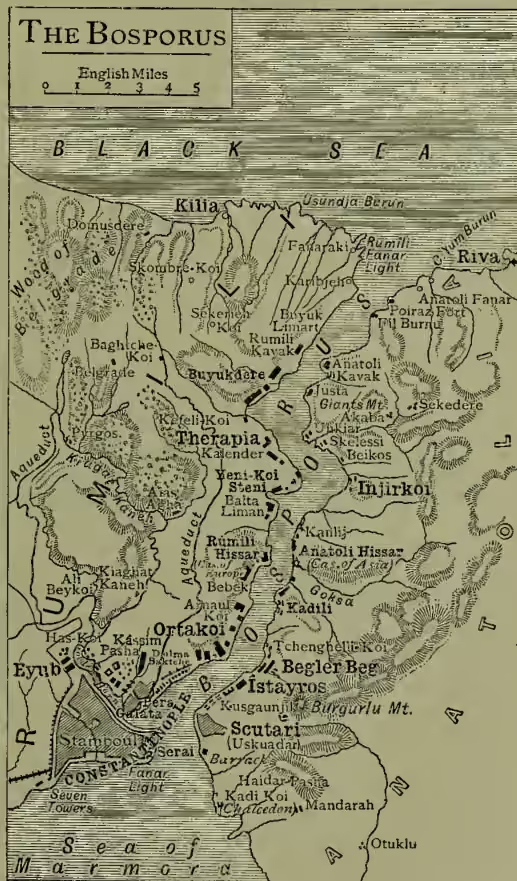
Among the other suburbs may be mentioned Kâsim Pasha, extending beyond Galata, along the north shore of the Golden Horn, the seat of the admiralty; continued by Hasköi, inhabited by a Jewish and Armenian colony; and at the head of the Golden Horn the picturesque village of Eyyûb, a green medley of gardens and graveyards surrounding the celebrated mosque where every sultan must gird on the sword of Osman ere he may ascend the throne. No Christian is allowed to approach the holy place. Along the European shore of the Bosphorus are many villages used as summer resorts by the Perotes, among which Therapia, the chief summer residence of the ambassadors, and Biyukderé are the most important. The Asiatic shore is also lined with settlements, from Scutari, which is the Asiatic suburb of Stambol (where is the chief Turkish burial-place, as well as the great Crimean cemetery), to Candili, where is a large European population, chiefly of the trading classes, and Beikos (see BOSPORUS). Numerous palaces of past sultans and ministers line both shores, Dolmabahçé on the European and Beglerbeg on the Asiatic being the largest; but the present sultan resides in a new palace called Yıldız Köşki, at the top of the hill of Beshiktâş, beyond Pera. Famous among pleasure resorts are the Sweet Waters of Europe, at the head of the Golden Horn; Kiahat-hâna, near the Castle of Asia; the forest of Belgrade; and the Princes' Islands in the Sea of Marmora, not far from Kadiköi, the ancient Chalcedon.—The population of Constantinople is estimated at about 875,000, of whom half are Mohammedans. The trade, chiefly in the hands of Europeans, is much below what it might be if properly developed. The burden of vessels entering and clearing the port is placed at 4,000,000 tons. The city has great strategic importance, and is fortified on the land side. The first through train from Paris reached Constantinople in 1888; there are also railways to Salonika and Uskub, and to Bourgas.
See BYZANTINE EMPIRE and TURKEY, and books there quoted; Brodribb and Besant, Constantinople and its Sieges (1878); Pears, The Fall of Constantinople (1885); books on the topography and history by W. H. Hutton (1900), E. Pears (1885), E. de Amicis (trans. 1896), Mrs Minto Elliott (1892), Paspates (1893), Coufopoulos (Black's Guides, 1895), F. Marion Crawford (1895), E. A. Grosvenor (1895); and on Santa Sophia by Lethaby and Swainson (1894). For the Councils of Constantinople, see COUNCIL.