Copper Stearate is obtained by adding stearate of soda to sulphate of copper in hot solutions. It is a light bluish-green powder used for colouring candles.
The pigment, Brunswick green, used in the arts, is an oxychloride of copper.
Copper in any liquid is easily discovered by placing in it a plate of polished iron, when it will be observed coating the metal with its well-known reddish tint, making its appearance over the part of the plate immersed in the fluid. If the quantity of copper is very small, the liquid should be concentrated till it half fills a watch-glass, and a bright steel needle used in place of an iron plate. Solutions of cupric salts have a blue or greenish-blue colour, but this on addition of ammonia in excess becomes an intense purplish blue.
Native Copper, although frequently met with wherever copper ores occur, is yet rarely discovered in sufficient quantity to admit of its being systematically worked. It is found crystallised in cubes and in modifications of this form; also in arborescent pieces, in thin laminae, and in irregular lumps or masses. Sometimes it forms a nucleus with first a layer of red oxide and then a second layer of carbonate of copper around it. The largest masses of native copper are obtained from mines in Russia and from copper-bearing strata in the neighbourhood of Lake Superior. One mass was mined at Minnesota in 1859, weighing 500 tons, which required the work of forty men for a year to extract it. The largest yet obtained was got in 1866 at the Central mines, Lake Superior, and weighed 800 tons.
The ores of copper are numerous. Cuprite, ruby copper, cuprous oxide, or red oxide of copper, is the richest ore. It contains, when pure, nearly 90 per cent. of copper. Malachite (q.v.), or green carbonate of copper, consists, when pure, of 57 per cent. of the metal. This ore occurs largely in Russia, South Australia, and in some localities in South America. Chessylite, azurite, or blue carbonate of copper, in a pure state contains 55 per cent. of copper. Chalcopyrite, copper pyrites, or yellow copper ore, a sulphide of copper and iron, is, from its abundance, the most important of copper ores. Although containing, when pure, 35 per cent. of copper, yet on account of impurities, what is mined in England does not yield, on an average, more than 8 per cent. of the metal. Some of the auriferous copper pyrites of the western states of America and elsewhere is worked as an ore of gold (see GOLD). Erubescite, or purple copper ore, is also a sulphide of copper in which the proportion of the metal varies from 60 to 70 per cent. Tetrahedrite, or gray copper ore, is a sulph-antimonite of copper of very variable composition, but often containing from 30 to 40 per cent. of copper, &c. Atacamite (q.v.) is an oxychloride of copper mined in Chili, and found in other countries. Melaconite, or black oxide of copper, and Chrysocolla, a silicate of copper, are sometimes smelted as ores of the metal.
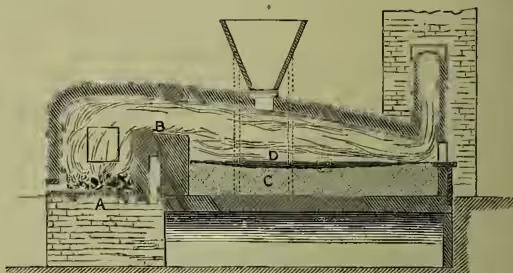
COPPER-SMELTING.—In practice, the process of smelting copper from ore (copper pyrites) like the Cornish is somewhat complicated, but in theory it is comparatively simple. The main impurities of the ore are quartz, iron, sulphur, and very commonly arsenic. The process is conducted with the view of separating the iron and quartz as a fusible slag, and of dissipating the sulphur and arsenic, by converting them into sulphurous and arsenious acids, through oxidation in the furnace. At Swansea, which is the chief seat of copper-smelting in this country, reverberatory furnaces are used, and these are of two kinds, called respectively calciners and melting furnaces. Gas, along with Siemens' regenerative apparatus, is now to some extent used in different parts of the world for supplying heat to copper furnaces, but at some places it has been given up, after a short trial, owing to the costly repairs which it causes. There are never fewer than six operations in the Welsh process of copper-smelting, and when so limited, a favourable admixture of ores, such as copper pyrites and copper carbonates, is necessary. In the first, the ore is calcined in a furnace for at least twelve hours, by which time the greater part of the sulphide of iron is decomposed, and much sulphurous and other acids have formed and escaped in fumes —i.e. a partial oxidation of the iron and sulphur takes place. In the second, the calcined ore is melted along with siliceous slags obtained in later stages of the process. Here a fusible slag, consisting in great part of silicate of iron, is formed, and the sulphides of iron and copper are run off as a regulus, termed coarse metal, and granulated in water. A section of a melting furnace is given in fig. 1. In the third, the coarse metal is calcined again for twenty-four hours, during which time most of the sulphide of iron is converted into oxide. In the fourth, the calcined coarse metal is melted with slags rich in oxide of copper, and also with rich ores, as oxide and carbonate. These oxidise any sulphide of iron remaining, and a regulus called white metal is formed, consisting almost entirely of sulphide of copper, and containing about 75 per cent. of the metal. In the fifth, called 'roasting,' the regulus is very slowly melted, so as to allow of the gradual and thorough reduction of the sulphide by heated atmospheric air through the formation of oxide of copper. When oxide and sulphide of copper are heated together, they decompose each other, the sulphur escapes as sulphurous acid, and impure metallic copper, called blister copper, is produced, while other foreign bodies are for the most part removed in the slag. In the sixth, the copper from the previous operation is refined. To effect this, it is melted in a furnace, and exposed to the oxidising influence of the air for from fifteen to twenty hours, by which time it is full of dioxide, and this is in turn reduced by throwing pure coal on the surface of the molten metal, and then stirring it with a pole of green birch-wood.
At those smelting works where the sulphurous acid produced in the calcining or roasting of copper pyrites is saved for the manufacture of sulphuric acid, peculiar furnaces, such as Gerstenhöfer's, Hasenclever and Helbig's, and Maletra's, are used for roasting the ore. Shaft or cupola furnaces, instead of those of a reverberatory kind, are used in some countries, for smelting copper ores where these are highly ferruginous, or oxidised, or comparatively poor. Coke, anthracite, or charcoal is used as fuel in cupola furnaces, which require a blast of air at a moderate pressure.
Wet Copper Extraction Process.—Soon after iron pyrites (sulphide of iron) began to be used about thirty years ago as the source of sulphur for the manufacture of sulphuric acid, it was thought desirable to recover the copper, amounting to a small per cent. of the pyrites used. The burnt pyrites, consisting chiefly of oxide of iron, along with 4 or 5 per cent. of copper, is mixed with from 12 to 15 per cent. of crushed rock-salt and the mixture properly calcined; when the whole of the copper is converted into a soluble chloride. The roasted mass is then lixiviated, and the copper contained in the solution thrown down as metal by scrap iron. This precipitate contains about 75 per cent. of pure copper, and is mixed with the copper of the later stages of purification got in the dry process.
APPLICATIONS OF COPPER.—The metal is used for a great variety of purposes. It is most largely consumed along with zinc in the production of Brass (q.v.). To a less, but still considerable extent, it is made into bronze and gun-metal, in which it is alloyed with tin and other metals (see BRONZE). Alone it is employed for boilers, stills, cooking vessels, seamless and other pipes, wire and wire-cloth, nails, and spikes. In the form of thin plates it has long been in demand for engraving and etching upon, and in the shape of strong rollers it is extensively employed for a like purpose by the calico-printer. Copper does not cast very well, but it is admirably adapted for producing works of art in electro-deposit instead of casting them. This process is extensively employed, and does even for objects as large as life-sized statues. In this way engravings and pages of type are also copied for the printing-press. For its use in coating other metals, see BRONZING. Copper is the metal usually chosen for lightning conductors. Writing-pens are made of an alloy consisting for the most part of copper, and for some purposes are better than those made of steel, as they do not corrode nearly so soon. These pens are usually white in colour. An alloy of copper, 'yellow metal,' is used for sheathing the bottoms of timber ships, so as to prevent molluscs and seaweeds from encumbering them. Copper, owing to its ductility, may be made into pipes, tubing, &c., by high pressure alone, without heat.
The copper-mines of the United Kingdom appear to have first risen into importance in the early part of the 18th century. According to Sir C. Lemon (Journal of the Statistical Society, vol. i.), the produce of the Cornish mines in 1771 was 27,896 tons of ore, yielding 3347 tons of copper. In 1856 (Hunt's Mineral Statistics for 1856) the returns were—Cornwall, 163,245; Devon, 42,025 tons of ore; together yielding 13,500 tons of metallic copper. Since 1860, the year of their maximum yield, the quantity of copper obtained from mines of the United Kingdom has steadily and rapidly declined from 236,696 tons of ore, and 15,968 of metal, to 5346 and 426 tons respectively in 1893.
The copper ore mined in other parts of the country besides Cornwall and Devon is comparatively trifling. Copper is chiefly smelted at Swansea and its neighbourhood, but to some extent also in Lancashire. The English smelting works are now most largely supplied with ore from Spain, South Africa (see CAPE COLONY, Vol. II. p. 735), Venezuela, the United States, and Australia (q.v.). The entire quantity of metallic copper smelted and refined in the United Kingdom annually varies from 25,000 to 30,000 tons.
The production of copper in the United States has increased rapidly since 1872. In that year the quantity of this metal obtained was 12,500 tons, while in 1897 it was as much as 212,000 (long) tons, and the United States is now the largest producer of copper. The richest mine in the world is said to be that at Calumet (q.v.), on Lake Superior, in which region copper was mined by the ancient Indian or pre-Indian inhabitants. The territories of Arizona and Montana are also productive; but copper occurs in several other parts of the Union. A very large quantity of copper wire is used in that country for electrical purposes. The enormous increase in the output of copper between 1880 and 1884, and its fall in price, led to the formation of a powerful syndicate to regulate the total production and control the price; which for a time succeeded, but by 1890 collapsed. The price of copper, which in 1890 was about £65 a ton, sank to £41 in 1895, rose to £49 in 1896, touched £78 early in 1900, but fell to £72 before the end of the year.