Coracle, CURRACH, or COURACH (Celt. corvq, curach; Lat. euruea, carroetum, carabus), the name given in the British Islands to a canoe or boat made of a slender frame of wood or wicker-work, and covered with skins. Skiffs of this sort, as well as canoes hollowed out of the trunks of oaks, were in use among the Britons in the earliest times of which we have record. Julius Cæsar, who built some of them after the British model, tells us that the keel and gunwales were of light wood, and the sides of wicker covered with hides. The first occurrence of the name seems to be in Gildas, who wrote in the 6th century; he speaks of the coracle as in use among the Scots and the Picts. A long voyage in the North Sea, made in a coracle, during the same century, by one of the companions of St Columba, is commemorated by Adamnan, who died in 704. In 878 three Irish missionaries sailed in a coracle from Ireland to Cornwall; the voyage occupied seven days; and the size of the coracle is indicated by the remark that it was one of two skins and a half. An old Life of St Patrick speaks of a coracle 'of one skin, with neither helm nor oar.' The coracle of a larger size had a mast and sail. The coracle, often now covered with tarpaulin, is still used on the Severn, the Dee, and on the Irish coast (Clare and Donegal). The last coracle known to have been used in Scotland is in the museum at Elgin. It was employed on the Spey towards the end of the 18th century. Shaw's History of Moray (1775) describes the coracle, which had then become rare, as 'oval in shape, near 3 feet broad and 4 long; a small keel running from the head to the stern; a few ribs placed across the keel, and a ring of pliable wood around the lip of the machine. The whole is covered with the rough hide of an ox or a horse; the seat is in the middle; it carries but one person, or, if a second goes into it to be wafted over a river, he stands behind the rower, leaning on his shoulders. In floating timber, a rope is fixed to the float, and the rower holds it in one hand, and with the other manages the paddle. He keeps the float in deep water, and brings it to shore when he will. In returning home, he carries the machine on his shoulders, or on a horse.' One who figures in the Dunciad—Aaron Hill the poet—by showing the Strathspey Highlanders how to make their timber into a navigable raft, hastened the disappearance of the coracle from Scotland. A boat of bison skin, essentially the same with the
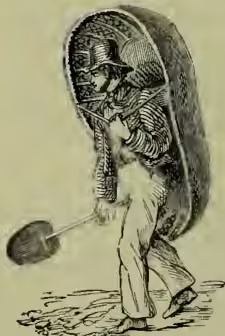
British coracle, is in use among some of the Indians of North America.
Coracoid, an important paired-bone in the breast-girdle, forming along with the scapula the articulation for the fore-limb, and always lying ventrally. In the lower fishes the entire girdle is cartilaginous; in the bony fishes distinct coracoids first appear; they are well seen in Amphibia and in all reptiles except snakes; they are very large and strong in birds; but become mere processes of the scapula in mammals. They very often exhibit a special anterior portion known as the pre-coracoid. See BIRD, SKELETON, Huxley's Anatomy of the Vertebrates, and such comparative anatomy text-books as those of Gegenbaur and Wiedersheim (translated by Professors Bell and Parker).
Corais (Fr. CORAY), ADAMANTIOS, a learned Hellenist, was born at Smyrna, 27th April 1748. He early abandoned hereditary mercantile pursuits to devote himself to letters at Paris, where he lived till his death, 6th April 1833. He published editions of many ancient Greek authors, as the Æthiopica of Heliodorus, and laboured all his life to promote Greek learning and the feeling for Greek patriotism. His Atakta, ou Mélanges sur la Littérature Grecque Moderne (5 vols. Paris, 1828-35) is a work of great value. His autobiography was published at Paris in 1829-33; his papers and letters at Athens (8 vols. 1881-91). See Koræa, a monograph by Thereianos (Trieste, 1891).
Coral, a term loosely applied to any animal in the class Cœlenterata which forms a hard skeleton. The tubular organ-pipe coral, the noble or red coral of commerce, and the reef-building madrepore corals, are familiar examples. Presuming an acquaintance with the general features of the class, as summed up in the article CŒLENTERATA, we may notice at the outset the fact that the formation of hard supporting structures is exhibited in very varied degrees, in manifold styles of architecture, and in widely separated forms.
Different Kinds of Coral.—(1) Among the Hydrozoa the skeletal investment of the polyp types, when present, is usually horny. In one subdivision, however, the supporting framework is limy, and to these forms—Millepores (q.v.) and Stylasterids—the title Hydrocorallina is fitly applied. (2) It is, however, in the other sub-class