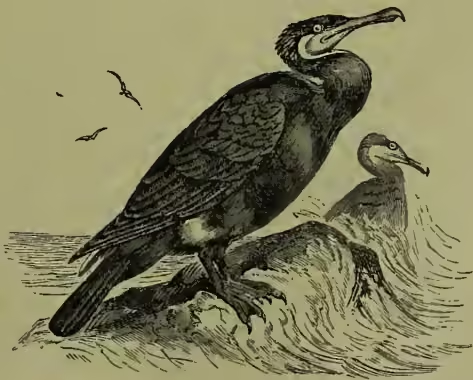
Cormorant (Gr. Phalacrocorax, 'bald-headed raven'), a genus of web-footed birds in the order Steganopodes, beside pelicans, solan-geese, and frigate-birds. They are familiar birds, frequenting islands in most parts of the world. They vary greatly in size, but have the following characters in common. The head is relatively small, and is naked behind the eyes and at the root of the beak. At the breeding season some forms exhibit a crest and wattles. There is a dilatable membrane beneath the lower jaw, showing incipiently what becomes exaggerated in the pelicans. The bill is moderately long, straight, rounded above, and strongly hooked at the end; the nostrils are linear and inconspicuous. The neck is long, snake-like, and naked on the throat. The wings are of moderate length; the tail is rather short and rounded, but with stiff feathers, which are used as aids in progression. The unfeathered lower leg is very short; all the toes are united in a web; the middle claw is serrated and apparently used in trimming the plumage.
The numerous species live on the shores of islands, or sometimes inland by rivers—e.g. the Danube—and lakes. They feed exclusively on fishes, and are proverbial for their voracity. They do not dive when in flight, but from the surface of the water. The smaller of the two British species has been caught in a crab-pot at a depth of 120 feet. When the prey is inconveniently seized, it is often tossed in the air and more adroitly recaptured. Eels are said to form a favourite prey. Their haunts are often peculiarly dirty. The nests are usually built of seaweed, and are strong though rude; they are sometimes found on mangrove and other trees. The egg is bluish-green, but the colour is much obscured by thick incrustations of lime. When attacked, the larger species, at any rate, fight vigorously and to purpose. The flesh is dark and fishy, but that of the young birds of some species is said to be eatable.
The Common British Cormorant (P. carbo) is an almost cosmopolitan bird about 3 feet long, for the most part of a blackish-green metallic colour, with brownish feathers on the shoulder region. When in full breeding plumage it has a crest on the head, white plumes on the throat, and a white patch on the lower flanks. The bill is black, the face yellow, the feet also black. It was formerly trained in England, as still in China, for fishing purposes. At first a ring is put round its neck to keep the bird from swallowing the fish it catches, but it soon learns to bring its prey to its master, being afterwards allowed to fish on its own account. The smaller species (P. cristatus or graculus) found on our coasts has a more decided green colour. The Dwarf Cormorant (P. pygmaeus), from South-eastern Europe, North Africa, Southern Asia, and the Florida Shag (P. floridanus) are other well-known species. Along with the genus Urile, the cormorants form a family (Phalacrocoracidae) including about three dozen species.