Coronation. The practice of placing a crown on the head of a monarch at the commencement of his reign is very ancient, and there is probably scarcely any country in which it has not been followed in one form or another. Generally it has been accompanied by what was regarded as the still more solemn rite of anointing with oil, a ceremony which, from the times of the ancient Hebrews to our own, has been peculiarly significant of consecration or devotion to the service of God. In England, before the Norman Conquest, the term was more usually 'hallowing' or consecration than coronation; but it would seem that the ceremony as then performed at Kingston-on-Thames or Winchester was in all essentials the same as that which now takes place in Westminster Abbey, though now the ceremony is a mere pageant. Detailed accounts of many English coronations, from Richard I. downwards, have been preserved.
There have been considerable variations from time to time in the oath. Originally the king pledged himself to three things—peace and reverence to God and the church, justice to the people, the upholding of good and abolition of bad laws. In Edward II.'s time it became more precise, and assumed the form of question and answer. The present form was settled after the Revolution of 1688. By it the sovereign, in a series of responses to questions by the Archbishop of Canterbury, swears to govern the people of the United Kingdom according to the statutes in parliament agreed on; to cause law and justice, in mercy, to be executed; and to preserve and maintain the Protestant religion established by law. This oath was held both by George III. and George IV. to prevent them from granting Catholic Emancipation, and was also by many regarded as an obstacle to the disestablishment of the Irish Church (see Bishop Phillpotts, The Coronation Oath, 1828). The treaty of Union between England and Scotland provides that the oath of the preservation of the government, worship, and discipline of the Church of Scotland should be taken not at coronation but at the accession of the sovereign. For the ceremonies connected with coronation, see CHAMPION; Chapters on Coronation (1838); Planché, Coronations of Queens of England (1838); Jones, Crowns and Coronations (1883); and Lives of Queen Victoria by Holmes (1897) and others.
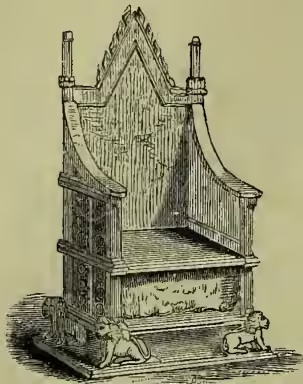
The Scottish coronation stone, the Lia Fail or
'Stone of Destiny,' was said by tradition to have been the stone which Jacob used for a pillow, and to have been brought to Ireland, and from Tara to Scotland, where it found a resting-place at Scone, till in 1296 Edward I. carried it to Westminster. It now forms part of the coronation chair, occupying the space beneath the seat. Skene, in his monograph (1869), asserts it to have been originally quarried from the rocks near Scone.