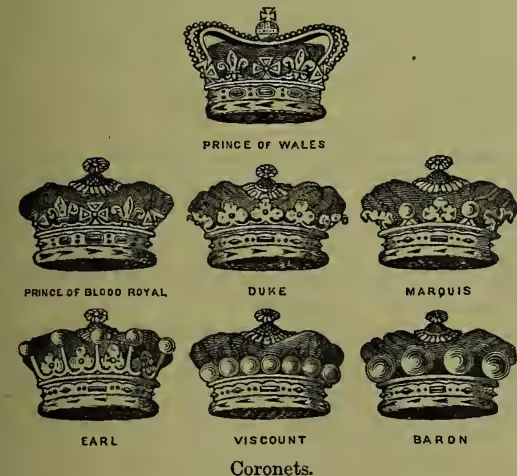
Corot, JEAN BAPTISTE CAMILLE, landscape-painter, was born at Paris, 28th July 1796, the son of a hairdresser who became a draper. Educated in the Lycée at Rouen, he became an assistant in a drapery establishment in Paris, and it was not till his twenty-sixth year that he was able to yield to his natural inclinations and begin the systematic study of art. He was instructed by Michallon and Victor Bertin, and in 1825 he settled in Rome, his small view of the Coliseum in the Louvre bearing that date. Here he studied under Aligny, 'l'Ingres des arbres,' and in 1827 he returned to Paris, and contributed his 'Vue prise à Narni,' and his 'Campagne de Rome' to the Salon, where he constantly exhibited till the year of his death. His main sketching ground was at Barbizon, in the forest of Fontainebleau ; but he made two other visits to Italy in 1835 and 1843. His earlier productions are careful and precise in execution, and it was not until about 1840 that he asserted his full individuality, and developed that style, characterised by great breadth and delicacy, and sacrificing accuracy of detail to unity of impression and harmony of general effect, which marks the works of his maturity. He was not an artist of great variety or of very extended range in subject and effect. He was the painter of misty lakes and vaporous rivers, of the quiet of moonlight, of the tender moments of pure sunrise, or of softly coloured evening ; and these he has treated in the spirit of a true poet, introducing very appropriately his figures of peasants, or more frequently of nymphs and classical personages, who take their place most fittingly in scenes like his which tend towards the ideal and the idyllic. His works made their way slowly with the public, but wealth and fame came to him in the end. At the Salon he won medals in 1833, 1848, 1855, and 1867. In 1846 he received the Cross of the Legion of Honour, and in 1867 he became an officer of the order. He exercised a most powerful and clearly marked influence upon the younger French artists, with whom his genius, his frank kindness, and his openhanded generosity rendered him the most popular of men and painters. In 1874, when the medal of honour of the Salon, which they expected to be bestowed on him, was awarded to Gérôme, they subscribed for a medal of their own, which they presented to 'le père Corot,' as they were fond of calling him, only three months before his death, which occurred at Paris, 22d February 1875. Among his masterpieces may be named 'Danse de Nymphes,' 'Macbeth,' 'Homère et les Bergers,' 'Orphée,' 'Souvenir de Montefontaine,' 'Joueur de Flûte,' 'Un Matin à Ville arches. The coronets of other princes, sons of the sovereign, are without arches. Princes, sons of the above, have a similar coronet, with strawberry-leaves substituted for fleurs-de-lis. The coronet of a duke has above the rim of gold eight strawberry-leaves, of which five are shown in pictorial representation. That of a marquis has four strawberry-leaves, alternating with as many large pearls upon short points. The coronet of an earl has eight d'Avray, 'Dante et Virgile.' He is well represented in public and private collections in Britain and the United States. See Lives by Dumesnil (1875), Robaut (1880), Rousseau (1884), and Roger-Miles (1891); and the Monograph by D. C. Thomson (1892, reprinted from his Barbizon School, 1891).