Countermine, a subterranean way to counteract besiegers' mines. See MINES (MILITARY), SIEGE.
Counterpoint, in Music, has been defined as 'the art of combining melodies.' The name arose from the early system of notation by points. When another part or melody was added to one already represented by a row of points, this was called punctum contrapunctum. A single melody is usually taken as the 'subject,' and the part or parts added are called the 'counterpoint.' When this is done according to the numerous and stringent rules of the old authorities, it is called strict counterpoint; but in modern music these rules are much relaxed. The devices of counterpoint are, however, still largely relied on; Wagner, the greatest innovator of our time, being also one of the greatest practical contrapuntists. The aim of Beethoven in his later works to make every part sing, and not be a mere filling up of the harmony, may be referred to as illustrating the object of these devices; and there is no doubt that as used by the classical writers, they are the source of some of the grandest effects in music.
In simple counterpoint the parts are written above or below the subject without regard to their capability of being transposed. It is divided into different species, according as the added parts contain one, two, or four notes against each note of the subject, or are written in syncopated notes, or have a combination of all or any of these, when it is called 'florid.' The so-called 'rules' are in effect limitations of the degrees in which the parts may progress—e.g. the prohibition of consecutive octaves and fifths. The general principle of them is to secure complete independence of melodic motion in the parts, while at the same time the laws of harmony are observed. When the parts reach the number of eight or more in vocal music, they are sometimes divided into different choirs, which sing alternately together and in antiphony. A famous example of this class is Tallis's motet 'Spem in alium non habui,' for forty voices, in eight choirs, each of five voices. In double counterpoint the subject and counterpoint are so written that each may form the bass to the other. When in this transposition the upper part is taken to the octave below, or vice versa, it is called double counterpoint at the octave; but it may also be at any other interval, the fourth, fifth, &c., or even at two different ones. In treble counterpoint each of three melodies can be put as the bass to the others; and similarly in quadruple and quintuple counterpoint; but counterpoint beyond double can only be at the octave, as the other intervals are impracticable. One or more free parts may be added to fill in the harmony. The following instance of quintuple counterpoint is taken from the finale of Mozart's 'Jupiter' Symphony:
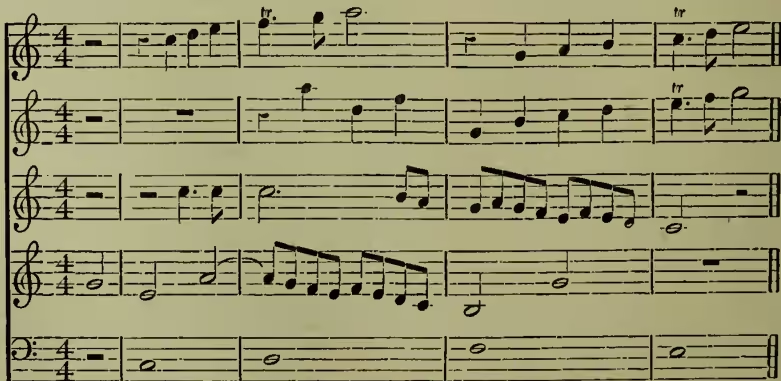
Among the other devices of counterpoint may be mentioned those of contrary motion, augmentation, and diminution, the latter two referring to the time-values of the notes. See IMITATION.
The history of the art of counterpoint can be traced step by step from its beginnings in the rude efforts at part-writing, called organum, barbarous to modern ears, in medieval church music, of which the earliest known account we have is by Hucbald, a Flemish monk, who died in 930. The earliest existing specimen of part-music is an English one—a rota or round, written by a monk of Reading in 1226 to words beginning 'Suner is icumen in,' the MS. of which is in the British Museum. The Polyphonic schools of composition in Flanders, England, Germany, and Italy, of the four succeeding centuries, reaching their culmination in Palestrina, were based pre-eminently on counterpoint. Bach is, however, usually considered its greatest master. There is an enormous number of treatises on the subject in most European languages; it will be sufficient to refer to that of Sir F. A. G. Ouseley, based on Cherubini, and to the primers published by Novello & Co.