Cowry (Cyprea), a large genus of Gasteropods in the Prosobranchiate section, including over a hundred species, some of which are very familiar as decorative objects and as furnishing a medium of exchange with uncivilised peoples. The shell has more or less of an oval form, and is usually thick, polished, and beautifully coloured. The young shells are delicate and more typically snail-like, but in the adults the large last whorl more or less conceals the others, and has its outer lip bent in towards the inner. The internal axis may be wholly absorbed. The animal has a broad head, a protrusible proboscis, eyes associated with the long horns, and a broad foot protruded through the elongated aperture. The mantle or skin fold, which forms the shell as in other molluscs, extends over the whole or most of the surface, and thus conceals during life what gives the dead shells half their charm. In habit the cowries are predominantly sluggish animals, creeping slowly on rocks and coral reefs. They are mainly carnivorous in diet. Though widely distributed, they thrive best in the tropical seas. Fossil forms occur abundantly (about 80 species) from the chalk onwards. The nearest relations of the cowries are the two genera Ovulum and Trivia. The former includes the Pouched Eggs and the Weaver's Shuttle (Ovulum volva); two species are found on British shores. The genus Trivia includes the little 'cowry' (Trivia europaea), not uncommonly found on British coasts—e.g. near John o' Groat's House.
The cowries proper are well known in several practical connections. The money cowry (C. moneta), found especially in the Maldive Islands, was long used as currency, and is still so used in Africa from Guinea to the Central Soudan. In Siam over 6000 cowries were required to make a tical worth 1s. 8d.
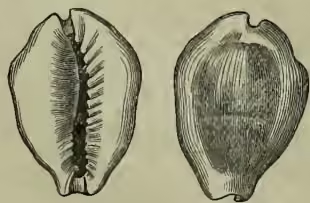
Cowries are familiar in England as counters in games of chance. From prehistoric times they have been used to form necklaces and other ornaments of the person. In some cases they are worn as charms, and their bright colours, so attractive to human eyes, have also been utilised in catching cuttle-fishes. Cowries have had their share in later days in the conchological craze, and 'small fortunes' have been spent in gathering that wealth of varied colour which a good cabinet displays. A single shell of C. princeps has been sold for £40.