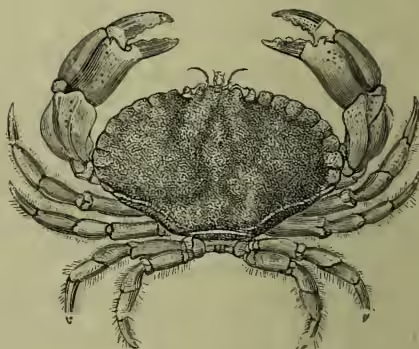
Crab, a popular name legitimately applied to any of the short-tailed (Brachyura) division of decapod Crustaceans (q.v.). The body is usually short and compressed; the abdomen is short and is tucked up beneath the relatively large cephalothorax; there are 1 to 4 reduced abdominal appendages, but seldom any tail-paddles; the antennæ are short. In the common Shore-crab (Carcinus maenas) the carapace is a wide shield, broader than long, and bent inwards at the sides; the eyes are stalked, and lie as usual above and in front of the antennules, though apparently rather external to them; the antennules have the ear-sac lodged in their dilated base; the bases of the antennæ are immovable, and the opening of the excretory organ at their base has a curious movable plate. The hindmost of the foot-jaws or maxillipedes is in part expanded into a broad plate which covers the neighbouring appendages. The great claws are generally larger in the male than in the female, and thus the market value of the male Edible Crab (Cancer pagurus) is said to be five times as great as that of the female. The reduced abdominal appendages of crabs are solely used for reproductive purposes. The two anterior pairs are copulatory in the males; those that persist in the females have the eggs attached to them. The abdomen is always larger and broader in the females. The nervous system is peculiar in the centralisation of the thoracic ganglia into a single mass. The alimentary, circulatory, and excretory systems do not present any important peculiarities. The gills are always fewer than in the crayfish, never exceeding nine on each side. The gill-cavity is large, especially in the land-crabs. In the common shore-crab, the larva leaves the egg as a zoea, after repeated moults becomes a sort of hermit-crab-like form known as a Megalopa, and gradually with broadening shield, loss of abdominal appendages, bending up of the abdomen, and modification of the anterior limbs becomes a miniature adult.
General Life.—Crabs feed chiefly on other animals both alive and dead. The Swimming Crabs (Portunus)—e.g. P. pelagicus, attack fishes. Cardisoma carnifex, found in the mangrove swamps of the West Indies, is fond of the fruit of a species of Anona, but is also notorious for burrowing in the cemeteries. The well-known Land-crab (Gecarcinus ruricola) damages sugar-canes. Many crabs are very rapid runners, especially the sand and land forms; others are powerful burrowers—e.g. the Calling Crab (Gelasimus), which has one of its great claws much exaggerated, and carried during locomotion over its head in such a way that it looks as if it were beckoning; others again are expert swimmers—e.g. our British pelagic Polybius henslowii, which has a light shell, and four of its thoracic appendages flattened for swimming. In regard to respiration it is worth noticing that the land-crabs are so far terrestrial that they are liable to be drowned in water. The male crabs are usually larger, and sometimes fight with one another as well as with other species. In some cases (Gelasimus) the bright colour is only acquired at the period of reproductive maturity. The sexes of the common Shore-crab (Carcinus maenas) are said to unite just after the female has moulted her hard shell. In all but the land-crabs the female carries about the eggs till they are hatched.
Habitat.—Almost all crabs are strictly marine forms, and the majority frequent shallow water. Among the terrestrial forms the best known are the species of Gecarcinus, swiftly moving nocturnal crabs in tropical regions of both hemispheres, chiefly vegetarian in their diet, migrating in companies to the sea for egg-laying purposes. The genus Ocypoda includes some land forms, and some which produce a shrill noise by rubbing the ridged surface of the second-last joint of the right great claw against a sharp edge of the second joint. The Calling Crab (Gelasimus) makes large burrows, and the male closes the mouth of the hole with its exaggerated great claw. The Pea-crabs (Pinnotheres) live inside bivalves (Pinna, Mytilus, Maetra, &c.). One species (P. veterum) was said by the ancients to nip the mollusc when danger threatened, and to receive its share of food in return. There is no doubt as to the share of food, but no evidence that the crab rewards its host. In the genus Telphusa all the species live in fresh water in the warm parts of the globe. The European species (T. fluviatilis) is tolerably common in southern Europe, was known to the ancients both in its habit and edibility, and is often figured on Sicilian coins. As regards geological distribution, the Brachyura do not certainly appear before the upper Jurassic, and become gradually more numerous in Cretaceous and Tertiary strata.
Moulting and Amputation.—Like other crustaceans, crabs periodically cast their chitinous and limy shells. The moults are most frequent in youth, when the rapid growth of the body conflicts with the rigidity of the armature. Extra feeding may accelerate the process. Before moulting the old shell becomes virtually dead, reserve stores are used in fresh growth, a new shell begins to form within the old, and finally with considerable, and sometimes fatal effort, the shell is cast. It is left in apparent intactness, a very image of its lost tenant. The new suit, which is at first soft, requires several hours or days to acquire firmness. The loss of internal linings, of stomach mill, of the outer covering of the eyes, &c., as well as of the entire outer armature, leaves the crab very much hors de combat. The period is one of great disadvantage to the crabs, not only from the fatigue and often fatality of the process, but from the state of defenceless helplessness in which they are temporarily left. In many cases crabs lose their limbs in fighting, and they may voluntarily resign them (as in Porcellana platychelys) to save their bodies. Sudden panic or injury is said to lead to similar self-inflicted amputation or 'autotomy.' Like many animals lower in the scale, crabs are able to make good their injuries, though several moults are required to regenerate a limb.
Masking.—A common habit among crabs is that of masking themselves with foreign objects. Thus both the European species of Maia (M. squinado and M. verrucosa) are usually overgrown by Algae, Hydroids, and Polyzoa; the same is true of Pisa; in Inachus the long feet are especially well concealed by seaweeds; our common Stenorhynchus is often covered by a sponge growth; the Mediterranean Dorippe lanata uses its hind-legs to carry some living or dead object upon its back, and thus very emphatically asserts its innocence; the common Dromia (D. vulgaris) holds sponges on its back in similar fashion. See COMMENSALISM.
Intelligence.—As in several features of their structure, so in their intelligence, crabs appear to hold the highest place among crustaceans. Moseley observed how a sand-crab (Ocypoda ippus), which dreads the sea, dug itself into the sand and held on against the undertide of each great wave. Romanes refers to the alleged habit of the common crab in stationing a hard-shelled individual as sentinel during the moulting season. There seems to be not a little of the intelligent in some cases of crab-commensalism. Darwin has, however, given a crowning instance of intelligence which is worth many less emphatic. Some shells were thrown towards the hole of a burrowing shore-crab (Gelasimus). One rolled in, three remained a few inches from the mouth. In a few minutes the crab came out, bearing the shell which had fallen in, and removed it to the distance of a foot. 'It then saw the three other shells lying near, and evidently thinking that they might likewise roll in, carried them to the spot where it had laid the first.'
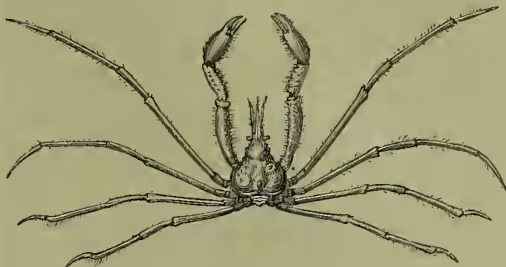
Common British Forms.—The Common Shore-crab (Carcinus manas); the Great Crab (Cancer pagurus), so much eaten; the Slender Spider-crab or Slender-beaked Crab (Stenorhynchus tenuirostris), with very long spider-like legs and bright pink triangular body; the large Thorny Spider-crab (Maia squinado); the Common Swimming Crab (Portunus variegatus), common on Scotch coasts, with the last pair of legs flattened like oar-blades; the Velvet Fiddler-crab or Devil-crab (Portunus puber), with a brown hairy shell; the Masked Crab (Corystes cassivelaunus), with a carapace marked so as to suggest a mask, often found buried in the sand of English and Welsh coasts; the small Four-horned Spider-crab (Pisa tetraodon); the little Pea-crab (Pinnotheres pisum, &c.), inside bivalves, are familiar British species.
Classification.—Crabs are generally classified according to the shape of their cephalothorax into five families: (1) Catometopa, usually quadrangular—e.g. Ocypoda, Grapsus, Pinnotheres, Gecarcinus; (2) Cyclometopa, usually broad, narrowed behind, bow-shaped in front—e.g. Telphusa, Cancer, Portunus, Carcinus; (3) Oxyrhyncha, triangular, pointed in front—e.g. Maia, Pisa, Hiyas, Stenorhynchus, Inachus; (4) Oxytomata, usually round—e.g. Calappa, Ilia; (5) Notopoda, with the last or last two pairs of limbs more or less turned back—e.g. Dorippe, Porcellana, Lithodes, Dromia.
See CRUSTACEA, CRAYFISH, HERMIT-CRAB, LOBSTER. Besides general works mentioned under Crustacea, see Balfour's Embryology; W. K. Brooks, Handbook of Invertebrate Zoology (Boston, 1882); Frédéricq, Archiv. Zoologie Expér. (1883); Huxley's Invertebrates; Romanes, Animal Intelligence (Inter. Sc. Series, 1886); Carus Sterne, Werden und Vergehen (1886); Woodward, in Cassell's Natural History.