Crag and Tail, a term used to designate a peculiar hill conformation, in which a bold and precipitous front exists on one aspect of a hill, while the opposite is formed of a sloping declivity.
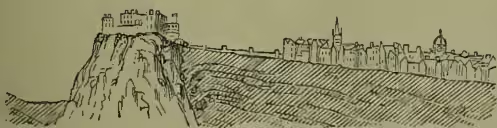
Fine examples of this structure occur in and around Edinburgh, where the bold 'crag' faces the west and the 'tail' slopes towards the east; as, for example, the Castle rock, precipitous and unapproachable on every side except to the east. The structure owes its origin to the juxtaposition of rocks of variable degrees of durability—the harder and more durable rocks having resisted denudation, and so protected the more readily eroded rocks that occur on the lee side of the former. The crag and tail phenomena of central Scotland and other regions which have been subjected to extreme glaciation (see GLACIAL PERIOD) is due to glacial erosion and accumulation. The crag faces the direction from which the ice came, and thus by opposing its advance induced excessive erosion upon the ground immediately in front. A hollow has thus usually been scooped out in this place, and continued along either side of the obstruction for some little distance. This somewhat crescent-shaped hollow is well seen on the west side of Edinburgh Castle rock, sweeping round on the north by Princes Street Gardens (the old Nor' Loch), and on the south by the valley of the Cowgate. The morainic material dragged along underneath the ice accumulated in the rear of the crag, so that the strata in that position are usually covered to a greater or less depth with boulder-clay, &c. The High Street of Edinburgh is thus built upon morainic materials.