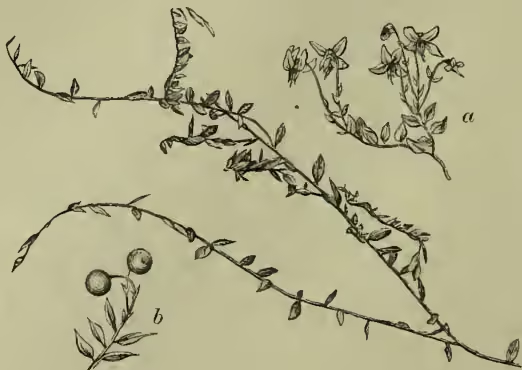
a, flower; b, fruit.
Cranberry (Oxycoccus), a north temperate and arctic genus of small evergreen shrubs of the order Ericaceæ (sub-order Vaccineæ). The only British species (O. palustris, formerly Vaccinium Oxycoccus) grows in peaty bogs and marshy grounds, and is a small wiry shrub with creeping thread-like branches, and small oval leaves rolled back at the edges. Large quantities of the fruit, which is chiefly used for making tarts, are collected in some parts of Britain, as also in Germany and other European countries, although the draining of bogs has now made it scarce where it was once plentiful. The berries are an excellent antiscorbutic, and hence furnish an excellent addition to sea stores. Wine is made from them in Siberia, and a beverage made from them is sold in the streets of St Petersburg.—The American Cranberry (O. macrocarpa) is of similar distribution, but is a larger and more upright plant, with bigger leaves and berries. The berries are not now collected by means of a rake, but by hand, as the former method bruises them. Large quantities are exported to Europe, and the berries are also imported into Britain from Russia and other parts of northern Europe. Both kinds may be cultivated in gardens, in a peat-soil kept very moist or round the margin of a pond.—The berries of the Red Whortleberry or Cowberry (Vaccinium Vitis-Idæa) are sold under the name of cranberries in Aberdeen and other places, and are used in the same way.—The Tasmanian Cranberry is the fruit of Astroloma humifusum, a pretty little trailing Epacridaceous shrub; while in Australia the same name is given to other plants of the same order, notably Styphelia ascendens and Lissanthe sapida.