Crayfish (Astacus, Fr. cercerisse), a large freshwater crustacean, in the long-tailed (Macrura) division of the order Decapoda. The body consists of two great divisions, the head and thorax protected by a rigid shield, and the abdomen or tail of six separate rings. The integument exhibits the characteristic Arthropod combination of lime and Chitin (q.v.). There are altogether twenty segments and nineteen pairs of appendages, not including the eyes. The sensitive antennules and antennæ, the six appendages crowded round the mouth, the great claws, the four walking legs, the little swimmerets under the tail, and the pair of large terminal paddles make up the series. These appendages, so different in form and function, are all homologous.
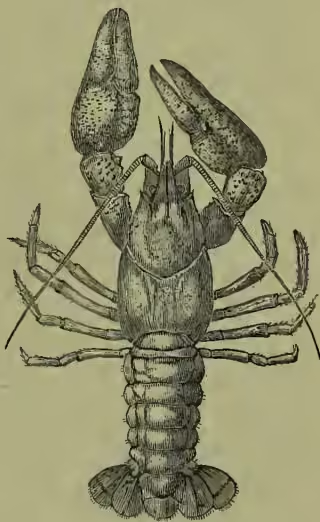
The muscles are well developed for working the tail, the appendages, and the stomach mill. The nervous system consists of brain and ventral chain of ganglia. The eyes are stalked and compound; the ear-sacs with their fringes of auditory hairs and inclosed foreign particles floating in a gelatinous fluid lie at the bases of the antennules, which also bear olfactory bristles. The most remarkable feature in the alimentary system is the gastric mill, a complex masticating apparatus in the fore-gut, the essential mechanism of which consists in the rapid clashing of three teeth—one dorsal and two lateral. On the walls of the stomach there are two limy concretions (gastroliths) which store lime preliminary to moulting. There is a large digestive gland opening into the small mid-gut; the hind-gut is long and straight. The circulatory system consists of a dorsal heart, whence the blood passes by arteries and capillaries to the body, thence by venous channels to the gills, and thence back again to the heart. The respiratory system includes twenty pairs of feathery gills lying under the shelter of the sides of the great shield. The ceaseless baling movement of one of the mouth appendages secures a current of water. The excretory system is represented by a 'green-gland' or kidney, lying behind the base of the antennæ, on which its opening, shielded by a prominent knob, may be readily seen. The reproductive system consists of three-lobed essential organs with paired ducts opening on the thoracic legs.
The eggs are laid in November or December, and are glued by a secretion to the abdominal legs of the mother. The young are hatched in May to July. They do not differ in any important features from the adults, and the crayfish has thus very much abbreviated the typical life-history. The young escape from the inclosing egg-cases, to which they, however, adhere for a while by means of the strongly incurved claw-tips. The female with its crowd of attached young presents a curious and interesting appearance. The young crayfish moult eight times during its first year of life, five times in the second, twice in the third. The male is adult in its third year, and continues for some time at any rate to moult twice a year. The female is mature in the fourth year, and has only one annual moult. The moult is in part the result of the fact that the inclosing armature does not grow with the growth of the body. Reserve products of lime and glycogen accumulate before moult; the old shell virtually dies; a new armature (at first soft) begins to be formed; the animal grows; the old lmsk, including the hard structures of the stomach, is cast; and the crayfish is left perfectly limp and helpless. The fatigue of the process is shown in the great mortality.
The crayfish is exclusively a fresh-water form, barring the fact that some related genera (Engæus, Cambarus, Parastacus) appear to be for the most part terrestrial. They usually make burrows by the sides of streams, and often lie at the mouths of their holes in wait for passing prey. They are chiefly nocturnal. In their diet they are strikingly omnivorous, eating most things available, from worms to water-voles. Dead animals, molluscs, worms, and insect larvae form their chief sources of supply. In captivity they may be kept for a while on bread crumbs. In certain cases they do not refrain from eating one another. Their chief enemies are said to be eels and otters.
Crayfishes, though fresh-water forms, have a peculiarly wide distribution. The English and Irish crayfish is a variety of A. fluviatilis, and is by authorities designated A. torrentium. It occurs all over Europe, except in Scandinavia and Scotland, but is locally limited by the presence of sufficient lime in the water for shell-forming purposes. Another variety of A. fluviatilis, A. nobilis, is also widely distributed on the Continent. This variety is much cultivated in France and elsewhere for the sake of its dainty though not abundant flesh. They are in best condition from May to August. In ponds for artificial breeding, the animals often fall victims to disease, probably of a fungoid character. In rivers they are sometimes netted, sometimes lured by a light in the darkness. Numerous other species occur both in the Old and New World, and along with the southern forms (Parastacidae) may be fairly called cosmopolitan. In the United States, where they are very common, their burrows sometimes cause crevasses or ruptures in the artificial dykes of rivers. The largest species measures over a foot in length. Crayfish-like forms appear in the Middle Mesozoic times, and a somewhat doubtful Astacus (A. philippi) has been found in the carboniferous limestone of Ireland. It is probable that they were originally marine. The term crayfish is often extended to the nearly related marine form, the Norway Lobster or Nephrops norvegicus (see LOBSTER). See Huxley's Crayfish: an Introduction to Zoology (Inter. Sc. Series, 1877).