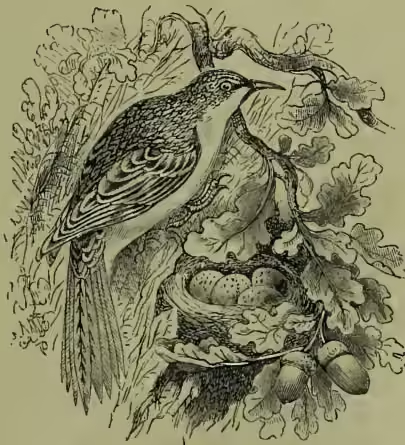
Creep (Certhia), a genus of Passerine birds, the type of the family Certhiæ. The bill is long, much curved, laterally compressed, and pointed; the tongue is long, narrow, sharp-pointed, and jagged near its tip; the tail is rather long, and the tips of the tail-feathers are firm and pointed, extending beyond the webs. The feet are rather slender; the hind-toe about as long as the others. The feet are well adapted for tree-climbing, and the stiff feathers of the tail are also employed for support. There is probably more than one species, but this is doubtful, and the distribution is somewhat wide. The Common Creeper (C. familiaris) is found in all temperate parts of the northern hemisphere, wherever woods abound. It is a permanent resident, but is never numerous or gregarious. It is not so well known as many other birds, in consequence of its restless habits, its rapid movements, and prompt retirement to the farther side of the tree from the spectator. The Scotch name, Bark-speeler ('climber'), describes its almost con- stant habit, as it searches for insects and their larvae in the crevices of the bark. The nest is usually in a hole of a decayed tree. The creeper is one of the smallest of British birds, although larger than the wren. Its prevalent colour is dark gray above, with spots of yellow and white; the under parts are white.—The Wall Creeper (Tichodroma muraria) of the south of Europe frequents walls and the faces of rocks.—The Nuthatch (q.v.) is a closely allied genus.