Cress, a name given to many plants belonging to the order Cruciferae, which have in common, in greater or less degree, a pungent mustard-like taste, and antiscorbutic, diaphoretic, and other medicinal qualities. They are very generally distributed abundantly over the temperate and northern countries of the earth, and much used as salads and medicinally by the peoples of those countries. In Britain the most commonly used is the Common Cress (Lepidium sativum), of which there are several
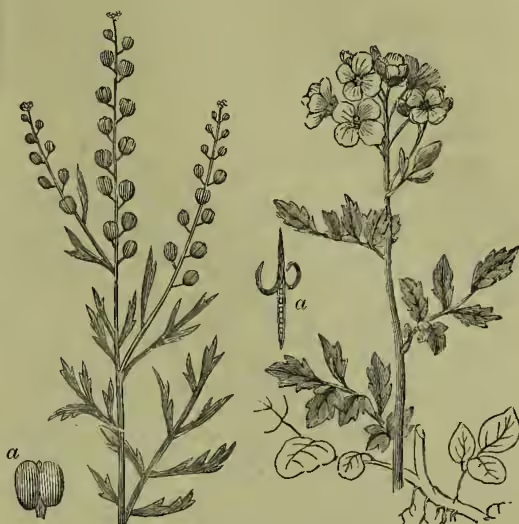
(Lepidium sativum):
a, silique.
Bitter Cress
(Cardamine amara):
a, silique, opening.
varieties, the most favoured being that known as the Curled Cress. Sown thickly in soil in moderate heat under glass, this may be raised during winter in a few days; and the seeds spread out thickly on flannel, which is kept saturated with warm vapour, as from a boiler or tank of boiling water, will vegetate and yield a crop within 48 hours after sowing. In this way it has been found invaluable during arctic voyages as an antiscorbutic. The Poor Man's Pepper is the Broad-leaved Cress (L. latifolium), a native of Britain, and formerly used as a condiment by the poor. The Virginian Cress (L. virginicum) has similar properties to the Common Cress, and is cultivated in Britain, in North America, and in the West Indies for use as a salad. L. piscidium, a native of the South Sea Islands, is there used to stupefy fish, and by sailors as an antiscorbutic. The allied genus Barbarea supplies the Winter Cress or Yellow Rocket of gardens (B. vulgaris), a native of Britain, and the American Cress (B. praecox), by some regarded as merely a variety of the preceding, is also a native of Britain, the European continent, and America, where both are used for the purposes already described.
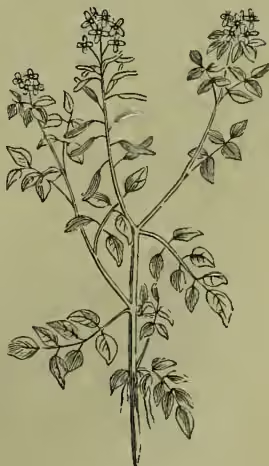
(Nasturtium officinale).
The Bitter Cress (Cardamine amara), the Lady's Snock or Cuckoo-flower (C. pratensis), and the Hairy Cress (C. hirsuta), are all natives of Britain and of other temperate and northern countries of the globe, but being more bitter than pungent, are less used in salads in this country than on the Continent and in America. Water Cress (Nasturtium officinale) is an aquatic perennial species of the same natural order, largely cultivated in England and on the Continent in slowly running brooks and ditches, where the water is pure and the bottom gravelly. In stagnant water and a muddy bottom the plant soon perishes. For the so-called Indian Cress, see NASTURTIUM.