Cricket (Gryllus), a genus of orthopterous insects akin to grasshoppers. Long feelers, a rasping organ on the wing-covers of the males, wings closely folded lengthwise, but often along with the wing-covers degenerate, great powers of leaping, and a retiring, more or less subterranean habit of life, are some of the more important characteristics of the family (Gryllidae) of which the cricket is a type. The females are fertilised by means of peculiar spermatophores, and as in allied Orthoptera there is no marked metamorphosis in the life-history. In the genus Gryllus the head is blunt, the antennæ are long and thin, the wings are always present, the hind-legs are very broad and strong, and the females have a straight protruding egg-laying organ.—The Field Cricket (G. campestris) is very common throughout Europe in fields and meadows (local in England), and is very well known from the sound, by means of which the male captivates his mate. The body is compressed, the head is black and shining, the wing-covers are brown and yellow at the roots. As in other crickets, the noise of the males is made by rubbing the wing-covers against one another. The under side of one of the nervures bears over a hundred sharp transverse ridges or teeth. These insects hide in burrows in the ground, and sometimes do much damage to vegetables. The female lays numerous eggs in the burrow, and the larvæ remain as such through the winter.—The House Cricket (G. domesticus) has a lanker, yellowish-brown body an inch long. A recent arrival in the United States, it is common throughout Europe in houses, is said to occur in the open air in Madeira, and even in Britain occasionally wanders out of doors in summer. It hides in nooks and crevices, and loves the neighbourhood of the fire, especially in winter. Its merry note has become associated with ideas of domesticity (as in Dickens's Cricket on the Hearth).
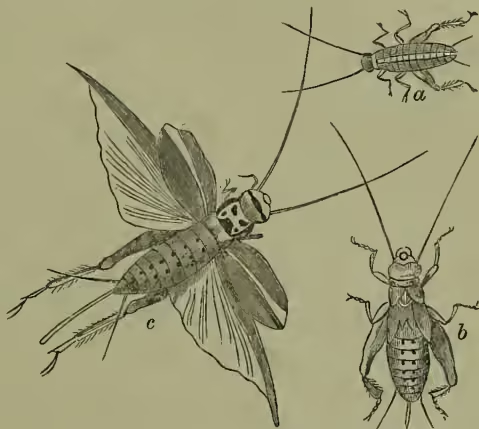
a, full-grown larva; b, pupa; c, perfect insect.
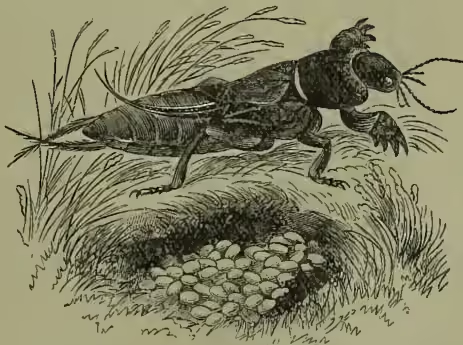
Without the heat of the fire, it becomes more or less dormant in winter. It remains quiet during the day, but hunts about actively at night for crumbs and other scraps both animal and vegetable. For the sake of both food and warmth it often frequents bakehouses. The larvæ are wingless, and the pupæ have only rudimentary wings. The loudest noise made by a cricket is probably that of a Sicilian species (G. megalos- cephalus), which is said to make itself heard 'at a distance of a mile.' Closely allied to the above genus is Myrmecophila, a wingless cricket with extremely strong hind-legs. Only the females are known, and these live parasitically in ants' nests. The Mole Cricket (Gryllotalpa) belongs to the same family, and is distinguished by the enormous burrowing fore-legs, by the large size of the anterior ring of the thorax, and by the absence of an ovipositor in the females. The only European species (G. vulgaris) is a large and formidable insect, sometimes attaining a length of two inches. It is of a grayish-brown colour, with a silken sheen. It burrows like a mole in fields and meadows, but is sometimes seen in flight in the evenings. Numerous eggs, inclosed in a cocoon, are laid underground. The larvae are long in becoming adult. The mole cricket often does damage by biting at the roots of vegetable crops. Like the field cricket, however, it feeds very largely on ground insects and the like. A South American and West Indian species (G. didactyla) damages the sugar-canes.