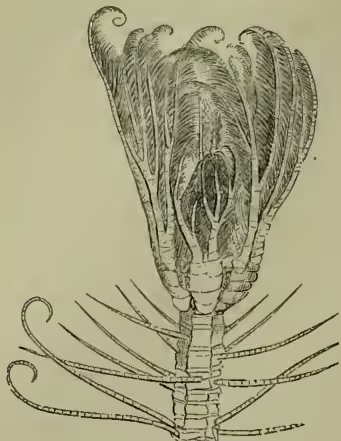
Crinoidea (Gr., 'lily-like'), a class of Echinodermata, sometimes called feather-stars or sealilies, and well known in fossil form as encrinites or stone-lilies. While agreeing in general structure with starfishes and other Echinoderms, the Crinoids present many peculiarities. They are fixed permanently or temporarily, mouth upwards, by a stalk, which is usually jointed. The visceral mass is inclosed in a cup at the apex of the stalk. As in most other Echinoderms, there are numerous limy plates, forming the stalk, the supporting cup, the framework of the arms, &c. The anus lies near the mouth. The 'arms,' though typically five in number, may be very much multiplied (towards 200) by branching; they usually bear lateral pinules, which produce a feathered appearance. The water-vascular ring does not communicate directly a central mass and radial extensions, being both sensory and motor. The sexes are separate and similar. The ciliated larval form (known in the case of Antedon) is not as divergent as that of the other classes of Echinoderms.
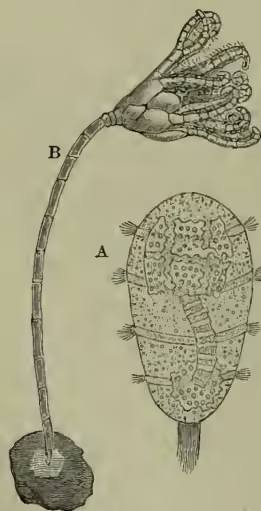
A, free-swimming larva, with skeleton of adult forming inside; B, fixed stalked young (Pentacrinus-like) stage.
Mode of Life.—The Crinoids are typically stalked and more or less fixed, but the modern family of Comatulidae break off from their stem at a certain stage. The stem of the stalked forms is usually anchored to a rock or other foreign object, but in some cases the animal grows more loosely on a muddy bottom. Like the extinct forms, the modern stalked Crinoids grow in masses, forming beds of sealilies on the ocean floor. Over a hundred specimens have been dredged in a single haul. When they move about, as in the Comatulidae, they do so by alternately bending and straightening the arms. The food, which consists of minute organisms (protozoa, diatoms, small crustacea, &c.), is wafted down ciliated grooves in the pinules and arms to the mouth. The known larvæ are actively free- swimming by means of cilia. Comatula and some others are the hosts of curious parasitic Chætopod worms (Myzostomidae), which cause deformities on the arms. Like many other Echinoderms, the Crinoids have the power of regenerating lost parts. Broken-off arms may be replaced, and even the renewal of the visceral mass has been observed.
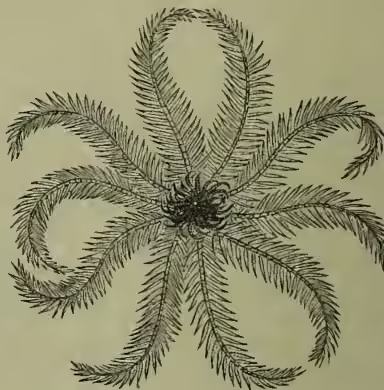
Important Forms and Classification.—The best-known genus is the cosmopolitan Antedon or Comatula, of which A. rosacea is the most abundant species, frequently dredged off British coasts. Along with the large genus Actinometra and some others less important, Antedon represents the family of Comatulids, which differ from other Crinoids in being stalked only in their youth. Professor J. Vaughan Thompson has the credit of having discovered the young stalked stage of A. rosacea, and thus revealing the existence of a most interesting habit. The free Antedon swims gracefully by bending its ten arms, and then settles down again for a while, anchoring itself by means of an inferior wreath of clawed attaching processes. Among permanently stalked Crinoids may be mentioned the genus Pentacrinus (e.g. P. asterius), from the Atlantic and Pacific, often at great depths; Rhizocrinus (e.g. R. lafotensis), from the Atlantic, usually abyssal; Holopus, from the Caribbean Sea, with very massive arms, and only a single extant species. These and others, being of more recent origin, are distinguished as Neocrinoidea, from the wholly extinct Palæozoic forms, the Palæocrinoidea or Tesselata. In the latter the cup does not invariably show that fivefold symmetry which is constant in the former.
Distribution.—Though recent deep-sea explorations have greatly increased the catalogue of living forms to a total of over 400 species, distributed in twelve genera, these nevertheless represent but a small fraction of the extinct Crinoid fauna. Over 200 genera and 1500 species are known from fossiliferous strata. These begin to appear in the Cambrian, and attain maximum development in Silurian, Devonian, and Carboniferous times. Recent Crinoids never attain the size exhibited by some of the fossil forms. Extinct species have been found with stems 50 and 70 feet in length.
Many of the stalked Crinoids are found at great depths, and some of the Challenger dredgings revealed the continuance in the deep sea of types which had previously been regarded as extinct. Thus the pear-encrinites (Apiocrinidae) are continued in the abyssal genera Rhizocrinus, Bathyrinus, and Hyocrinus. Bathyrinus gracilis has been dredged from a depth of 2435 fathoms, an Antedon from 2900 fathoms, Holopus and Hyocrinus from 1200 to 2500 fathoms. The majority, however, and especially the free forms, frequent shallower water. Antedon is a cosmopolitan genus; Holopus is confined to the Caribbean Sea; stalked Crinoids are found between the parallels of 68° N. and 46° S. lat.; Comatulidae between 81° N. and 52° S. lat.
Relations.—There seems little doubt that the Crinoids, Ophiuroids, and Asteroids are more closely linked to one another than to Echinoids and Holothurians. In some ways the Crinoid type is struc- tureally the lowest, and probably appeared first. With the primitive Crinoids two entirely extinct classes must be associated—the Cystoids and Blastoids. The former were sessile or shortly stalked, with oval or globular bodies, and very limy. The Blastoids had a short stalk and ovate body, and were also heavily weighted with lime.
See ECHINODERMATA, STARFISH, &c.; P. H. Carpenter, Challenger Reports, xi. (1884), &c.; De Loriol, Paleontologie Française (Paris, x. 1882-84); H. Ludwig, Anat. der Crinoiden (Leip. 1877); E. Perrier, La Comatulerosacea (Archiv. Zool. Expér., ii. 1872); C. Wachsmuth and F. Springer, Revision of Palæocrinoidea (Phila. 1879-85); Zittel, Handbuch der Paläontologie (1876-80).