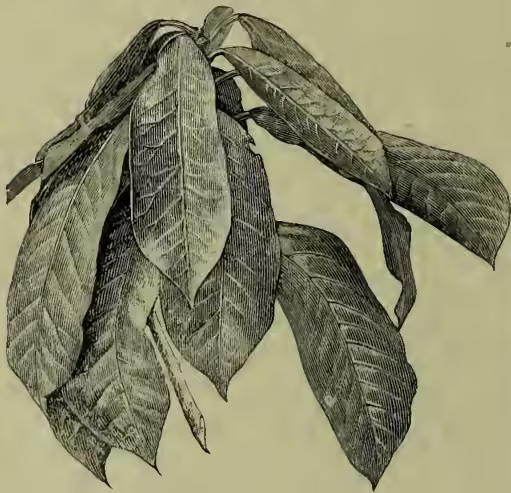
Croton, a genus of plants of the natural order Euphorbiaceæ, with numerous species, which are mostly tropical or subtropical trees or shrubs, a few herbaceous. The most important is the Purging Croton (C. Tiglium), a small tree, a native of India and the more easterly tropical parts of Asia. The leaves are extremely acrid; the wood in a fresh state is a drastic, and in a dried state, a more mild purgative; and the seeds (Croton Seeds, or Tilly Seeds) are a very powerful drastic purgative, formerly much employed in Europe, but latterly disused on account of violence and uncertainty of action, although still valuable as yielding croton-oil. They are oval or oval-oblong, about the size of field-beans. So great is their acridity, that dangerous effects have ensued from working for some hours with packages of them. The oil is obtained mostly by expression, and partly by treating the cake with alcohol. The wood and seeds of C. Parvæ are employed in some parts of the East in the same way as those of C. Tiglium. Other species possess similar properties. Very different are the properties of the species which yield Cascarilla (q.v.) and Copalchi (q.v.) barks. Other species are still more aromatic, and some delightfully fragrant, containing in great abundance a thickish balsamic sap. The sap of C. gratissimus is employed as a perfume and cosmetic at the Cape of Good Hope; that of C. originifolium is used in the West Indies as a substitute for Balsam of Copaiva; that of C. balsamiferum, also West Indian, furnishes Eau de Mantes by distillation; and the balsamic sap of some South American species is dried and used as incense. The C. Draco and other species yield a blood-red juice, which, when dried, forms the finest kind of dragon's-blood, and is possessed of astringent properties.
CROTON-OIL is the oil expressed from the seeds of the C. Tiglium, and is a sherry-coloured, viscid liquid, with an acrid taste, a somewhat rancid smell, and a fluorescent appearance. It contains a number of oily bodies, none of which have as yet been definitely shown to be the cause of its purgative and vesicating properties. Croton-oil is a violent purgative, in most cases a single drop being sufficient to remove constipation. When rubbed upon the skin it produces rubefaction and pustular eruption, and thereby tends to relieve some affections of the internal organs. It is used either by itself in the unmixed state, or diluted with olive-oil, soap liniment, alcohol, &c. It is not to be employed except under the advice of a doctor.