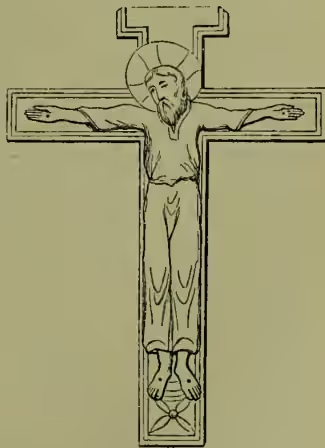
Crucifix (Lat. crux, 'the cross,' and figo, 'I fix'), a cross with the effigy of Christ fixed to it. The principal crucifix in Catholic churches stands in the centre of the high-altar.
It overtops the tapers, and is only removed to make place for the host in the service of Benediction. In well-appointed churches, the altar crucifix is generally either of gold or silver. Crucifixes are used in Lutheran churches, and in Prussia they are often made of Berlin iron. The crucifix first began to take the place of the plain cross in the time of Constantine, but it was never publicly acknowledged by the Greek Church, and did not come into general use in the East till towards the end of the 8th century. It was not till the Carolingian age that it became general in the Latin Church. On the earlier crucifixes, Christ is represented as alive, with open eyes, and generally clad, and fastened with four nails. On later ones he is represented as dead, naked, except for a cloth round the loins, and fastened with three nails—i.e. the two feet pierced by a single nail. See CROSS.
Cruden, ALEXANDER, born at Aberdeen, 31st May 1701, from the grammar-school passed to
Marischal College, where he took his M.A., but, having shown symptoms of insanity, was for a short time placed in confinement. On his release he left Aberdeen, and, after spending ten years as a tutor, in 1732 established himself as a bookseller in London. In 1737 appeared his Complete Concordance of the Holy Scriptures, a really admirable work. It was dedicated to Queen Caroline, who graciously promised to 'remember him,' but unfortunately died a few days later. Cruden now relapsed into insanity, and for ten weeks was kept in a mad-house, as again for a fortnight in 1753. Earning meanwhile his livelihood as a press-reader, he assumed the title of 'Alexander the Corrector,' and in 1755 began to go through the country, reproving by voice and pen the nation's sins of Sabbath-breaking and profanity. But many a good and kindly action was interwoven with his crack-brained courtships, his dreams of knighthood and a seat in parliament. He was just back from a visit to his native city, when he died at his prayers in his Islington lodgings, 1st November 1770. See the Life by A. Chalmers, prefixed since 1824 to many of the numerous editions of the Concordance. See CONCORDANCE.