Crypt (Gr. krypto, 'I hide'). In the early days of persecution the Christians were accustomed for security to worship in the catacombs or crypts where they buried their dead (see CATACOMBS). When persecution ceased, this custom led to the erection of churches over the graves of martyrs and saints; but at a later date the bodies of the saints were transferred to chambers, constructed to resemble the catacombs, under the sanctuary or altar of the new churches, in order to add to their sanctity. These crypts and their sacred shrines were visited by numerous pilgrims, and were frequently constructed for the accommodation of the devotees, of sufficient size to admit a number at a time, who descended by one stair, and ascended by another. In other cases the crypts were so placed that the shrine of the saint could be seen from the aisles of the choir, the floor of which was necessarily raised considerably above the level of the nave. Crypts of these kinds were usual in the early centuries, and many examples of them have been preserved in Italy and France, even where the churches over them have been rebuilt. The crypt of the Circular church of St. Bénigne at Dijon was one of the largest. There a great circular aperture in the centre of the floor of the upper church enabled a very large congregation of pilgrims, including those in the crypt, to see the shrine of the saint, and witness any ceremony taking place there.
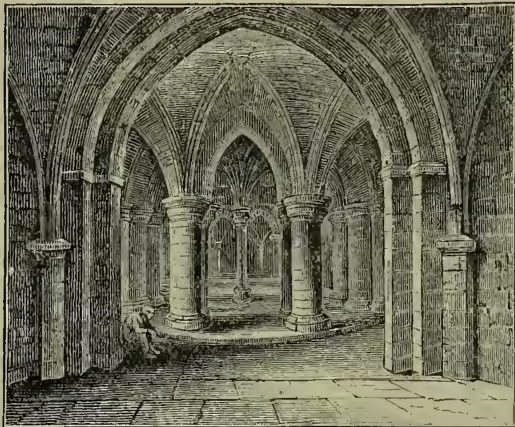
After the 13th century crypts were not so much in use. The great cathedrals were regarded as much in the light of civil as of ecclesiastical edifices, and the floor of the choir was brought down to the level of the rest of the building. It sometimes happened that owing to the slope of the site considerable underbuilding was required under the choir, in which case an under church was constructed, which was called by the old name of the crypt, and was generally used for sepulchral purposes. The crypt of Canterbury is one of the finest of this kind. The crypt of Glasgow Cathedral is also a very beautiful example, the vaulting over the shrine of St Mingo being pointed out by Sir Gilbert Scott in his lectures as one of the best specimens of its class.