Crystallography (from the Greek krustallos, 'ice,' an idea among the ancients being that rock-crystal, which may be taken as a type of crystalline minerals, resulted from the subjection of water to intense cold). Minerals, salts, and inorganic bodies generally (examples, rock-crystal, fluor-spar, alum, and sugar) exist in the crystalline state; and when we examine all crystals, whether occurring naturally or obtained artificially, certain laws have been discovered, and phenomena observed, and these laws and phenomena constitute the science of crystallography. The following are the more important laws and principles of the science:
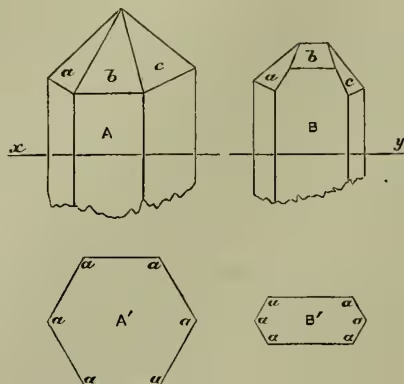
Drawings of two crystals differing much in appearance, but with angles at a shown to be constant when similar sections are made.
(1) Law of Constancy of Angles.—Crystals of the same substance may differ much in general appearance, but when the angles between their faces are measured these angles are found constant. Thus the crystals A and B (fig. 1), when cut through in the direction xy at right angles to the prism, give the sections shown at A', B'; and in each section the angles a will be found the same—viz. ; or again, if the angles between the faces ab, bc, or ac, be measured, they will be found identical in both crystals.
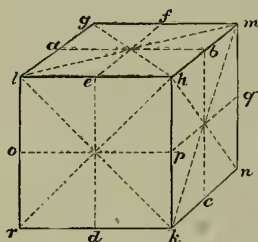
Each of the planes represented by dotted lines is a plane of symmetry.
(2) Law of Symmetry.—Suppose we cut a crystal in two, and then place the two parts with their cut surfaces on a mirror. The mirror will reflect each part, and may or may not produce the appearance of the original crystal. If the mirror will produce the appearance of the original crystal, we have severed the crystal in a plane of symmetry. Thus with a cube, if we cut it in either of the planes while with other forms varying numbers of planes of symmetry may be found, until with a sphere there are an infinite number of planes of symmetry, for it is obvious that if a sphere be cut anywhere by a plane passing through its centre, and the half thus obtained be laid upon a mirror, the appearance of a complete sphere will be produced. Now examining all (holohedral) crystals, it is found that they fall into one of the following six categories or systems: (1) Anorthic System.—No plane of symmetry—examples, copper sulphate and anorthite. (2) Oblique System.—One plane of symmetry—gypsum and washing-soda. (3) Prismatic System.—Three planes of symmetry at right angles to each other—barytes, saltpetre, and native sulphur. (4) Rhombohedral System.—Three planes of symmetry at to each other—calcite, quartz, and ice. (5) Pyramidal System.—Five planes of symmetry—cassiterite, zircon, and idocrase. (6) abc, def, ghk, lmn, opq, rhm, nhg, lkn, gmk, and place in each case the two severed parts on a mirror in the way described, the reflection together with the object will reproduce a cube. There are then in the cube nine planes of symmetry. The octahedron and dodecahedron similarly have nine planes of symmetry. With such a form as a common brick there are three planes of symmetry,
Cubic System.—Nine planes of symmetry—fluor-spar, galena, and alum.
(3) Law of Rationality of Indices.—The various planes of crystals, as explained below, are indicated in the Millerian system by three numbers, which together form the symbol of the plane. Thus we have planes represented by 1 2 3, by 1 1 1, by 1 1 0, &c. Now the law of rationality asserts that the symbol of a plane must be represented by numbers which are rational—i.e. numbers which can be expressed exactly, not those like , , &c., which can only be obtained approximately. Thus by the law of rationality, no plane of a crystal can have such a symbol as , , &c.
Crystallographic Notation.—Several methods of representing planes of crystals by symbols are in use. Two of these only need be mentioned—viz. Miller's notation and Naumann's notation. In both systems the planes are referred to three axes corresponding in direction to three edges of the crystal.
Let abc (fig. 3) represent parts or parameters cut off from three axes xyz, then in Miller's
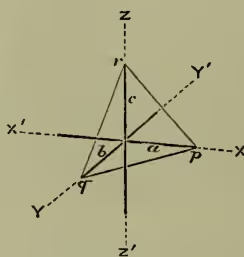
The plane 1 1 1 in Miller's notation.
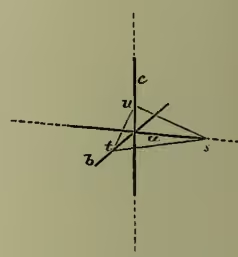
The plane 1 2 3 in Miller's notation.
system the plane 1 1 1 represents a plane which cuts the x axis at one-ninth of a, the y axis at one-ninth of b, and the z axis at one-ninth of c. Such a plane is indicated by pqr. The plane 1 2 3 means a plane which cuts the x axis at one-ninth of a, the y axis at one-half of b, and the z axis at one-third of c. Such a plane is represented by stu, fig. 4. The plane 1 1 0 means a plane which cuts the x axis at one-ninth of a, the y axis at one-ninth of b, and the z axis at one-ninth of c—i.e. does not cut c at all, or is parallel to it. Such a plane is represented by uvx in fig. 5.
The plane 1 1 0 in Miller's notation.
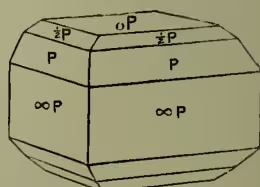
In Naumann's system some form is selected as the fundamental pyramid of the crystal, and his pyramid, which corresponds to Miller's form, 1 1 1, is represented by the letter P in all systems but the cubic (in this system it is called O) and the rhombohedral (in this system it is called R). Thus the planes marked P (fig. 6) form the fundamental pyramid, the planes are those of a pyramid one-half the height, while the basal plane is represented by oP or a pyramid
Fig. 6.
A crystal with the faces marked in Naumann's notation.
of no height, while the planes represent a pyramid of infinite height.
Drawing and Mapping of Crystals.—Various modes of representing crystals have been adopted. Perspective drawings are made by projecting the axes according to the rules of Projection (q.v.), then the various planes are indicated, and from these their intersections are known, and these intersections form the drawing of the crystal. Fig. 7 represents one octant of the form
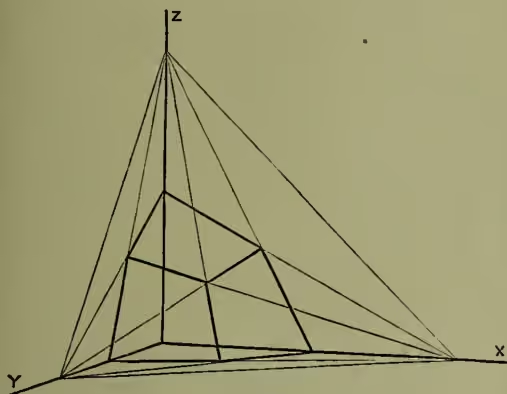
Mode of drawing a crystal from projection of axes. drawn by this method. Some writers represent crystal forms by orthographic projections—that is, represent them in plan and front elevation. Of all methods, however, of representing crystals from measurements made with the goniometer, the most elegant and convenient is that of spherical projections. Two kinds of spherical projection are in use—viz. the gnomic and the stereographic. Imagine a glass sphere placed within a crystal, as in fig. 8, and suppose the faces of the
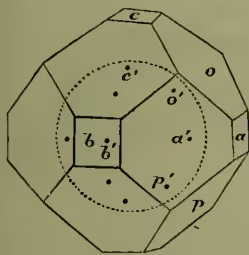
Sphere within a crystal. When planes are moved they touch the sphere where dots are marked. on which the map is to be made, and the eye is then placed at the centre of the sphere. The various dots when projected on to the paper as seen by the eye placed at the centre of the sphere produce the map. If the map is to be made on the stereographic projection, suppose a piece of glass to pass through the centre of the sphere as in fig. 9, and let the eye be placed touching the sphere at E, then the dots as they appear on the glass to the eye at E form the map. Such a map of the crystal of fig. 8 is given in fig. 10. In the stereographic projection all great circles on a sphere are represented on the map by either straight lines or arcs of circles, whereas in the gnomonic projection they are represented by straight lines. The map (fig. 10) shows not only the position of the dots or poles, but also great circles passing through the sphere. These great circles correspond to the planes of symmetry of the cube (fig. 2) and other forms of the cubic system. These stereographic maps, as will be seen by reference to treatises on
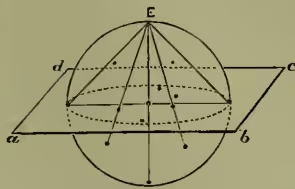
The eye placed at E sees the dots on lower part of sphere projected on the plane .
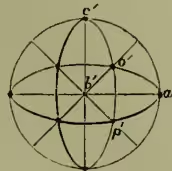
Stereographic map of the crystal of fig. 8 as obtained by method in fig. 9. the subject, convey a good deal of information respecting the crystals they portray.
Planes of crystals form a zone when the intersections of the planes (i.e. the edges) are parallel to each other. Thus, in fig. 6 the faces , , , and form a zone. Now in Miller's notation these forms have the indices , , , , and it will be noticed that all these symbols have a common ratio—thus, the first and second index are equal to each other. It may be shown that this is universally true; hence, knowing the indices of a plane, we can say whether it is on a particular zone, or knowing that a plane lies in two zones, we can determine its indices. Thus, the planes , , , &c., are all in one zone, as the symbols have the common ratio , and the plane cannot be on this zone, because its symbol does not contain the ratio .
Holohedrism and Hemihedrism.—Crystals which have all faces present as required by the law of symmetry are termed holohedral. Where, as is often the case, only one-half of these faces are present, the crystal is said to be hemihedral; while if only one-fourth of the full number of faces are present, the crystal is said to be tetartohedral.
Physical Crystallography.—The physical properties of crystals have some interesting relations to the symmetry and form of the crystal, and these properties are included generally with crystallography. Thus, if in the regular system a face is striated or has any peculiarity, this striation or peculiarity will be found on each face which is present by the law of symmetry. Again, most crystals cleave (i.e. break easily) in certain directions, and the cleavage planes follow the law of symmetry. Again, when examined by polarised light, other properties of crystals in relation to symmetry are brought out. Thus, crystals of the regular system (except in a few certain cases) do not doubly refract light, no matter in what direction the light is incident. With crystals of the rhombohedral system and the pyramidal system light is not doubly refracted when it falls parallel to the vertical axis, but in other directions it is doubly refracted; while in the remaining systems two directions can be found in which the crystals of these systems do not doubly refract light, though they do so in all other directions. Again, heat is conducted differently in different systems of crystals. Suppose crystals turned in a lathe into spheres, and that the centre is made suddenly hot, then in the regular system the heat spreads equally, and after a time the surface of the sphere is uniformly raised in temperature; with other systems the effect is different; with the pyramidal and rhombohedral systems a similar experiment would result in the surface of the sphere being heated uniformly over belts corresponding to an equator and parallels of latitude, but the tempera- ture of the different belts would be different, thus showing that heat is propagated in two directions at right angles to each other with different velocities. With other systems more complex results would be obtained owing to heat being propagated in three directions with different velocities.
When soluble crystals are placed in a solvent the faces are eaten out differently, producing figures termed by German writers 'aetzfiguren'. These figures will often indicate the symmetry of the crystal, and have been useful in such determination. As physical properties generally are related to elasticity, Groth states that the best way to define a crystal is that it is a solid body, the elasticity of which is the same in all parallel directions, but on the contrary is different in different directions.
See A Tract on Crystallography, by W. H. Miller (Deighton, 1863); A Treatise on Crystallography, by W. H. Miller (1839); Introduction to Mineralogy, by William Phillips (ed. by Brooke and Miller, 1852); Crystallography, by H. P. Gurney (S.P.C.K.); A Guide to the Mineral Gallery of the British Museum, by L. Fletcher; N. S. Story Maskelyne, Crystallography (Oxford, Clarendon Press, 1895); W. J. Lewis, A Treatise on Crystallography (1899). In most treatises on mineralogy a portion of the work is devoted to crystallography.