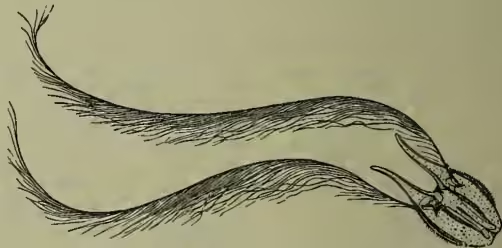
Cteno'phora (literally, 'comb-bearers'), a sub-class of Cœlenterates (q.v.), representing the climax of activity in that series of animals. The Common Berœ and Pleurobrachia are good types. Venus' Girdle (Cestum veneris) is a well-known aberrant form, which has been elongated sideways to a yard or more in length. They are beautifully delicate, free-swimming marine organisms, generally globular in form, moving by means of comb-like plates. These are composed of numerous agglutinated cilia, and disposed along eight meridional rows. The mouth is at one pole of the sphere, two excretory or anal apertures lie at the other, which also exhibits a sense organ and a probable steering mechanism usually known as the 'otolith.' There are numerous alimentary vessels regularly disposed in relation to the main central cavity. In most cases there are two retractile tentacles; the stinging cells so characteristic of Cœlenterates are usually modified into 'adhesive cells.' The Ctenophores are hermaphrodite, carnivorous in diet, extremely active in habit, and often phosphorescent. They are connected with the veiled (Craspedote) medusoids by the transitional genus Ctenaria, a medusoid which in some ways looks like a Ctenophore in the making. Some would place them along with Hydromedusæ rather than allow them the rank of a distinct sub-class. Lang has suggested the derivation of some of the lower worm-types from Ctenophora, but other authorities do not regard such a connection as at all probable. See BEROE, CELENTERATES.