Cuckoo (Cuculus), a well-known genus of birds in the order Coccygiformæ, or, according to others, Picariæ, and type of a large family (Cuculidæ). The common cuckoo (Cuculus canorus) is a widely distributed bird, breeding in summer in the northern parts of Europe and Asia, and migrating in winter to Africa, as far as the Cape, or to India. It is best known for the 'coo-coo' cry with which it announces its arrival and that of spring, and for its habit of utilising for its own family the nests and the brooding of other birds. The cuckoo is slightly over a foot in length; the bill is as long as the head, slender and slightly curved; the wings are long and pointed; the tail is also long and rounded; the upper part of the shank is feathered.
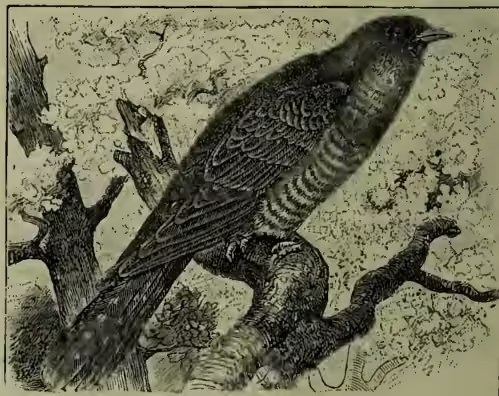
The upper surface is ashen gray, the belly and legs are whitish with undulating transverse brown lines, the tail is spotted with white above, and the root of the bill and the feet are yellow. The young birds are blackish, and mottled with yellow and gray. A reddish variety occasionally occurs. The bird arrives in North Europe in April or May, and leaves again in August or September. Its cheerful call ceases to be heard about the middle of June. Predominantly an arboreal bird, it is rare in treeless districts. Each cuckoo seems jealous to 'preserve' a certain territory for itself. Like the other species of Cuculus, it is a shy, restless, unsocial bird. It is extremely valuable on account of its insatiable appetite for caterpillars. The hairy forms are especially delighted in, and the indigestible hairs form a felt-like coating in the stomach. The female lays its eggs singly (sometimes to the number of eight), each in the nest of some suitable bird, choosing such as feed their own young on insects—in order of preference, hedge-sparrow, water-wagtail, titlark, yellow-hammer, green linnet, and whin-chat. The young cuckoo, unconsciously reared by its foster-parents, manages to secure the bulk of the food-supply, and in the struggle for existence completely monopolises the nest, ousting the rightful brood. Stories of the ungrateful young bird devouring its foster-parent are entirely mythical. Nor has it been shown that the adult ever sucks the eggs of other birds. The males greatly outnumber the females. The latter have somewhat darker feathers, and a somewhat less emphatic note. The males are said to be very passionate in their love-making, but there is no regular pairing or continued attachment. The musical interval between the cuckoo's two notes is not uniform, and varies from a minor to a major third (the latter being that adopted in Beethoven's reproduction). See Nature, vol. xxxvi. p. 344.
The genus Cuculus includes about a score of other species, restricted to the eastern hemisphere. In the same family as the true cuckoos are several important genera: The Honey-guide (Indicator), of Ethiopian distribution, feeding chiefly on wild bees, and directing attention to their nests; the Golden Cuckoo (Chrysococcyx); the Jay-cuckoo (Cocystes), utilising the nests of crows and magpies; Eudynamis, of similar habit; Seythrops, a very large form in Australia, New Guinea, and the Celebes; the swift 'Road-runner' or 'Ground Cuckoo' (Geococcyx), of California; the grub-eating Ani-bird (Crotophaga, q.v.); the Coucal or Spurred Cuckoo (Centropus), with the claw of the inner toe prolonged into a great spur. An East African cuckoo (Tepe-tepe) is a delightful song-bird. The American Cuckoo (Coccyzus americanus) is particularly interesting, since it makes but a very rudimentary nest, has a very irregular way of laying, and exhibits an unnatural indifference to its young. Its egg is occasionally found in the nest of other birds. These facts, according to Burroughs, raise the question whether the American cuckoo 'is slowly relapsing into the habit of the European species, which always foists its egg upon other birds; or whether, on the other hand, it be not mending its manners in this respect.'
The parasitic habit of our common cuckoo demands further attention, as one of the strangest of bird habits. The facts, which are very hard to explain, may be thus summarised: (1) The habit of utilising the nests and brooding patience of other birds is not common to the genus. It is also the practice of an Australian species, and of some related genera, and is occasionally exhibited by the American representative. Professor Newton notes that a few of our common birds, 'whether by mistake or stupidity, not unfrequently lay their eggs in the nests of others.' In the genus Molothrus, allied to starlings, and far separated from cuckoos, the various species exhibit a gradual perfecting (if we may use the term in such a connection) of the parasitic habit. (2) The modus operandi of the habit is usually as follows: The cuckoo selects the nest of an insect-eating bird, much smaller than herself, and often with eggs approximately like her own. Into this, say of a hedge-sparrow, she lifts her egg with her bill, having previously laid it upon the ground. After an interval of two or three days, she repeats the process in another nest. The hedge-sparrow or other bird, all unaware apparently of what has happened, sits on the cuckoo-egg along with her own. The young cuckoo is generally hatched first, and is restless and uneasy until it has got rid of the other eggs or young birds. This it does with considerable exertion, and sometimes with a real struggle, by lifting the living burden upon its back and throwing it over the side of the nest. Thereafter it remains sole though wrongful possessor, and is reared in peace. (3) Among the facts which make the habit a success, the following should be noted. The relatively small size of the cuckoo's egg is striking. 'The egg of the cuckoo is not any larger than that of the skylark, although an adult cuckoo is four times the size of an adult skylark.' This makes the duping of the small birds easier, if, indeed, they have any suspicions. The laying of the egg in a small bird's nest makes the ousting work of the young cuckoo an easier task. In many cases, as already noted, the cuckoo's egg is coloured approximately like those of the victimised foster-parent. Till the young cuckoo is about twelve days old, when the disposition for turning out its companions begins, according to Jenner, to decline, its broad back has a curious depression in the middle. The presence of this cavity makes it easier for the restless and still sightless nestling to bear up and toss over the eggs or young birds which interfere with its desire for sole possession. (4) The advantage to the young bird, which earns by its exertions plenty of growing-room and an extra portion of food, is obvious enough. The individual parent is also saved both time and trouble, as well as all the patient sacrifice of brooding. Jenner has pointed out that the advantage to the species is probably this, that by leaving their eggs to other birds to incubate, the cuckoos are able to have a numerous progeny reared in the short period of their stay in northern Europe. Or, to put it in another way, the parasitic habit enables the cuckoos to migrate earlier. Hence Darwin believed the constant parasitic habit of our cuckoo to have been derived from its occasional occurrence (as in the American form) through the action of natural selection. Those cuckoos which fell in with the trick succeeded better than their neighbours, till gradually only those survived in whom the trick had become habitual.
It is interesting in this connection to note the occasional reversion of a cuckoo to parental responsibilities. Mr Romanes has given a detailed discussion of the subject in his work on Animal Intelligence, and also comes to the conclusion that 'we are justified in setting down the instinct to the creating influence of natural selection.' It ought not, however, to be overlooked that all the cuckoos are solitary, unsocial birds; that the American genus is said to be immorally uninterested in the fate of the young; that the species of Molothrus, which has most completely developed the parasitic habit, is extremely careless about the brood, and often drops its eggs on the bare ground. The habit may be regarded not so much as requiring special explanation, as an expression of a general constitution or habit of life. Brehm describes the cuckoo as a greedy, discontented, ill-conditioned, passionate, in short, decidedly unamiable bird. It seems plausible, therefore, to suggest that one dominant 'physiological tendency' or mood shows itself in the restless selfishness of the nestling, in the jealous, solitary individualism of the adult, in the preponderance of males, in the very note, in the relatively small size of the egg, and in the parasitic habit as the most striking outcrop.
The folklore of the cuckoo is almost inexhaustible in every country of Europe. It has the gift of prophecy as the herald of spring and of long life, the prelude of storms, of prosperity, and of speedy marriage to maidens. Countless superstitions, and those of the most varied character, are connected with its origin, the cause of its cry, its winter transformation into a hawk, as well as with the first hearing of its call, the hearer's occupation at the moment, and the direction from which it comes; while as many proverbs play upon the monotony of its note, its supposed stupidity, and its obvious connection with cuckoldom, from its habit of depositing its offspring with alien parents. It has only been by a strange transference of meaning that the name cocu or cuckold has been transferred from the paramour to the unsuspecting husband, unless cuckold means, as explained by Littre, one who has been cuckoo-ed or treated after the manner of the cuckoo. The earliest English song extant (13th century) is an expression of the joyousness of the first cuckoo-call.
For details of Cuckoo folklore, see Mannhardt in the Zeitschrift für Deutsche Mythologie, vol. iii. pp. 209-298; James Hardy's 'Popular History of the Cuckoo,' in Part II. (1879) of The Folklore Record; and Swainson's Folklore of British Birds (1886).