Curassow, or Hocco (Crax), a genus of large game-birds inhabiting the forests of Central and South America. Their most distinctive features concern the head. This is adorned with a crest of feathers, curled forwards, and capable of being raised and depressed; while the often brightly coloured cere is enlarged into a prominence at the root of the high beak. Eight species are found from Mexico to Paraguay, predominantly arboreal, living mostly on fruits, but in general habit like poultry. They are very unsuspicious of danger, especially careless at the love-making season, and are very readily tamed. The best-known species is C. alctor—the Royal Pheasant of the Mexicans.
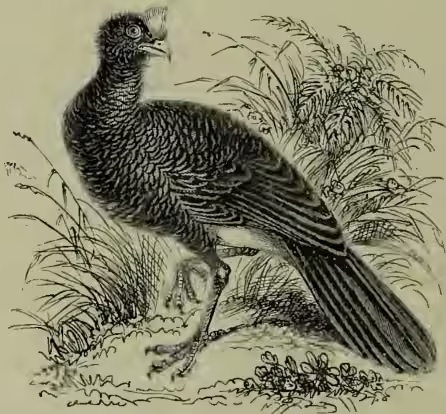
It is a very sombre bird, about the size of a turkey. It is occasionally domesticated, and a stock imported into Holland at the end of last century seemed to become acclimatised. It was, however, lost amidst the troubles subsequent to the French Revolution. Though their love-making is keen, the birds are not very productive, and it is probable that the natives have discovered that this apparently very profitable bird will not breed readily under domestication. Closely allied, and of similar distribution and habit, are the fierce Guans and Penelopes (Penelopinae), and the rare Mountain Curassow (Oreophasis derbianus). The Turkeys (q.v.) are also near relatives.