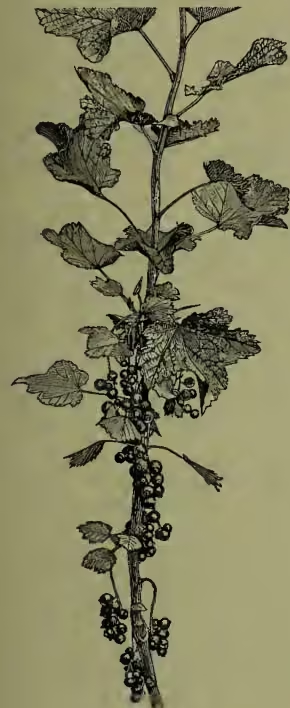
Currant, a name originally belonging to a small kind of grape (see CURRANTS), and transferred, in consequence of the similar size of the fruit, to many species of Ribes (order Saxifragaceæ, sub-order Grossulariaceæ). The species known as currants are destitute of spines, and have the flowers in racemes: the spiny species are known by the name Gooseberry (q.v.). Among the fruit-shrubs most generally cultivated in our gardens is the Red Currant (R. rubrum), Grosscille of the French, a native of woods and thickets in the south of Europe, found also in some parts of Asia and of North America, perhaps rather a naturalised than a truly native plant in Britain. It has long been cultivated, although it does not appear that it had a place in the gardens of the ancient Greeks or Romans. The berries, besides being used for dessert, and to a much greater extent for pies, and for making jelly (eaten with mutton and hare), are used also for making an agreeable and refreshing beverage, called in France Eau de Grosseilles (made of the juice of the fruit, water and sugar, strained and iced), and a well-known fermented liquor called Currant Wine (q.v.).—The White Currant is a mere variety of the red, the result of cultivation, with fruit less acid, and more fit for dessert, generally also rather larger. There are many sub-varieties, and many intermediate shades of colour. Both the red and the white currants are either trained as standard bushes, or against walls, the latter treatment producing larger and finer fruit, and both are sometimes trained on a north wall, to retard their ripening till after the ordinary season. They grow readily, like the shrubs of this genus in general, from cuttings. Unlike the black currant, the red and the white grow in clustered bunches.—The Black Currant (R. nigrum), Cassis of the French, grows in moist woods, and on the banks of streams in Europe and the north of Asia. The fruit is much larger than the red currant, and cultivation has lately produced varieties remarkable for size. There is a variety found in Russia with yellow berries. The jelly and preserve made from it are very useful for sore throats, as is also black currant vinegar, made in the same manner as raspberry vinegar. In Russia, the berries are gathered in large quantities in the woods, and dried in ovens, to be used in pies. They are tonic, and also slightly diuretic and sudorific. A liqueur, called Liqueur de Cassis, is prepared in France from the black currant, and it has been suggested to introduce this manufacture in the Hebrides and Shetland Islands. Those who are fond of the flavour of green tea in mixture with black, but to whom it is injurious, may effectually gratify their taste by dropping one or two leaves or a bud or two of black currant into the teapot during the process of infusion.—Many other species, some of them probably deserving of cultivation, are found in temperate and cold climates in almost all parts of the world. One with large beautiful red berries, occurs on the Himalaya at an elevation of 13,000 feet.—R. oxyacanthoides, a native of North America, is much like the common gooseberry in flavour, and the colour is red or green in different varieties.—R. lacustre, also a North American species, produces its fruit in bunches, a fruit like that of the black currant.—The fruit of R. fragrans is sweet, but the species is more remarkable for the production of a pleasant balsamic resin which exudes from the under side of the leaves in yellow drops and has the smell of black currants.—The Red-flowered Currant (R. sanguineum), now so common as an ornamental bush in shrubberies, and trained on walls, producing in April a profusion of deep-red flowers in large drooping racemes, is a native of the north-west of America, and was introduced into Britain in 1826. Its bluish-black, mucilaginous, insipid berries are not, as is popularly believed, poisonous.—The Golden Currant (R. aureum), also a very ornamental shrub, from the same regions, has a tubular calyx and long golden-yellow flowers. Its fruit, which is either yellow or black, and of fine flavour, is not freely produced in Britain.—The name Native Currant, or Australian Currant, is given in Australia to the berries of different shrubs, particularly the white berries of Leucopogon Richei (order Epacridaceæ). Other fruits bearing the same name are produced by species of Coprosma (order Cinchonaceæ), but they are very inferior.