Chambers's Encyclopaedia, Volume 3: Catarrh to Dion, p. 626
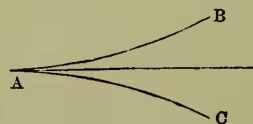
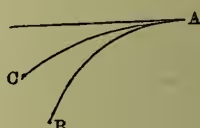
Cusp (Lat. cuspis, 'a lance-point'). If we conceive a curve to be generated by a moving point, then a cusp is where the point suddenly stops and
Figure 1: A diagram showing a curve with a cusp point. A horizontal line extends to the left from the cusp point, labeled A. Two branches of the curve extend to the right, labeled B (upper) and C (lower).Figure 2: A diagram showing a curve with a cusp point. A horizontal line extends to the right from the cusp point, labeled A. Two branches of the curve extend to the left, labeled B (lower) and C (upper).
returns for a time in the same general direction as that in which it was moving when it reached the cusp point. A later name is 'spinode.' When two branches (as BA, CA) meet a common tangent without extending further, the point of contact is a cusp. Fig. 1 is an example of the first species, and 2 of the second.