Cuttle-fish (A.S. cudele), strictly speaking, a member of the genus Sepia, more generally applied to any Cephalopod (q.v.). A brief account is here given of the structure, life-history, and habits of the common British species (Sepia officinalis, Linn.), with a tabular indication of its relationships.
The Sepia (fig. 1) measures from six to ten inches in length, and its colour varies from pale gray to dark brown or neutral tint. The body is oval, flattened from above downwards, and contained in a tough muscular sac (mantle), which expands along the whole of either margin into a narrow fin. The integument consists of a single layer of cells, lying upon connective tissue, in which are imbedded 'chromatophores,' or cells charged with variously coloured pigment-granules. By expansion of the cell the pigment is diffused, and by its contraction concentrated, hence the rapid flashes of changing colour for which the cephalopoda as a whole are so remarkable.
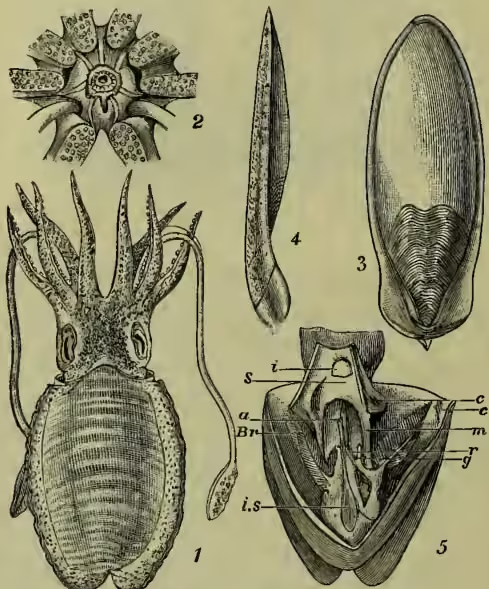
The head is broad, and contains a cartilage of complex shape which protects the central nervous system, and forms a socket on either side for the large eye; this has a bright green lustre during life, the black pupil is shaped like the Greek letter , and there are two eyelids, the upper coloured, the lower white. The front of the head is occupied entirely by the bases of the arms and the mouth. The former are ten in number, eight of them being alike, oblong in transverse section and tapering off to slender extremities; they have the surface which is turned towards the mouth covered with suckers in four longitudinal rows. The suckers consist of a muscular periphery, strengthened by a horny ring; a fleshy pad acts like a piston in the base of this latter. Each sucker is mounted on a short flexible stalk. The two remaining arms, known as 'tentacles,' occupy the interspaces between the ventral arms and those next to them. They are twice as long as the others, and have a cylindrical stem, slightly expanded at the extremity into a club furnished with larger and smaller suckers. They can be withdrawn into pockets situated beneath the eyes, and are carried in this position when not in use. The mouth (fig. 2), situated in the centre of the roots of the arms, is surrounded by a lip with seven prominent angles, which bear small suckers in some species, and have been compared to rudimentary arms. Projecting from it may be seen the two black horny mandibles, shaped like those of a parrot, but with the lower overlapping the upper.
On the lower aspect of the animal, between the muscular sac and the body proper which contains the viscera, is a hollow space, the 'branchial' or 'mantle-cavity.' When this is opened by a longitudinal incision it is seen to contain the following structures (fig. 5). Anteriorly is the base of the 'siphon,' or 'funnel,' s, a conical tube containing a valve, i, through which water can be forcibly expelled by the contraction of the mantle. At its posterior margin on either side is an almond-shaped depression, lined with cartilage, c, into which fits a prominence on the inner surface of the mantle, c', an arrangement which largely contributes to the solidarity of the body as a whole. Lying along the middle line is the terminal portion of the intestine, a, furnished with two small flap-like appendages of uncertain function, and on either side, a little farther back, is a small papilla, r, upon which the kidney opens, and on the left side only, the genital orifice, g. Two large gills, Br, are situated in the lateral recesses of the mantle-cavity, each consisting of an arterial stem running up the attached side, and a venous stem passing down the other aspect, the bulk of the organ being made up of a series of folds passing transversely from one to the other, and richly supplied with vessels containing the blood to be aerated. Respiration is carried on by rhythmic contractions of the mantle, in consequence of which water enters at either side, passes over the gills, and is expelled by the siphon; this takes place about seventy times in a minute.
On the dorsal side of the animal, immediately beneath the integument, is a closed sac which contains the internal shell (cuttle-bone, sepiostare, figs. 3, 4). Speaking generally, this may be said to be of an elongated spoon or boat shape; it consists of a horny lamina, which gives it its characteristic outline, extending also into the small cone at the back, which in many species is much larger than in the one now under consideration, and has been compared with the guard of the Belemnite (q.v.). On the dorsal surface is a granular calcareous deposit; while the concave ventral aspect of the spoon is occupied by a series of layers of calcareous matter, which are deposited in succession and do not entirely cover each other, so that the hinder portion of this surface presents a striated appearance due to their parallel margins. This part of the shell is porous and extremely light, the interstices being filled with air. These shells are imported into Liverpool in some quantity, and ground into fine powder to form a dentifrice.
The Digestive Organs.—Within the beak above alluded to is a solid muscular mass (buccal cone), part of which is devoted to its movements. Through its centre passes the gullet, the lower wall of which bears a most remarkable organ, the tooth-strap or 'radula;' this consists of seven longitudinal rows of horny teeth, which are secreted by certain special cells of the epithelium, and whose apices are directed backwards. They can be moved to and fro by appropriate muscles. Behind the buccal cone the oesophagus bears the salivary glands, and still farther back it opens into a round sacular stomach with muscular walls. A large bilobed gland, commonly called 'liver,' but having the functions of a pancreas, is situated on the oesophagus. Lying parallel to the terminal portion of the intestine is the 'ink-bag,' i.s., a hollow gland opening near the anus, and furnishing a deep-brown fluid, which is ejected by the animal when alarmed in order to conceal its retreat. When genuine, the pigment known as 'sepia' is prepared from it.
The Circulatory Organs.—The heart is situated posteriorly, and consists of a pear-shaped sac which receives on either side a vein from the gills, dilated just before its termination into a muscular contractile antechamber or auricle. It gives off an artery anteriorly to supply the head and arms, and one posteriorly to the abdominal organs. The blood, after being distributed throughout the body, is collected in veins which traverse the walls of the kidneys and pericardium, and eventually pass to the gills, at the base of which a muscular dilatation (branchial heart) is situated, serving to effect the circulation of the blood through the gills.
The Nervous System consists of the three pairs of ganglia common to the Mollusca concentrated round the œsophagus. One pair (pedal) supplies the arms and siphon; a second (pleuro-visceral) the gills, viscera, and mantle; a third (cerebral) the head and eyes. In the mantle on either side is a large nervous mass (ganglion stellatum) situated on the pleural nerve, and supplying the mantle. In addition to these parts, and connected with them, there is a system of so-called 'enteric' nerves, springing from the buccal ganglia, which lie on the œsophagus just in front of the cerebral ganglia.
Of the Organs of Sense the eyes are the most conspicuous. They occupy depressions in the head cartilage, the hinder part of which is occupied by the optic ganglia, ocular muscles, and a white glandular substance of unknown function. The retina consists of an inner layer of rods with swollen bases, and an outer layer of nucleated cells with a limiting membrane between them. The retinal chamber is closed in front by a spheroidal lens, made up of an inner and outer portion, which are secreted separately by an epithelial structure occupying a groove round its equator. In front of the lens is the iris, supported by a cartilage and containing a sphincter muscle; the outer surface of the whole organ is formed by the transparent cornea, which, though continuous in the Sepia, is perforated in the members of a large group of Cephalopoda (Cegopsida).
The ears are a pair of small closed vesicles, imbedded in the head-cartilage, and supplied by nerves which, though apparently springing from the pedal ganglia, really have their origin in the cerebral. A ciliated pit, usually considered to be olfactory in function, lies behind each eye.
Generative Organs.—The sexes are separate. The testis and ovary are both single and situated in the hinder part of the body; the latter lies in the visceral sac or pericardium above described, the former in an almost closed diverticulum of it. The eggs have a tough capsule, with a projection at one end and a kind of handle at the other by which they are attached in bunches to a twig of seaweed or other similar substance. As in the hen's egg, the proportion of nutritive to formative yolk is very large, and the embryo, as it develops, comes to stand head downwards on the former.
Habits.—The animals are found in littoral regions or in moderately deep water; ordinarily they rest horizontally on or near the bottom, the fins gently undulating, the tentacles retracted, and the arms depressed (see cut at CEPHALOPODA). Progression may take place by means of the fins with considerable rapidity in either direction, the funnel being turned so that the stream of water issuing from it assists in propulsion; rapid darts backwards when the animal is alarmed are brought about either by the sudden ejection of water through the siphon, or by spreading out and reuniting the arms. When feeding, the Sepia remains motionless till its prey is within striking distance; then the dorsal arms are raised, the others open out sideways, the tentacles are shot forth with the rapidity of lightning, and the victim seized between their terminal clubs (see cut at CEPHALOPODA).
Distribution.—Fifty-eight recent species of Sepia have been described, of which some forty or fifty may be regarded as valid. By far the greatest number belong to the Indo-Malayan region, whilst, with one doubtful exception, none occur on the shores of the New World. About a dozen fossil forms have been recorded from Tertiary deposits. For large and fabulous Cephalopods, see OCTOPUS, SEA-SERPENT.