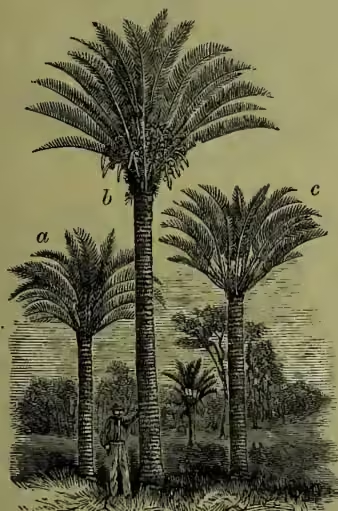
Cycads, or CYCADACEÆ, an order allied to Coniferae (see GYMNOSPERMS), but in vegetative appearance rather resembling ferns and palms. The stem, which is externally covered with leaf-scars, may be so short that the crown of leaves arises little above the surface of the ground; more frequently, however, it rises to a height of a few feet, then resembling a tree-fern; and in exceptional cases (e.g. Cycas media of Australia) may attain a height of 50 or 60 feet. The foliage-leaves, which develop under the protection of reduced bud-leaves, are usually pinnate, and mostly parallel-veined; but in Cycas we have a middle vein only, and in the curiously fern-like Stangeria a mid-vein with lateral branches. The leaves are always of more or less leathery consistence, and sometimes become very hard and spiny at the tips and on the edge. In Cycas off and propagate the plant. In some cases, however, we have an apparent dichotomy, although probably due to branching. Dichotomy of the roots has also been described; this, however, not as a normal development, but due simply to irritation by a fungus-mycelium or a nostoc-like alga, which commonly invests the root, and even penetrates the tissue (see SYMBIOSIS). Yet among those who admit the pathological nature of this, some still regard it as an atavistic reappearance, the last surviving trace of the dichotomy so common among the ancestral cryptogams (see FERNS, Lycopodiaceæ).
The exceedingly primitive flowers are found on separate plants, and are respectively composed simply of staminate or pistillate leaves, in both cases usually spirally aggregated as cones. The stamens are reduced and undivided leaves bearing on their dorsal surfaces a usually indefinite number of pollen-sacs, so furnishing a perfectly intermediate form between the sporangium-bearing frond of a fern and the stamens of higher plants. The pollen-grains show a very distinct remnant of the male prothallium.
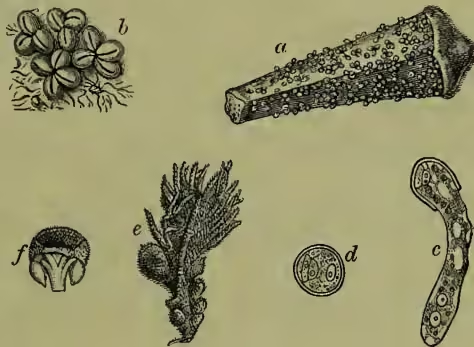
Passing to the female flowers, we find those at least of Cycas to be terminal on the axis, which the pinnæ are circinate in bud as in ferns, although the midrib is straight; conversely in Zamia, the leaf itself is inrolled, although the pinnæ are straight; in others, however, where both are straight, the pinnæ overlap each other from above downwards, as in the moon-wort fern (Botrychium). The stem is of complex internal structure, but is thickened by permanent cambium. It may bear lateral buds on the axils of old leaves, especially in unhealthy plants; and these may fall after flowering resumes vegetative growth, a condition which occurs only as an anomaly or reversion in higher plants (e.g. proliferous roses). The separate carpellary leaves retain more or less distinct traces of vegetative character; thus in Cycas the ovules (microsporangia) represent the reduced lower pinnæ; more frequently, however, only two are developed (Zamia, fig. 2); but the carpellary leaf is always open, and shows no trace of that still more precocious development of its ovules and arrest of its opening altogether, which would give us the ovary of the higher flowering-plants (see OVARY). On ripening, the cone may fall to pieces, liberating the ovules; in the simpler Cycas the separate naked seeds become modified and enlarged into large fruit-like bodies, with an outer fleshy and an inner stony wall. The nucellus is crushed into little space by the growth of the endosperm, which contains the straight embryo with its one (Ceratozamia) or two, often unequal (Cycas, Zamia), cotyledons.
The more vegetative character, both of the flowering axis and of the carpellary leaves, which distinguish Cycas from all the other genera, explains the separation of the order by systematists into Cycadeæ and Zamie. Among the latter, Stangeria of Port Natal is at once distinguished by its pinnate venation; and Bowenia of Queensland by its bipinnate leaves. Dioon (Mexico) is characterised by the origin of its ovules on cushion-like modifications of the two parent pinnae, instead of being simply sessile as in the remaining genera, which are merely distinguished by slight differences in the shape of their cone-leaves. The thirty species of Zamia range from Mexico into the Antilles and far into South America. Ceratozamia is Mexican, and Microcyas Cuban, while Macrozamia is distributed over Eastern Australia, and Encephalartos is characteristically South-east African. But the widest distribution is that of Cycas itself. The best-known species, C. revoluta of Japan, is not only widely found both wild and in cultivation in many parts of the Old and New World, but C. circinalis of the East Indies, C. media and Normanbyana of Australia, C. Seemani of the Fijis, may also be mentioned as of importance.
Schimper enumerates no less than thirty-four fossil genera, with 278 species. The group appears to have attained its maximum in Triassic and Jurassic times. They are familiar to English paleontologists in the Lias and Oolite especially.
The stem of many cycads contains an abundant starchy deposit, which is used as food in many countries. It resembles sago, and so has frequently led to the confusion of cycads with the true Sago-palms (q.v.). C. revoluta yields a coarse sago in Japan and elsewhere; from Dioon edule a kind of arrowroot is prepared in Mexico, and from Zamia pumila, &c. in the Antilles and Florida; while Encephalartos is often called Kafir Bread.