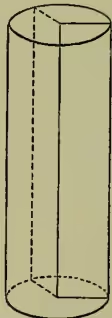
Cylinder (Gr., 'a roller'), a well-known solid whose cross-section at any point of its length gives always the same circle; or, mathematically, a solid generated by the revolution of a rectangle about one of its sides, which line is called the axis of the cylinder. That, the typical cylinder, is frequently called right, and if cut by two parallel planes not perpendicular to the axis, the result is an oblique cylinder, with elliptical ends or sections. The term has also been generalised to include a solid generated by a line moving parallel to a fixed direction while tracing any fixed closed curve. In all cases the content of the cylinder is found by multiplying the number of square units in the base by the number of linear units in the altitude, which is the perpendicular distance between the two ends. The area of the convex surface is equal to the product of the circumference of the end, and the length of the generating line. To this must be added the areas of the two ends, to get the whole surface of the cylinder.