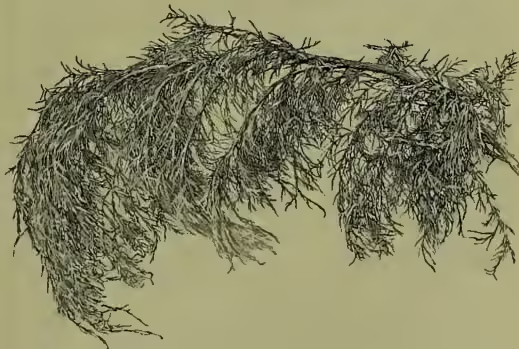
Cypress (Cupressus), a genus of evergreen coniferous trees or shrubs, with small generally appressed and imbricated leaves, and with almost globular cones, the peltate woody scales of which bear numerous hard winged seeds. The best-known species is the Common Cypress (C. sempervirens), a native of the Mediterranean countries, Asia Minor, and Persia, whence it has been introduced into mild localities in Britain. It has two main varieties, one (var. horizontalis) with spreading or drooping branches, forming a flat-topped tree, the other (var. fastigiata) with closely appressed branches like a Lombardy poplar, and capable of attaining a height of 100 feet. On account of its sombre colour yet upward aspect, this variety has been planted since classic times around temples and tombs; in this latter aspect, the drooping variety often took a marked place. The Greeks and Romans put its twigs in the coffins of the dead, they used it to indicate the house of mourning, and planted it about burial-grounds, as is still the custom in the East. The vast Turkish cemeteries, of which European and American cemeteries may be regarded as imitations, are thickly planted with the poplar-like variety, and are often growing into sombre forests. The wood of the cypress is yellow or reddish, and has a pleasant smell. It is very hard, compact, and durable; the ancients reckoned it indestructible; and the resin which it contains gives it the property of resisting for a long time the action of water. It is not liable to the attacks of insects, and being also of beautiful colour and easy polish, was formerly much esteemed for the finest kinds of work in wood, even Cupid's arrows being traditionally made of cypress-wood. Some believe that the cypress is the true cedar-wood of Scripture, and it has also been identified by commentators as the gopher wood of Noah's ark. In any case, cypress and cedar have been prized for shipbuilding in the East from the earliest times. The doors of St Peter's at Rome, made of cypress, lasted from the time of Constantine the Great to that of Pope Eugene IV., above 1100 years, and were perfectly sound when at last removed, that brazen ones might be substituted. Medicinal virtues were formerly ascribed both to the wood and seeds of the cypress, and oriental physicians have long been wont to send patients suffering from chest-diseases to breathe the air of cypress-woods, thus curiously anticipating the western practitioner. The resin has also had medicinal repute from classic times, while the Turks still use also the fruit and bark. The ethereal oil of cypress-wood was also used by the ancients for embalming, and the coffins of mummies were made of the wood.
More common in cultivation in Britain is the extremely hardy C. Lawsoniana, a native of Upper California, but of which there are now many varieties. C. fragrans and maerocarpa, from the same region, are also often cultivated, together with C. thyoides, the White Cedar of Canada, and C. nutkaensis (Thujopsis borealis), the valuable Yellow Cypress of Alaska and Oregon. Among tenderer species are occasionally seen C. lusitanica, the Portugal Cedar, or Cedar of Goa, a native of Goa naturalised in Portugal; C. torulosa, from the Himalaya; C. excelsa and others, from Mexico. The pretty little Retinosporas of Japan, now so common in cultivation, forms for some authors only a sub-genus of cypress, or with some of the preceding (e.g. C. nutkaensis) are separated on account of their two-seeded fruit-scales, as the genus or sub-genus Chamaecyparis.