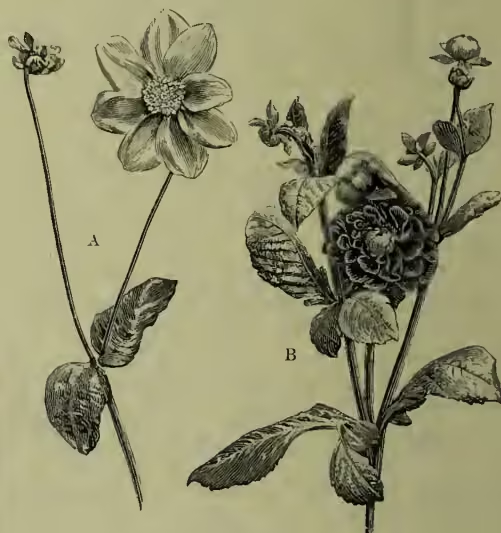
Dahlia (Dahlia Georgina)—after Dahl, a Swedish botanist, and pupil of Linnaeus—a genus of large perennial composites (sub-order Tubulifloræ, family Asteroideæ). It was first brought from the botanic garden of Mexico to that of Madrid in 1784, whence it reached England in 1789, and France in 1802, while in 1804 Humboldt sent a fresh supply of seed to Berlin. Its extraordinary variability soon attracted the attention of florists, who brought to bear on it all the resources of selection and crossing, with so much success that by about the middle of the present century no fewer than 2000 varieties had been described, all from D. variabilis or D. coccinea or their hybrids, and chiefly from the first named. For a long time only 'double' dahlias were cultivated, but of late years the single dahlia, in which the florets of the disc remain tubular, has again come into fashion; while among double dahlias the less regular cactus dahlia is highly esteemed. They are easily cultivated, and propagated by seeds, cuttings, or tubers; but the tubers require to be taken up and stored in a dry place out of the reach of frost. They flower luxuriantly in autumn, until cut off by the first frosts. On account of the quantity of inulin in their tubers, they are cultivated for food in Mexico, but similar attempts in Europe have failed because of their unpalatableness. See Nicholson's or other Dictionary of Gardening, also any florist's catalogue.