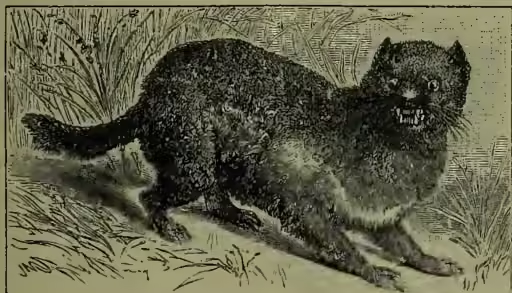
Dasyure (Dasyurus), a genus of carnivorous marsupials, including forms which in the Australian and Tasmanian fauna take the place filled in other regions by carnivores. The large sharp canines, the sharp-pointed cusps on the back teeth, and the clawed toes are among the adaptive carnivorous features, and there are others of a more technical nature. The dasyures are nocturnal and savage animals, and as one would expect, peculiarly untamable. One of the most pronounced is the Tasmanian Devil (D. ursinus), a savage animal, about the size of a badger, with a disproportionately large and broad head, and massive crowded teeth. The body is plump; the fur is coarse and brownish-black, with a white band on the chest, and another at the end of the back; the tail is thick, and about half as long as the body. In Tasmania these 'devils' used to commit great havoc among poultry and even sheep, but are being driven into more and more remote haunts. The Spotted Dasyure (D. maculatus), also Tasmanian, is a much smaller animal, about the size of a cat. Another 'wild cat' of the same country and Victoria is Mauge's Dasyure (D. maugei or viverrinus). Other species occur in Australia and New Guinea. Nearly allied to the dasyures are two genera,
Thylacinus and Phascogale. The former, the Thylacine (q.v.) or Tasmanian wolf, is the largest carnivorous marsupial; the latter is insectivorous. See MARSUPIAL.