Date Palm (Phoenix), a genus of palms, the most important species of which is the Common Date Palm, the Palm Tree of Scripture (P. dactylifera), a native of the northern half of Africa, the southwest of Asia, and some parts of India, and of which the cultivation is no less wide, and still extending.
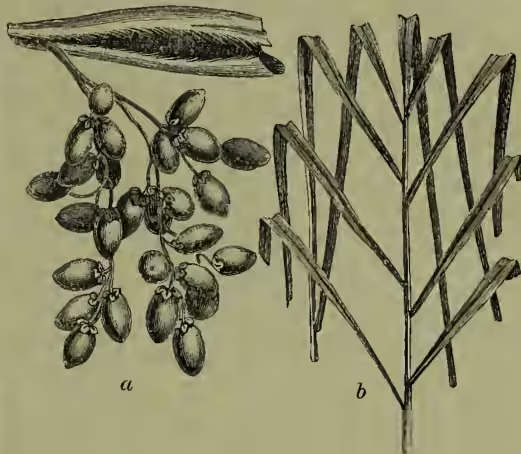
Some parts of China produce large crops. The stem, which is straight and simple, reaches a height of 30 to 60 feet, and bears a head of 40 to 80 glaucous pinnated leaves, of 8 to 10 feet long, and a number of branching spadices, each of which on the female tree bears 180 to 200 fruits (dates, dactyli). A bunch of dates weighs 20 or 25 lb., so that an average year's crop may be reckoned at 300 to 600 lb. per tree, and the yield per acre at about twelve times that of corn. From the earliest times fertilisation has been artificially aided by cutting off the male inflorescences just before the stamens ripen, and suspending them among those of the female tree; so avoiding the risks and losses of ordinary wind-fertilisation. In a palm grove there may be but one male stem to forty or fifty fruit-bearing ones. The Arabs seldom raise palms from seed; to make sure of the sex they take suckers from female trees known to bear good fruit. The tree begins to bear about the eighth year, reaches maturity at about thirty years, and does not decline until about the age of one hundred. This is one of the most important and useful of all the palms. In Egypt, and generally in North Africa, Persia, and Arabia, dates form the principal food, and date palms the principal wealth of the people. The fleshy part of the fruit contains 58 per cent. of sugar, accompanied by pectin, gum, &c. The fruit is eaten either fresh or dried, and in the latter state becomes an article of commerce. Cakes of dates pounded and kneaded together, and so solid as to be cut with a hatchet, are the store of food provided for African caravans on their journey through the Sahara. A sweet juice (date-honey) can be expressed from the fruits, from which a kind of wine is obtained by fermentation; also a sort of vinegar; an ardent spirit is of course also distilled from the fermented juice. Palm-wine is also made from the sap after the terminal bud is removed. The bud is eaten as palm-cabbage, similarly also the undeveloped panicles of flowers. The date 'stones' or seeds are roasted in North Africa as a substitute for coffee, and have also been introduced into Britain for the same purpose. They are also ground and pressed for oil, and the residue used for feeding cattle. From leaf-stalks of the common date palm, all kinds of basket and wicker work are also made, and walking-sticks, fans, &c. The leaves themselves are made into bags, mats, &c.; the fibres of the web-like integuments at the base of their stalks into cordage. The wood is used for building, fences, &c.—The Toddy Palm of the north of India, or Wild Date Palm (P. sylvestris), so nearly resembles this species, that it is doubtful if it is distinct. In some places, the trees present a curiously distorted and zigzag appearance, from the practice of yearly tapping the alternate sides for the sap or toddy. This forms a grateful and wholesome beverage; readily also fermenting into palm-wine, and by distillation yielding Arrack (q.v.); whilst if boiled down it yields the syrup called jaggery, from 4 lb. of which 1 lb. of sugar is obtained, a single tree producing about 7 or 8 lb. of sugar annually. The operation of tapping for toddy spoils the fruit of the tree, which is small and much inferior to the African date. It is, however, eaten.—Another species, P. paludosa, the most gregarious of Indian palms, growing only 6 or 8 feet high, covers the landscape of the Sunderbunds with the liveliest verdure. P. acaulis and P. farinifera are also dwarf and closely allied common Indian species. P. reclinata is a characteristic palm of the Natal coast, and P. spinosa of Sierra Leone, &c. Some derive the origin of the colonnade pillar in architecture to the regular mode of its planting and the use of its stem in building, while in symbolic interest it stands second to no other plant. The symbol of beauty and of victory alike to Hebrews and Hellenes from the earliest times, it passed readily to the suggestion of victory over death and glorious immortality; hence alike the name Phoenix from the fabled bird, and the habit of representing angels and the blessed with palms in their hands. It was largely used also for decoration of festivals, and for strewing in processions. Christ's triumphal entry into Jerusalem is still commemorated on Palm Sunday (q.v.).