Day originally meant the space of time during which it is light, in opposition to the space of darkness or night; it now more usually denotes a complete alternation of light and darkness. It is the earth's rotation that causes the vicissitude of day and night. The earth being a globe, only one-half of it can be lighted up by the sun at once; to that half it is day, while to the other half, which is in shade, it is night. But by the earth's rotation, the several portions of the surface have each their turn of light and of darkness. This happens because the position of the earth is such that the equator is on the whole presented towards the sun; had either pole been towards the sun, that hemisphere would have revolved in continual light, the other in continual darkness.
One complete rotation of the earth does not make a day, in the usual sense. If the time is noted when a particular fixed star is exactly south or on the meridian, when the same star comes again to the meridian the next day, the earth has made exactly one rotation, and the time that has elapsed is called a sidereal day. This portion of time may be regarded as being always of the same length; for the motion of the earth on its axis differs extremely little from absolute uniformity. Hence sidereal or star-time is much used by astronomers. But the passage of a star across the meridian is not a conspicuous enough event for regulating the movements of men in general. It is not a complete rotation of the earth, but a complete alternation of light and darkness that constitutes their day. This, which is called the civil or the solar day, is measured between two meridian passages of the sun, and is about four minutes longer than the sidereal day. The cause of the greater length is this : When the earth has made one complete turn, so as to bring the meridian of the place to the same position among the fixed stars as when it was noon the day before, the sun has in the meantime (apparently) moved eastward nearly one degree among the stars, and it takes the earth about four minutes more to move round so as to overtake him. If this eastward motion of the sun were uniform, the length of the solar day would be as simple and as easily determined as that of the sidereal. But the ecliptic or great circle in which the sun apparently moves, crosses the earth's equator, and is therefore more oblique to the direction of the earth's motion at one time than another; and besides, as the earth moves in her orbit with varying speed, the rate of the sun's apparent motion in the ecliptic must also vary. The consequence is, that the length of the solar day is constantly fluctuating; and to get a fixed measure of solar time, astronomers have to imagine a sun moving uniformly in the celestial equator, and completing its circuit in the same time as the real sun. The time marked by this imaginary sun is called mean solar time; when the imaginary sun is on the meridian, it is mean noon; when the real sun is on the meridian, it is apparent noon. It is obvious that a sun-dial must show apparent time, while clocks and watches keep mean time. Only four times in the year do these two coincide. The difference is called the equation of time, because, when added to or subtracted from apparent time, according as the sun comes too soon or too late on the meridian, it makes it equal to mean time. The mean solar day is divided into twenty-four hours, the hours into minutes and seconds. A sidereal day, we have seen, is shorter; its exact length is 23 hours, 56 minutes, 4 seconds of mean solar or common time. Astronomers divide the sidereal day also into twenty-four hours, which are of course shorter than common hours. In the course of a civil year of 365 days, the earth turns on its axis 366 times, or there are 366 sidereal days. Astronomers reckon the day as beginning at noon, and count the hours from 1 to 24. The civil day begins at midnight, and the hours are counted in two divisions of twelve each. The ecclesiastical day was reckoned from sunset to sunset. The Greeks counted their day from sunset, as did also the Hebrews, the Romans from midnight, the Babylonians from sunrise, the Umbrians from mid-day.
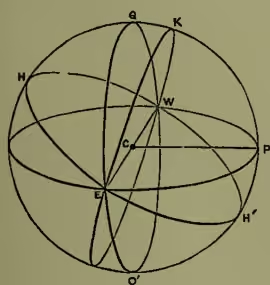
The diagram will explain the variation in the relative duration of light and darkness at different times of the year and different parts of the earth's surface. C represents the position of the earth, P being the north pole of the heavens. E and W represent the east and west points. EQW and EKW are the celestial equator and the ecliptic respectively. Let us suppose the observer to be in the northern hemisphere and that HEH'W is his hor- zon. When the sun is on the equator it is obvious that the arcs EQW and EKW are equal—i.e. the sun is as long above the horizon as it is below it. But, if the sun be in the northern half of the ecliptic, its apparent path is a circle parallel to EQW passing through the sun's position; and more of this circle is above the horizon than below it. Similarly we can explain the appearances for other positions of the sun and of the observer.
Day, as opposed to night, varies with the latitude and the season of the year. As we go north from the equator it increases in summer, and decreases in winter. At the equator, day is a little more, night a little less than twelve hours; at the poles, day is a little more, night a little less, than six months. For the time of day in different countries, see TIME.
A day, in Law, includes the whole twenty-four hours from midnight to midnight. In reckoning periods of time from a certain event, the day on which the event occurred is excluded. On the other hand, if it be required to prove survival for a certain number of days, it will suffice if the person be alive for any portion, however small, of the last day. While an obligation to pay on a certain day would therefore be theoretically discharged by payment before midnight, the law requires that reasonable hours be observed—e.g. if the payment (as a bill) is at a bank or place of business, it must be within business hours.
A lawful day is a day on which there is no legal impediment to the execution of a writ—i.e. all days except Sundays and fast-days appointed by government. Criminal warrants, and in Scotland warrants against debtors in meditatione fugæ, are an exception to this rule, and may be both granted and executed on Sundays and fast-days. By 29 Car. II. chap. 7, all contracts made by persons in their ordinary calling on a Sunday are void. The exceptions to this rule will be explained under LORD'S DAY. In England, Christmas-day and Good-Friday generally stand on the same footing with Sundays and fast-days appointed by royal proclamation; but in Scotland there is no exception made in favour of any of the feast or fast days of the church.
Days of Grace.—The time at which a bill is actually due and payable, except in the case of bills payable on demand or at sight, is three days after the time expressed on the face of it, and these three additional days are called days of grace. If the third day of grace fall on a Sunday, Christmas-day, Good-Friday, or a national fast or thanksgiving day, the bill is payable the day before. If it fall on any of the other bank holidays, or if the last day of grace is a Sunday and the second a bank holiday, the bill is payable on the succeeding business day (see BILL). Days of grace have now been abolished in many countries, but there are still three allowed in the United States, and ten in Russia.