Deaf and Dumb. Persons who are born deaf, or who lose their hearing at a very early age, are dumb also; hence the compound term deaf-and-dumb. But deafness is the primary defect; dumbness is only the consequence of deafness. Children ordinarily hear sounds, and then learn to imitate them—i.e. they learn to repeat what they hear other persons say. It is thus that every one of us has learned to speak. But the deaf child hears nothing; cannot, therefore, imitate, and remains dumb. Persons who lose their hearing later in life are not to be classed among the deaf and dumb. Having learned to speak before their hearing was lost, they can readily communicate with others; and if they are educated, there are still open to them all the stores of knowledge contained in books, from which the juvenile deaf and dumb, ignorant of all written and spoken language, are utterly excluded. It is this latter class alone which is contemplated in our census enumerations, and for which our institutions for the education of the deaf and dumb are designed.
The term 'deaf and dumb' is somewhat unfortunate, as embodying and repeating the error that the affliction is twofold. It affects two organs, certainly, but only, as above described, in the way of cause and effect. The organ of hearing is wanting, but the organs of speech are present; they merely lack the means of exercise. The ear is the guide and directress of the tongue; and when the ear is doomed to perpetual silence, the tongue is included in the ban; though, if we could by any means give to the ear the faculty of hearing, the tongue would soon learn for itself to fulfil its proper office. To correct the error involved in this apparent misnomer, some authorities use the term deaf simply, others speak of the deaf-dumb and deaf-mute. The latter term is common in America, as in France is its equivalent Sourds-muets. In the Holy Scriptures the same original word is translated 'deaf' in some places (as in Mark, vii. 32), and 'dumb' or 'speechless' in others (see Matt. ix. 33, and Luke, i. 22).
This affliction is very much more common than, for a long time, and up to a recent period, it was supposed to be. Happily, however, along with the knowledge of its extensive prevalence, has come the means of alleviating it, by education. It was only when the schools now in existence began their useful work, and caused inquiries to be made, that the actual numbers of the deaf and dumb began to appear. In every place where it was proposed to establish a school—in Paris, London, Liverpool, Manchester, Yorkshire, and in New York—the objection was immediately started that children could not be found in sufficient numbers to require such schools. Their promoters, however, knew better than this, and persisted in their design. They soon had the satisfaction of converting the objectors into their warmest supporters. The facts thus ascertained, and the calculations based upon them, continued to be the only statistics upon the subject of deaf-dumbness in Great Britain and Ireland until the census of 1851, when for the first time the number and ages of the deaf and dumb formed a part of the inquiry.
In 1891 the total number of deaf and dumb persons in England and Wales was 14,192, in Scotland 2125, in Ireland 3365, and in the United Kingdom 19,682—a decrease in proportion to the total population (38,104,975 in the United Kingdom at the same date), as appears from the figures for earlier census years:
| 1851. | |||
|---|---|---|---|
| Number of Deaf and Dumb. | Total Population. | Proportion. | |
| England and Wales ..... | 10,314 | 17,927,609 | 1 in 1738 |
| Scotland ..... | 2,155 | 2,888,742 | 1 " 1340 |
| Ireland ..... | 4,747 | 6,552,385 | 1 " 1380 |
| Islands of the British Seas.. | 84 | 143,126 | 1 " 1704 |
| Total ..... | 17,300 | 27,511,862 | 1 in 1590 |
| 1861. | |||
| England and Wales ..... | 12,236 | 20,066,224 | 1 in 1640 |
| Scotland ..... | 2,335 | 3,062,294 | 1 " 1311 |
| Ireland ..... | 4,930 | 5,798,967 | 1 " 1176 |
| Islands of the British Seas.. | 87 | 143,347 | 1 " 1647 |
| Total ..... | 19,588 | 29,070,832 | 1 in 1484 |
| 1871. | |||
| England and Wales ..... | 11,518 | 22,712,260 | 1 in 1971 |
| Scotland ..... | 2,088 | 3,360,018 | 1 " 1609 |
| Ireland ..... | 4,467 | 5,412,377 | 1 " 1211 |
| Islands of the British Seas.. | 77 | 144,638 | 1 " 1878 |
| Total ..... | 18,150 | 31,629,293 | 1 in 1742 |
| 1881. | |||
| England and Wales ..... | 13,395 | 25,974,439 | 1 in 1953 |
| Scotland ..... | 2,142 | 3,735,573 | 1 " 1744 |
| Ireland ..... | 3,993 | 5,174,836 | 1 " 1296 |
| Islands of the British Seas.. | 88 | 138,791 | 1 " 1577 |
| Total ..... | 19,518 | 35,023,639 | 1 in 1794 |
The increase of population in 1861 above that of 1851 was millions, and the number of deaf and dumb had also increased; but although the population in 1871 had increased by millions above that of 1861, the returns show a large decrease in the proportion of deaf and dumb. A further increase of population in 1881 of millions still shows a diminution in the proportion of deaf and dumb; there was only a total increase of 1368 deaf and dumb. We can only attribute this to more extended and improved sanitary measures, advanced knowledge in medical treatment, and more careful nursing of children when suffering from those diseases which so frequently result in deafness.
But while social science is prosecuting its important inquiries into the causes, inevitable and preventable, of deafness, Philanthropy has before her the work of educating these 'children of silence,' to whom the ordinary means of instruction are obviously inapplicable, and for whom, until little more than a century ago, there existed scarcely any available means of education at all. The deaf are spoken of frequently in the writings both of the Old and New Testaments; they are alluded to by the poets, philosophers, and lawgivers of antiquity; yet we have no account of any attempt at educating them until the 15th century; no school existed for them until the middle of the 18th; nor could it be said that education was freely offered, and readily accessible, until within the last fifty or sixty years.
Some isolated attempts had been made before the 18th century, by different men, in different countries, and at long intervals, to give instruction to one or two deaf and dumb persons, and their endeavours were attended with various degrees of success. These several cases excited some attention at the time; but after the wonder at their novelty had subsided they seem to have been almost forgotten, even in the countries where the experiments were made. Bede speaks of a dumb youth being taught by St John of Beverley (q.v.), to repeat after him letters and syllables, and then some words and sentences. The fact was regarded as a miracle, and was classed with others alleged to have been wrought by the same hand. From this time, eight centuries elapsed before any record of an instructed deaf-mute occurs. Rodolphus Agricola, a native of Gröningen, born in 1442, mentions as within his knowledge the fact that a deaf-mute had been taught to write, and to note down his thoughts. Fifty years afterwards, this statement was controverted, and the alleged fact pronounced to be impossible, on the ground that no instruction could be conveyed to the mind of any one who could not hear words addressed to the ear. But the discovery which was to give the key to this long-concealed mystery was now at hand. In 1501 was born, at Pavia, Jerome Cardan (q.v.), a man of great but ill-regulated talents, who, among the numerous speculations to which his restless mind prompted him, certainly discovered the theoretical principle upon which the instruction of the deaf and dumb is founded. He says: 'Writing is associated with speech, and speech with thought; but written characters and ideas may be connected together without the intervention of sounds,' and he argues that, on this principle, 'the instruction of the deaf and dumb, though difficult, is possible.' All this, which to us is obvious and familiar, was a novel speculation in the 16th century. With us it is a common thing for a man to teach himself to read a language, though he cannot pronounce it. There are, for instance, hundreds of persons who can read French, who do not and cannot speak it. Now it is evident, in this case, that written or printed words do impart ideas independently of sounds, yet this was a discovery which the world owes to Jerome Cardan; and it was for want of seeing this truth, which to us is so familiar, that the education of the deaf and dumb was never attempted, but was considered for so many centuries to be a thing impossible.
It was in Spain that these principles were first put into practice by Pedro Ponce (1520-84), a Benedictine monk, and again, in the following century, by another monk of the same order, Jnan Paulo Bonet, who also published a work upon the subject, which was the first step towards making the education of the deaf and dumb permanent, by recording the experience of one teacher for the instruction of others. This book, published in 1620, was of service to De l'Epée a hundred and forty years later; and it contains, besides much valuable information, a manual alphabet identical in the main with that one-handed alphabet which is now in common use in the schools where the alphabet is used, on the Continent and in America. His own system of teaching, however, like that of every teacher in every country before De l'Epée, was in the main oral. The practicability and adaptability of signs, for conversation rather than teaching, had occurred to several of the earlier teachers, but De l'Epée was the first to adopt them as a distinct medium, and the chief medium, of teaching; and so to establish them as a language. Bonet himself says of the manual and written alphabets that they 'should be associated with speech, by pointing to the letter as written with the finger corresponding with the same letter in the manual alphabet and the articulated sound.' He also describes the positions and movements of the vocal organs necessary in pronunciation, as he himself used them, and as, with little variation, Wallis and Amman used them also in later times, believing themselves to have been the original inventors of the methods they employed. From the time of Bonet there was a general awakening of the attention of intellectual men, not only to the importance of the subject, but to the practicability of instructing the deaf-mute. One of Bonet's pupils was seen by Charles I., when Prince of Wales; and the case is described by Sir Kenelm Digby, who met the prince in Madrid, during his memorable matrimonial journey to Spain (1623). Of this pupil, a younger brother of the Constable of Castile, Sir Kenelm gives an interesting account in his Treatise of Bodies, how he 'would repeat after anybody any hard word whatever'—not Spanish merely, but English, and even Welsh.
When the art died away in Spain, it was taken up by Englishmen, and began forthwith to assume an entirely new aspect. Dr John Bulwer published, in 1648, his Philocophus, or the Deafe and Dumbe Man's Friend, in which he speaks of a 'lip-grammar, which may enable you to hear with your eye, and thence learn to speak with your tongue.' Bonet also found in the course of his experience that lip-reading reached a much greater utility than he had, at the outset, thought it capable of. It has been described as the backbone of the oral system. It is the conviction arising from experience, which has in our own days, and in nearly every country, in Italy and France especially, made some of the most eminent sign-teachers the chief advocates of the oral system. Dr William Holder published his Elements of Speech, with an Appendix concerning Persons Deaf and Dumb, in 1669; and Dr John Wallis, Savilian Professor of Mathematics in the university of Oxford, both taught the deaf and dumb with great success, and wrote copiously upon the subject. In 1662 one of the most proficient of his pupils was exhibited before the Royal Society, and in the presence of the king. The Philosophical Transactions of 1670 contain a description of his mode of instruction, which was destined to bear ample fruits long after his death.
Before the close of the 17th century many works of considerable merit appeared, the chief of which are the Surdus Loquens (1692) of John Conrad Amman, a physician of Haarlem; and the Didascalocophus, or Deaf and Dumb Man's Tutor, of George Dalgarno (q.v.). This treatise, published in 1680, and reprinted in 1834 by the Maitland Club, is eminently sound and practical, which is the more remarkable, as the author speaks of it as being, for aught he knows, the first that had been written on the subject. He is the first English writer who gives a manual alphabet. The one described by him, and of which he was the inventor, is, most probably, the one from which the present two-handed alphabet is derived. Henry Baker (q.v.) about 1720 introduced an improved system of his own; in 1765 the Abbé de l'Epée established his little school in Paris; and five years previously, the first school in the British dominions had been started in Edinburgh by Thomas Braidwood (q.v.). He commenced with one pupil, the son of a merchant in Leith, who had strongly urged him to carry into effect the plan of instruction followed by Dr Wallis, and described in the Philosophical Transactions ninety years before. His school, the parent and model of the earlier British institutions, was visited and spoken of by many of the influential men of that day, and its history and associations are imperishable. Its local name of 'Dumbiedykes' suggested to Sir Walter Scott a designation for one of his most popular characters in the Heart of Midlothian. A visit paid to it in 1773, by Dr Johnson, and his biographer Boswell, supplies one of the most suggestive and characteristic passages in the Journey to the Western Islands, in which he speaks of Henry Baker and his unpublished work. In 1783 Braidwood removed to Haekney, near London, and the presence of his establishment so near to the metropolis undoubtedly led to the foundation of the London Asylum in 1792. Dr Watson, its first principal, was a nephew, and had been an assistant, of Braidwood; and he states that, some ten or fifteen years previously, the necessity for the establishment of a public institution had been plainly seen, and some few but insufficient steps taken towards the accomplishment of such a design. From its foundation in 1792 until 1829, it was directed with great ability by Dr Joseph Watson, author of Instruction of the Deaf and Dumb.
The numbers of deaf and dumb children at school in the United Kingdom, at the dates given, were as follows:
| 1851. | 1861. | 1871. | 1881. | 1885. | |
|---|---|---|---|---|---|
| England and Wales.. | 816 | 1001 | 1200 | 1782 | 1991 |
| Scotland..... | 250 | 240 | 301 | 386 | 412 |
| Ireland..... | 234 | 399 | 478 | 545 | 555 |
| Total..... | 1300 | 1640 | 1979 | 2713 | 2958 |
In 1895 the schools for the deaf and dumb certified under the Elementary Education (Blind and Deaf Children) Act of 1893 provided accommodation for 2755 deaf children (1155 day-scholars and 1600 boarders) in England and Wales, and in Scotland for 525 children. In Ireland the number of deaf and dumb children receiving education is somewhat larger than in Scotland.
In England and Wales there are some 25 public institutions for deaf and dumb, and several private ones. The oldest is that of Old Kent Road, London, founded in 1792, and now at Margate; the next, that at Edgbaston, Birmingham, in 1812. In Scotland there are 8, that in Edinburgh dating from 1810; in Ireland 4, one in Dublin founded in 1816. In the United Kingdom there are about 50 schools and classes, with 250 teachers and 3800 pupils. In the United States there are over 60 schools, with 7500 pupils and 600 teachers; in Germany, 96 schools, with 5892 pupils under 595 teachers; in France, 70 schools, 3655 scholars, and 364 teachers; in Italy, 35 schools, 1500 pupils, and 238 teachers. If to these we add the schools in Austria, 18; Switzerland, 15; Sweden, 17; Norway, 8; Russia, 11; Belgium, 11; Spain, 7; Holland, 3; Canada, 7; Australia, 3; with others in New Zealand and Cape Colony, and one at Bombay (the only one in Asia), it will be evident that the schools throughout the world must be about 500 in number.
It is to the 19th century that the honourable distinction belongs of having done so much for the deaf and dumb. This has not been by inventing the art of teaching, or by raising up the earliest labourers in this field of usefulness, but by founding and supporting public institutions for this purpose. De l'Épée, when he opened his school in 1765, had no foreknowledge of the work he was commencing. As his labours increased, he invited others to his assistance, and they were thus enabled to carry the light of instruction elsewhere, and to keep it alive when he was no more. His death took place in 1789, and his assistant, Sicard, succeeded him. Four years afterwards, the school was taken over by the French government, and now exists as the Institution Nationale of Paris. A pupil of this institution, M. Laurent Clerc, went in 1816 to the United States with Mr Thomas Hopkins Gallaudet (1787-1851), the founder and first principal of the American asylum, who in the New World became, like De l'Épée, 'the father of the deaf and dumb.'
There is some diversity of opinion as to which is the best kind of school for the deaf—the boarding or the day school. And with this question is involved, to some extent, the question of systems of instruction. Until the introduction of the oral system from Rotterdam in 1867, and the establishment in 1874 of the classes for the deaf in the ordinary schools by the School Board for London, all the institutions in Great Britain were boarding-schools. Of the two systems—by congregation or by separation—the former, the boarding-school system, is upheld by its advocates for its advantages of continuous teaching, influence, and discipline. These they hold to be of special necessity for the deaf, and not to be attainable, generally, under the day-school system. The latter system is accepted by some, but only as a necessity—not the best to be hoped for, but the best which can be got. Others defend separation, and oppose congregation altogether, on the ground that with the oral system it is the best, absolutely; that the pupils, being taught to speak in order to prepare them for the world, ought to live in the world, and so to bring into constant exercise and practice what they have been taught. Living at home or boarding out in families is therefore advocated and adopted, on this ground, in London and in various large towns on the Continent, though in many places where the oral system finds its strongest supporters the boarding-school is still retained. The possible danger to life and limb in passing through crowded streets alone, has combined with other reasons to produce in London the establishment of homes for deaf children—where they are boarded, lodged, and cared for, and receive their education in a conveniently adjacent school-board class. These homes, now occupying seven separate houses, were established by the Rev. Dr William Stainer. They are largely made use of by Boards of Guardians and others, and are called by the founder's name.
The mental condition of the deaf and dumb is so peculiar—so entirely unlike that of any other branch of the human family—that it is extremely difficult, without very close thought, to obtain an accurate conception of it. While almost every one will readily admit that there is a wide difference between a deaf and a hearing child, very few, who have not had their attention specially drawn to the subject, possess any adequate notion of the difference, or could tell wherein it consists. Sometimes the deaf are compared with the blind, though there exists no proper ground of comparison between them. Except that the blind are more dependent than the deaf and dumb, the relative disadvantages of the two classes do not admit of a moment's comparison. The blind can be talked with and read to, and are thus placed in direct intercourse with the world around them: domestic converse, literary pleasures, political excitement, intellectual research, are all within their reach. The born-deaf are utterly excluded from every one of these. The two affictions are so essentially dissimilar, that they can only be considered and spoken of together by way of contrast. Each of them affects both the physical and the mental constitution; but blindness, which is a greater physical affliction, falls less severely on the mind; while the effect of deafness is the extreme reverse of this—it touches only one bodily organ, and that not visibly, but the calamity which befalls the mind is one of the most desperate in 'the catalogue of human woes.' The deprivation under which the born-deaf labour is not merely, or so much, the exclusion of sound, as it is the complete exclusion of all that information and instruction which are conveyed to our minds, and all the ideas which are suggested to them, by means of sound; as it is through sound alone, in the first instance, that we all learn language, the medium of all knowledge. The deaf know almost nothing, because they hear nothing. We, who do hear, acquire knowledge through the medium of language—through the sounds we hear, and the words we read—every hour. But as regards the congenitally deaf, speech tells them nothing, because they cannot hear; and books teach them nothing, because they cannot read; so that their original condition is far worse than that of persons who 'can neither read nor write' (one of our most common expressions for extreme ignorance); it is that of persons who can neither read, nor write, nor hear, nor speak; who cannot ask you for information when they want it, and could not understand you if you wished to give it to them. Your difficulty is to understand their difficulty; and the difficulty which first meets the teacher is, how to simplify and dilute his instructions down to their capacity for receiving them.
A class thus cut off from all communication through the ear, can only be addressed through the eye (1) by means of objects, or representations of them, or by the visible language of pictures, signs, and gestures; (2) the finger-alphabet (or Dactylogy) and writing, which make them acquainted with our own written language; or (3) articulation and reading on the lips, which introduce them to the use of spoken language. The education of the deaf and dumb must be twofold—you must awaken and inform their minds by giving them ideas and knowledge, and you must cultivate them by means of language. Where the oral system is employed, the deaf child is taught by spoken language as other children are. Where the combined system is in use, a knowledge of things is conveyed by the use of signs; but to this must be added a knowledge of words. These pupils are therefore taught, from the first, that words convey the same ideas to our minds as pictures and signs do to theirs; they are therefore required to change signs for words until the written or printed character is as readily understood as the picture or the sign. This, of course, is a long process, as it has to be repeated with every word. Names of visible objects (nouns), of visible qualities (adjectives), and of visible actions (verbs), are gradually taught, and are readily acquired; but the syntax of language, abstract and metaphorical terms, a copious diction, idiomatic phrasology, the nice distinctions between words called synonymous, and those which are identical in form but of different signification—these are far more difficult of attainment; they can only be mastered through indomitable perseverance and application on the part of the pupil, in addition to the utmost skill and ingenuity of the teacher. The wonder, therefore, surely is, seeing the point of starting, that this degree of advance- ment is ever reached at all on the sign system; though oral teachers maintain that on their system it is attained readily, in a manner similar to that of hearing children.
Yet it has been set forth by otherwise respectable authority, that the deaf and dumb are a 'gifted race;' that they are remarkable for 'their promptitude in defining abstract terms;' and those who ought to have known better have strengthened this delusion by putting forth, as the bond-fide answers of deaf-mutes, those brilliant aphorisms and definitions of Massieu and Clerc, which are so often quoted at public meetings by eloquent speakers who know nothing of the subject. It is very well known to those who are acquainted with the subject, that the so-called definitions of Hope, Gratitude, Time, Eternity, &c., were not Massieu's at all, but those of his master, the Abbé Sicard. The influence of these fallacies has been most mischievous; they raise expectation to a height which is unreasonable, for it is thought that what was done by 'the celebrated pupil of the Abbé Sicard' may be done every day; and disappointment is the inevitable consequence. The honest, laborious teacher who cannot produce these marvellous results, and will not stoop to deception, has often to labour on without that appreciation and encouragement which are so eminently his due; the cause of deaf-mute instruction suffers; and a young institution is sometimes crippled by the failure of support, which was first given from one impulse, and is now withdrawn from another—not a whit more unreasonable than the first, but very unfortunate in its consequences.
In 1886 the education of the deaf and dumb was referred to the investigation of a Royal Commission which has instituted far-reaching inquiries, whose valuable report appeared in 1889. But the most striking feature of all has been the rapid diffusion of the pure oral system. Originally confined to Germany and Holland, it has since 1867 spread over western Europe and America, sometimes forming by itself the sole principle of instruction, and sometimes, though against the views and protests of its principal advocates, in combination under the same roof with the sign or manual system. It was introduced into London in 1867, at the instance of the late Baroness Meyer de Rothschild, and applied by Mr Van Praagh, at the Jews' Deaf and Dumb Home. In 1871 it was extended by the establishment of the 'Oral Association,' whose school and training college, placed under the direction of Mr Van Praagh, are in Fitzroy Square. In 1877, by the efforts and influence of Mr B. St John Ackers, the training college and school was founded which has its headquarters at Ealing, and of which one of the chief objects was the diffusion of the 'German' system in the United Kingdom. The college of teachers was established later, in 1885. It has had a successful career. Nearly every head-master in the kingdom is a member, and it has attracted a large number of the younger teachers to its examinations, all of whom are required to pass in subjects set by the heads of the profession, including the ability to teach on the oral system. This method, advocated by the means already named, had been prosecuted with great zeal and much success, but was wonderfully accelerated by the international congress held at Milan in September 1880. Here the pure oral system was stamped with almost unanimous approval, and its acceptance, either wholly or partially, speedily followed in every country in Europe and some more distant regions. It was at once adopted in the three national institutions of France—the birth-place and cradle of the sign or French system; and by 1884 more than 60 per cent. of all the known schools in the world had proclaimed their full adoption of it. In Germany, Austria, Hungary, Luxemburg, the Netherlands, and Switzerland its adoption was universal; in Italy it prevailed in 34 out of 35 schools; and in Norway in 6 out of 7. In other words, it was the system in actual practice in all the schools of some countries, in nearly all of other countries, and in a continually increasing number in every country where the deaf are taught at all.
The oral system, discarding signs and the manual alphabet as instruments of teaching and as means of communication, employs speech and lip-reading for these purposes. The child is taught (a) to speak by seeing how his teacher speaks; (b) to lip-read—that is, to read the speech of his teacher and others as expressed upon their lips; and to understand so much of this as is co-extensive with his own knowledge of language, to which he is of course adding daily and hourly by means of speech. Instruction comes to him by the spoken and written language of the hearing, not by the signs and gestures of the deaf. Thus, he speaks, he lip-reads, and he has books opened to him. The first attainment, striking as it is, is as nothing to the second, and the second is inferior to the third. It cannot be too clearly understood that the greatest and most certain of all these advantages is the last-named. The acquirement of speech may be more or less perfect, therefore more or less uncertain as a means of communication; but the ability to read the lips of other persons does not depend on this, and it is much the more valuable of the two, because by this means the mind which is full is laid open for the information of the mind comparatively empty. But the ultimate attainment—the command of books and literature afforded by the mastery of language—is, in regard to intellectual cultivation and moral guidance, incomparably the most valuable acquirement of all, however gained. Nothing is to be compared with this as a means of breaking down the barrier and bridging over the gulf which separates the deaf from the hearing—the most formidable and at first sight the most impassable which can separate man from man. By way of illustration, it has been said that the mental condition of the born-deaf, without education, is blank imprisonment in the most awful solitude; that the sign system removes this to the extent of enabling the captives to associate with each other; while the pure oral system throws open the doors of their captivity, and sends them out to take their part in the life and action of the world around them.
The modes of teaching on the oral system are not everywhere uniform, though the principles are the same. These methods vary to some extent in different countries, being influenced by the character of the language, and are essentially traditional. Some eminent authorities teach the vowels first, others the consonants; the simple combinations follow, afterwards those which are less simple, and then short phonetic words, leading on to simple sentences. The vocal organs are trained to pronounce and the eye to observe (i.e. to lip-read) simultaneously. It is gravely erroneous to suppose that teaching speech is all that is meant by teaching on the oral system. Its advocates say that, with pupils properly taught, lip-reading, articulation, and writing are simultaneous. One branch is not allowed to get ahead of the other. To acquire a new word, the pupil first reads it from his teacher's lips; he is next taught to pronounce it himself, and then to write it down. On this principle the whole course of instruction is carried out. The system, to be successful, demands its own conditions, of which a longer school term (eight years at least), an earlier commencement (at the age of seven or younger), smaller classes (of not more than eight or ten), teachers trained specially to the work, and the exclusion of signs and the manual alphabet are held to be indispensable. The growth and decadence of the sign system is historic. It came in after 1760. It then took hold and grew, and maintained its ascendancy for nearly a hundred years, when the reaction began which has marked our own times. Before 1760 there were no public schools; all teaching was individual and private, and it was oral. After 1765, when De l'Epée had a school of sixty children and no assistants, it is no wonder that he gave his preference to signs, whereby the pupils could help to teach each other, and he could address them all at once. So speech was abandoned, except in some favourable cases as an accomplishment; signs became the language of deaf-mutes, teachers were few and inadequate, a large proportion of them efforts, succeed in rising to the level of those that hear, yet the efforts made are themselves improving, and habitual practice is still more so; whereas the practice of signing is distinctly lowering and hindering. Those taught by signs think in signs; those taught by speech think in words. The mixture of the two is injurious; translation from signs to words produces confusion; signs invert language, and when the two systems are placed together signs become the dominant power, and speech the lesser one; then comes in a combined system in which the oral system stands degraded, of which it has been said, to degrade it is to kill it. Natural signs—the signs which all hearing persons understand—are allowed to be used for purposes of explanation, and some authorities permit the use of the manual alphabet as well, because what is conveyed by the manual alphabet is identical with language, and not, like conventional signs, an imperfect substitute for it. But the inflexible advocates of the pure oral system condemn and exclude signs and the manual alphabet altogether. Signs, they say, are at best but a 'baby language,' wedded to which the mind cannot grow, and with which, alone, intellectual maturity can never be attained.
Excellent work for the deaf and dumb has been done in the United States. The institutions there are munificently supported by grants from the states, and are admirably managed. The staff of teachers is numerous, able, and efficient, and a high degree of success is attained where the work is carried on under advantages which are unknown in the schools of Great Britain. At Washington a college was established in 1864, under the presidency of Dr E. M. Gallaudet, the youngest son of the founder of the American Asylum. It is empowered by the United States government to confer degrees, and has expressed this power by conferring the title of Doctor upon four prominent experts in Great Britain—Messrs Charles Baker and D. Buxton in 1870, and R. Elliott and W. Stainer in 1887. The same honour was conferred in 1880 upon Professor A. Graham Bell. The inventor of the telephone, he is also well known by his interest in the education of the deaf on the oral system, of which he is one of the most eminent and influential advocates. That advocacy is mainly based on educational grounds, but also as a check to the evils arising from the congregation of the deaf and dumb together in institutions—their general association with each other, their frequent intermarriages, the consequent excess in the births of deaf-mute children, and the danger, by no means visionary, he insists, of 'the formation of a deaf variety of the human race.' In New York the Rev. Dr Thomas H. Gallaudet, vicar of St Anne's, in 1852 started services in his church in the sign language, and in 1872 organised a mission to promote the temporal and spiritual welfare of adult deaf-mutes in other cities of the Union. In London St Saviour's church was built to meet the same necessity, and religious services have been conducted there by successive chaplains. Another clergyman and several laymen conduct similar services in various parts of the metropolis. In Liverpool, Manchester, Edinburgh, Glasgow, and Dublin, also in Birmingham, and the large manufacturing towns of Yorkshire, special funds are raised, and special agents employed, to promote in like manner the social and religious benefit of deaf and dumb.
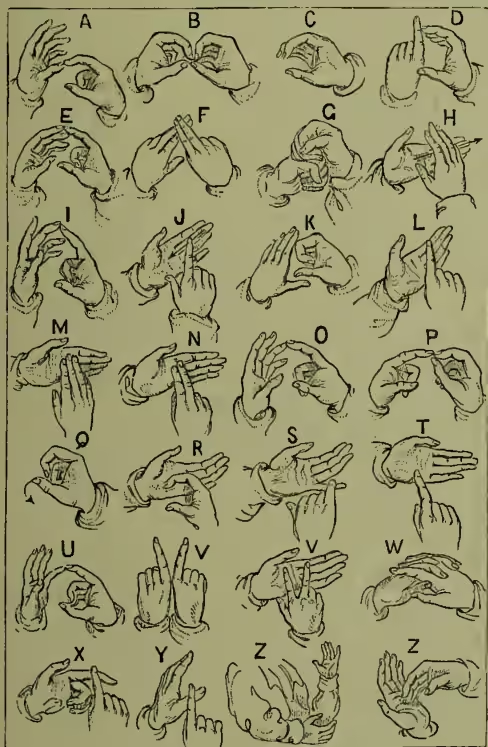
The contentions between the rival systems have been carried on with much vigour and spirit in numerous articles, reports, and pamphlets; and education has been promoted by the publication of lesson-books such as those of Dr Harvey P. Peel of New York, and of Moritz Hill of Weissenfels (trans. by Stainer). See, besides the report of the Royal Commission above mentioned, the Manual were deaf themselves, teaching deteriorated, and interest languished. Meanwhile, the best men did the best that was possible with an imperfect instrument. The sign system was such an instrument, and what was within its capabilities they did devotedly and did well. But with the superior instrument, the oral system, applied with the same energy and zeal, higher results have been reached, notably, in many instances, by the same men.
Though they have worked on each method as it came before them, there never was in the minds of the most experienced teachers any doubt as to the superiority of speech over signs. The question was never, which system is the best? but which system is the most practicable in large schools? It is obviously better that deaf persons should use the speech common to everybody than the language of nobody but themselves. Until seventeen hundred people go out of their way to learn the language of one, the deaf minority must stand isolated in the world, shut up with each other. Though such as have learned to speak may not, with all their on the Education of Deaf Mutes by T. Arnold (1872) and his Method (1881); W. R. Scott, The Deaf and Dumb (1870); J. A. Seiss, The Children of Silence (Phila. 1888); French books by Ordinaire (1836), Dubranle (1884), Dupont (1884), Goguillot (1889), Denis (1886), and Drouot (1896); and German books by Hill (1867), Schöttle (1874), Hartmann (1880), Walther (1882 and 1895), Schmaltz (1884), Gude (1880), Heidsiek (1889), Hedinger (1884), Vatter (1892), Mygind (trans. 1894), and Bezold (1896).