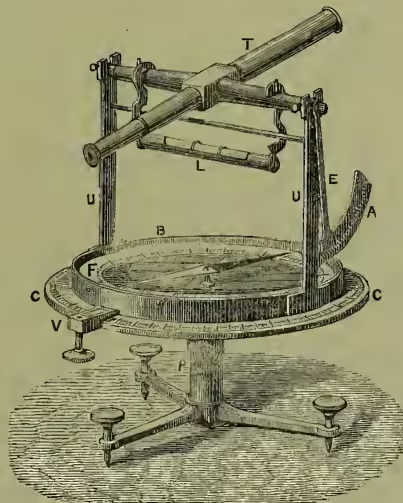
Declination Needle, or DECLINOMETER. The magnetic meridian passing through any place on the earth's surface is a vertical plane whose direction is that in which a magnetic needle, free to move about a vertical axis, comes to rest under the influence of the earth's magnetic force. In general, the magnetic and geographical (or astronomical) meridians are not coincident; the angle between is termed the magnetic declination, or (in nautical phraseology) the variation. It is east or west, according as the magnetic is east or west of the geographical meridian. Any apparatus for the measurement of this angle is termed a declinometer, and consists essentially of a means of ascertaining the two necessary elements—viz. the directions, at the place of observation, of the two meridians. The accompanying figure represents one such instrument, the declination needle or compass. Upon a tripod, provided with levelling screws, stands the pillar P, to which is fixed the graduated circle CC. The compass-box B, with the attached verner V, moves on the azimuthal circle by means of a pivot on the pillar P. Two uprights, U, U, are fixed to the side of the compass-box, on the tops of which rests the axis of the telescope T. A graduated arc, A, is fixed to the bottom of one of the uprights, and the angle of elevation of the telescope is marked by the verner on the arm E, attached to the axis of the telescope, on which is hung the level L, for adjusting the instrument previous to making an observation. Inside the compass-box is another graduated circle F, the line joining the zero-points of which is parallel to the axis of the telescope. The compass-box and telescope thus move round together on an axis passing through the centre of the azimuthal circle. When an observation is made, the instrument is first of all levelled, and the telescope directed to a star which is either on the astronomical meridian or whose position with respect to it is known. The reading of the inner circle then gives the declination at once, in the former case; if the latter—i.e. if the star be not on the meridian, the reading of the inner circle has to be corrected by adding or subtracting, as the case may be, the position of the star in azimuth, in order to give the declination. In order to obviate error due to the non-coincidence of the magnetic and geometric axes of the needle, a second reading is taken with the face of the needle reversed; the mean of the two readings is taken as the true declination.
It is found, however, that this instrument only gives results approximately correct, and has in consequence been superseded in observatories and magnetic surveys by a form of the unifilar magnetometer. For an account of the determination of declination by this latter instrument, see MAGNETOMETER. Details as to the value and secular change of the declination at different places on the earth's surface will be found under MAGNETISM.