Dervish, signifying 'poor,' is a Persian word (derived from a root connected with 'door,' indicating the door-to-door mendicancy of the dervish) of which the Arabic equivalent is Fakîr (q.v.). It designates, in Mohammedan countries, a class of devotees who correspond in their various aspects with the monks, the mendicant friars, and the freemasons of medieval Europe. Some are wanderers, depending upon alms, and often demanding charity with insolence; others are settled for the most part in convents, called Tekyas or Khânkâs, where they observe special rites, or devote themselves to solitary meditation and penance; others, again, are more like freemasons—ordinary tradesmen and labourers for most of the year, and exercising their special ceremonies only on stated occasions; whilst some, again, form a class of religious entertainers, who are hired out to chant their monotonous dirge or Zikr at public and private festivals. They belong to an infinity of orders or brotherhoods, among which the best known are the Kâdiris (commonly known in Europe as the 'howling dervishes,' on account of their peculiar chant), founded 1165 A.D.; the Rifâ'is (1182), formerly famous for their feats of eating glass and live coals and swallowing swords, and also for the ceremony, recently abolished, of the Dôseh, where the sheikh of one of their sub-orders (the Sa'dis) rode over the prostrate bodies of the faithful in the streets of Cairo; the Mevlevis (1273), or 'dancing'—i.e. whirling—dervishes; the Nakhshibendis (1319); Bektâshis (1357), whose founder blessed and named the famous corps of Janizaries (q.v.); the Jemâlis (1750); and the Kalenderis, the 'calendars' of the Arabian Nights, who are under a vow of perpetual tramping: the names are taken from those of their founders.
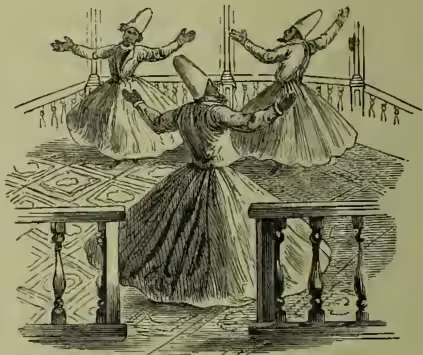
The various orders have distinctive dresses, and the sheikh or pir who commands them is also distinguished from his followers by his robes. The conical cap of the Mevlevi is well known. The rites of the different orders when they meet together vary, but consist chiefly in prayers, religious dances, monotonous recitations of the name of God and of certain pious formulas. Frequently the devotees work themselves into a state of spiritual frenzy which is accompanied by extravagant, and, to the vulgar, miraculous, feats of strength and endurance, and not unfrequently terminates in an epileptic seizure. The dervishes and their performances are held in the deepest veneration by the people, and sultans have often held them in high respect, and bestowed large endowments upon their tekyas.
It is difficult to say when these religious orders took their rise. From the earliest times, pious persons in the East have held it to be meritorious to renounce earthly joys, to free themselves from the trammels of domestic and social life, and to devote their thoughts in poverty and retirement to the contemplation of God. In this sense, poverty is recommended by Mohammed in the Koran, though monachism is distinctly repudiated. Tradition refers the origin of these orders to the earliest times of Islam, making the califs Abû-bekr and 'Ali found such brotherhoods; but most of them are of much later date. See Lane, Modern Egyptians, chap. x.; Hughes, Dict. of Islam; D'Ohsson's Tabl. Gen. de l'Empire Ottomane.