Dial and Dialling. A sun-dial is an instrument for measuring time by means of the motion of the sun's shadow cast by a stile erected on its surface. It is an instrument of very great antiquity, and before clocks and watches became common, it was in general use as a time-keeper. Some old sun-dials are very elaborate—e.g. that at Glamis Castle, Forfarshire; and many bear quaint mottoes (cf. Leisure Hour, 1870, p. 413; and Mrs Gatty's Book of Sun-Dials, 4th ed. 1900). Dial-making was then an important branch of mathematical study; now it is more an object of curiosity than utility. A dial consists of two parts—the stile or gnomon, usually the edge of a plate of metal, always made parallel to the earth's axis, and pointing towards the north pole; and the dial-plane, which may be of any hard substance, and on which are marked the directions of the shadow for the several hours of the day, their halves, quarters, &c. Dials receive various names, according mostly to the positions which they are constructed to occupy. When the dial-plane is on the plane of the horizon, the dial is called a horizontal dial; when perpendicular to that plane, a vertical dial. An equinoctial dial is one whose plane is parallel to the equinoctial plane. The south dial, north dial, east dial, west dial, polar dial, declining dial, are named from the position of the dial-plane. The cylindrical dial is a dial drawn on the curved surface of a cylinder. The ring dial is an ingenious small portable dial, but rather a curious toy than a philosophical instrument. A night or nocturnal dial is an instrument for showing the hour of the night by the shadow of the moon or stars. Moon-dials may be constructed relative to the moon's motion; or the hour may be found by the moon's shadow on a sun-dial. But because of the irregularity of the moon's motion, due to its varying speed at different parts of its orbit, the time so found is subject to considerable error.
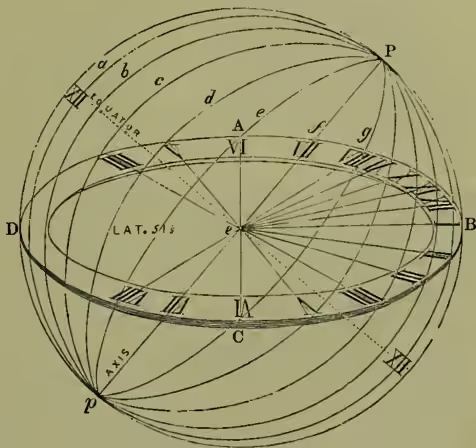
Dialling.—The stile of a dial being parallel to the earth's axis, those familiar with spherical trigonometry will readily see that the problem of constructing a dial resolves itself into that of ascertaining where the hour-lines cut a given circle, with a view to the graduation of the dial-plane. Suppose Pep (fig. 1), a hollow and transparent sphere, as of glass, to represent the earth; and suppose its equator divided into 24 equal parts by the meridians a, b, c, d, e, f, g, one of them passing through a given place, say London (see HORIZON), at the point a. If the hour of twelve be marked at the equator, both on the latter meridian and that opposite it, and all the rest of the hours in order on the other meridians, those meridians will be the hour-circles of London, because, as the sun appears to move round the earth in 24 hours, he will pass from one meridian to another in one hour. Then, if the sphere has an opaque axis, as Pep, terminating in the poles P and p, the shadow of this axis would fall, in the course of the day, on every particular meridian and hour, as the sun came to the plane of the opposite meridian, and would thus show the time at London, and at all other places on the same meridian as London. If the sphere were cut through the middle by a plane ABCD, in the rational horizon of London, and if straight lines were drawn from the centre, E, of the plane to the points where its circumference is cut by the hour-circles of the sphere, those lines would be the hour-lines of a horizontal dial for London; for the shadow of the axis would fall upon each particular hour-line of the dial, when it fell upon the like hour-circle of the sphere. Similarly, if we suppose the sphere cut by any other plane facing the meridian, the hour-circles of the sphere will cut the edge of the plane in those points to which the hour-lines must be drawn straight from the centre; and the axis of the sphere will cast a shadow on these lines at the respective hours. The like will hold of any plane, whether it face the meridian or not, provided it do not coincide with it, or do not coincide with a plane through the poles, and perpendicular to the plane of the equator. In the latter case, the axis would have no elevation above the plane of the dial; in the former, the shadow would not move circularly.
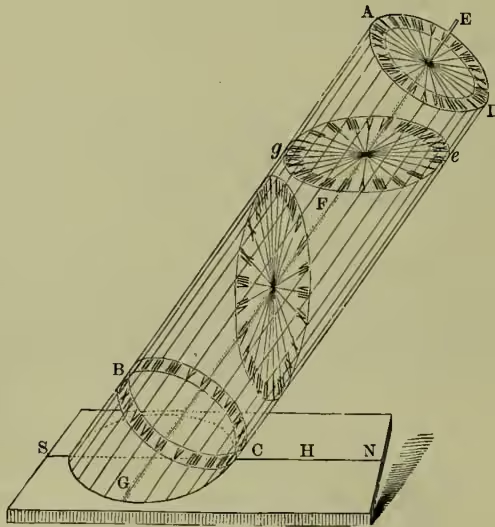
The universal dialling cylinder, an invention of Ferguson's, is represented in fig. 2. ABCD is a glass cylindrical tube, closed at both ends with brass plates, on the centres of which a wire or axis, EFG, is fixed. The tube is either fixed to a horizontal board, H, at an angle equal to the latitude of the place, or moves on a joint, so that it may be elevated till its axis is parallel to the earth's at any latitude. The 24 hour-lines are drawn on the outside of the glass, equidistant from one another, and parallel to the axis. The XII next B stands for midnight; the XII next the board, for noon. When the axis is adjusted for the latitude, and the board levelled, with the line HN on the meridian, and the end towards the north, the axis EFG, when the sun shines, will serve as stile, and cast a shadow on the hour of the day among the parallel hour-lines. As the plate AD is parallel to the equator, and EFG perpendicular to it, right lines drawn from the centre to the extremities of the parallels will be the hour-lines of an equinoctial dial, and the axis will be the stile. A horizontal plate, ge, if put into the tube, with lines drawn from the centre to the several parallels cutting its edge, will be a horizontal dial for the given latitude; and similarly a vertical plate fronting the meridian, and touching the tube with its edge, with lines drawn from its centre to the parallels, will be a vertical south dial, the axis of the instrument in both cases serving for the stile; and similarly for any other plate placed in the cylinder. If, instead of being of glass, the cylinder were of wood, any of these dials might be obtained from it by simply cutting it in the planes of the plates, and drawing the lines on the surface of the section.
Dialling sometimes occurs as a term for surveying by help of a compass with sights, such as is called a 'miner's dial,' and is used especially in underground surveys and mine-surveying.