Diamond (corrupted from adamant, q.v.), a natural form of crystallised carbon, highly valued as a precious stone, but of much less value than the ruby. The diamond crystallises in the cubic or monometric system, its common forms being the regular octahedron, the rhombic dodecahedron, and the six-faced octahedron. The faces are often curved, and the general form of the crystal is more or less rounded. Cleavage is perfect, parallel to the faces of the octahedron—a fact which is often taken advantage of in splitting off fragments for the purpose of removing flaws. The surface of the diamond frequently exhibits striae and triangular impressions, while the interior may contain microscopic cavities and various inclusions. A distinctly lamellar structure is by no means uncommon.
The lustre of the diamond is peculiar to itself, and hence termed 'adamantine.' In a natural condition, however, the surface often presents a dull lead-gray semi-metallic lustre. The high refractive and dispersive powers of the diamond produce, when the stone is judiciously cut, a brilliancy and 'fire' unequalled by any other stone. The mean index of refraction is 2.4, and the angle of total reflection about ; the latter accounts for the lustre, inasmuch as a large proportion of the incident light is in a well-cut diamond reflected from the inner surface of the stone. The diamond, especially when coloured, is highly phosphorescent, that is to say, after exposure to brilliant illumination it emits the rays which it has absorbed, and thus becomes self-luminous in the dark. Under the electric discharge in a highly-rarefied medium it exhibits beautiful phosphorescent phenomena, as pointed out by Mr Crookes.
The specific gravity of the diamond is about 3.52, and its degree of hardness greater than that of any other mineral, being indicated by 10 in the ordinary scale. The excessive hardness serves to distinguish the diamond from other gem-stones: any stone which readily scratches ruby and sapphire must be a diamond. Notwithstanding its hardness the diamond is brittle, and hence the absurdity of the ancient test which professed to distinguish the diamond by its withstanding a heavy blow struck by a hammer when placed on an anvil.
Regarded formerly as a peculiar kind of rock-crystal, the chemical composition of the diamond remained for a long time extremely obscure. It was shown by the Florentine academicians Averani and Targioni, about 1695, that the diamond could be volatilised at a high temperature, their experiments having been made at the cost of the Grand-duke Cosmo III.
Newton in 1704 expressed the opinion that the diamond, from its high refrangibility, was probably an unctuous body coagulated. In 1751 the Emperor Francis I. performed an experiment which showed that diamonds strongly heated in a furnace completely disappeared. Towards the latter part of the 18th century several French experimentalists, including Darcet and Macquer, examined the behaviour of diamonds at a high temperature; but it was reserved for Lavoisier in 1772 to demonstrate that while the diamond is extremely refractory if heated with total exclusion of air, it is readily combustible at a moderate temperature in the presence of air or oxygen, with production of carbonic acid gas. In 1797 the English chemist Smithson Tennant satisfactorily showed the identity of diamond with carbon. In recent years highly refined researches on this subject have been made by Dumas, Stas, Roscoe, and Friedel, all tending to prove that the diamond is practically pure carbon. Chemists have generally experimented, for sake of economy, with impure specimens, and have thus obtained on combustion a considerable amount of ash, the nature of which has not been well ascertained. It has been shown, however, that the purer the diamond the smaller is the proportion of ash left on its combustion. Gustav Rose, shortly before his death, subjected diamonds, inclosed in a vessel free from air, to the intense heat of the voltaic arc produced by a powerful dynamo constructed by Siemens of Berlin. Under these circumstances the gems became gradually incrustated with a dark coating of graphitic matter, and in some cases triangular depressions were developed on the faces, similar to those often observed in the South African diamond in its natural state.
As the chemical composition of the diamond is well known, it has often been supposed that carbon might be induced by artificial means to assume the characters of the gem. In 1880 J. B. Hannay of Glasgow announced that he had succeeded in producing artificial diamonds by inclosing a mixture of paraffin spirit and bone-oil distillate, with metallic lithium, in a strong wrought-iron tube, and exposing it to prolonged heat in a reverberatory furnace. Specimens of diamantoid carbon were thus obtained, but of small size, and it was found that these, when placed on the wheel, immediately crumbled. As the experiments offered no promise of commercial success, and were of so difficult and dangerous a character, they have not been repeated.
It is notable that the occurrence of diamonds has been recorded in a meteorite. Jeofeiff and
Latchinoff in examining the meteorite which fell on September 22, 1886, near Novi-Urei, government of Penza, South-east Russia, detected the presence of about 1 per cent. of diamantoid carbon.
An imperfect variety of diamond known as bort, or boart, occurs in the form of small spherical concretions with crystalline texture. Although unfit for use as an ornamental stone, it is employed when ground as an abrading agent; and the powder mixed with oil serves to feed the lapidary's wheel when cutting hard stones. Much of the bort of commerce is not the mineralogical variety, but consists of splinters, rough fragments, and imperfect crystals of ordinary diamonds. The diamonds used by the glazier for cutting glass are ordinary crystals with rounded faces, and are known as vitré diamonds. The cut, though only to the depth of about the th of an inch, is sufficient to determine with precision the direction in which the glass shall break.
Carbon, or carbonado, is the name applied to an opaque, black, granular, or imperfectly crystallised variety of diamond found only in Brazil, where it was discovered in 1843. While its density is less than that of crystallised diamond, its hardness is much greater, and hence it is used in the arts, especially for mounting in the steel heads or crowns of the rotary diamond drills for rock-boring.
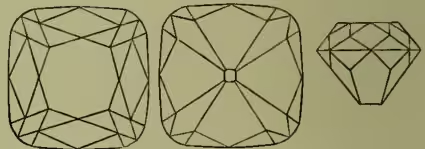
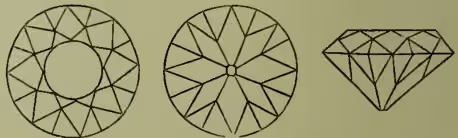
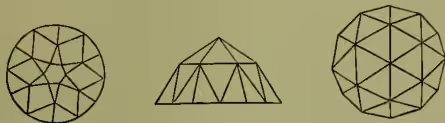
The art of cutting and polishing the diamond is said to have been discovered in 1456 by Louis de Berguem of Bruges. As now practised, the stone is first, if necessary, cleaved or split, and then 'bruted' or rubbed into shape. The faces of the stone thus 'cut' are ground and polished on flat metal discs, fed with diamond dust and oil, and revolving with great rapidity by steam-power. Amsterdam is the chief home of this industry, and the trade is chiefly in the hands of Jews; but diamond cutting and polishing are also now extensively carried on in London, Antwerp, &c. The common form of the diamond is either the brilliant or the rose cut. The brilliant resembles two truncated cones, base to base, the edge of the junction being called the girdle, the large plane at the top is the table, and the small face at the base the culct; the sides are covered with symmetrical facets. Fig. 1 shows a square-cut brilliant, and fig. 2 a round-cut brilliant. The rose has a flat base, with sides formed of rows of triangular facets rising as a low pyramid or hemisphere; but this form of diamond is daily becoming less fashionable, and is therefore of comparatively little value. It is illustrated by fig. 3.
India was formerly the only country which yielded diamonds in quantity, and thence were obtained all the great historical stones of antiquity. The chief diamond-producing districts are those (1) in the Madras presidency, on the Kistna and Godavari rivers, commonly though improperly termed the Golconda region; (2) in the Central
Provinces, including the mines of Sumbulpur; and (3) in Bundelkhand, where the Panna mines are situated.
At present the diamond production of India is insignificant. It is notable, however, that in 1881 a fine diamond, weighing carats, was found near Wajra Karur, in the Bellary district, Madras. The stone was cut into a brilliant weighing carats, and is known as the 'Gor-do-Norr.'
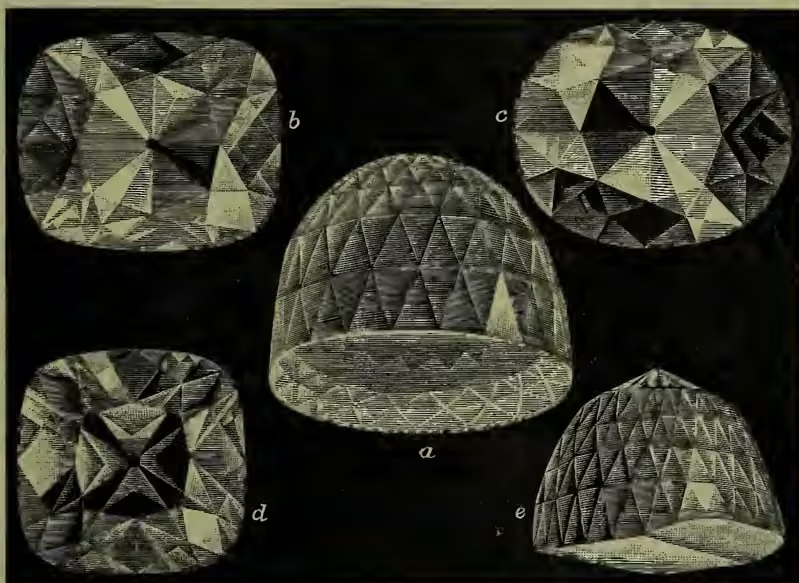
Brazil was not regarded as a diamond-yielding country until 1727, when the true nature of certain crystals found in the gold washings of the province of Minas Geraes was first detected. Diamonds occur not only in this province, but in Bahia, Goyaz, Matto Grosso, and Paraná. The geological conditions under which the mineral occurs have of late years been carefully studied by Professors Derby, Gorceix, and Chatrian. The diamonds are found in the sands and gravels of river-beds, associated with alluvial gold, specular iron ore, rutile, anatase, topaz, and tourmaline. In 1853 an extraordinary diamond was found by a negress in the river Bogagem, in Minas Geraes. It weighed carats, and was cut into a brilliant of perfect water, weighing 125 carats (see fig. 4, b). This brilliant, known as the 'Star of the South,' was sold to the Gaikwar of Baroda for £80,000.
Both the Indian and the Brazilian diamond-fields have of late years been eclipsed by the remarkable discoveries of South Africa. Although it was known in the last century that diamonds occurred in certain parts of South Africa, the fact was forgotten, and when in 1867 they were found near Hopetown, the discovery came upon the world as a surprise. The principal mines are situated in Griqualand West, but diamonds are also worked in the Orange River Free State, as at Jagersfontein. The stones were first procured from the 'river diggings' in the Vaal and Orange rivers. These sources have occasionally yielded large stones; one found in 1872 at Waldeck's Plant on the Vaal weighed carats, and yielded a fine pale yellow brilliant, known as the 'Stewart.'
It was soon found that the diamonds of South Africa were not confined to the river gravels, and 'dry diggings' came to be established in the so-called 'pans.' The principal mines are those of Kimberley, De Beer's, Du Toit's Pan, and Bultfontein. At these localities the diamonds occur in a serpentinous breccia, filling pipes or 'chimneys,' generally regarded as volcanic ducts, which rise from unknown depths and burst through the surrounding shales. The 'blue ground,' or volcanic breccia containing fragments of various rocks cemented by a serpentinous paste, becomes altered by meteoric agents as it approaches the surface, and is converted into 'yellow earth.' At Kimberley the neighbouring schists, or 'reefs,' are associated with sheets of a basaltic rock, which are pierced by the pipes. In the year 1887 the production of the principal mines was as follows:
| Weight in Carats. | Value. | |
|---|---|---|
| Kimberley..... | 1,333,832 | £1,410,207 |
| De Beer's..... | 1,014,048 | 1,022,878 |
| Du Toit's Pan..... | 686,576 | 987,253 |
| Bultfontein..... | 602,246 | 612,982 |
| St Augustine..... | 197 | 250 |
| 3,646,899 | £4,033,550 |
The great number of large stones found in the mines of South Africa, as compared with those of India and Brazil, is a striking peculiarity. In the earliest days of African mining a diamond of about 83 carats was obtained from a Boer. This stone when cut yielded a splendid colourless brilliant of carats, known as the 'Star of South Africa,' or as the 'Dudley,' since it afterwards became the property of the Countess of Dudley. Some of the
African stones are 'off coloured'—i.e. of pale yellow or brown tints; but a large gem of singular purity was found at Kimberley in 1880. This is the famous 'blue-white' diamond of 150 carats, known from the name of its possessor as the 'Porter Rhodes.' See CAPE COLONY.
It has long been known that diamonds occur in Australia, but hitherto the Australian stones have been all of small size, and it is notable that these are much more difficult to cut, being harder than other diamonds. Although Victoria and South Australia have occasionally yielded diamonds, it is New South Wales that has been the principal producer. The chief diamond localities have been near Mudgee, on the Cudjegong River, and near Bingera, on the river Horton.
Borneo also yields diamonds. The stone known as the 'Matau' is said to have been found in 1787 in the Landak mines, near the west coast of Borneo. It is described as being an egg-shaped stone, indented on one side, and weighing, in its uncut state, 367 carats. Great doubt, however, exists as to the genuineness of this stone, and the Dutch experts who examined it a few years ago pronounced it to be simply rock-crystal. Among other diamond localities may be mentioned the Ural Mountains and several of the United States. The largest diamond yet recorded from North America was found at Manchester, Chesterfield county, Virginia. It weighed 23 carats, and yielded, when cut, a brilliant known as the 'Ou-i-nur,' which weighed, however, only 11 carats.
A few special diamonds, from their exceptional size or from the circumstances of their history, deserve notice. Of all the great diamonds, the 'Koh-i-nur' is perhaps the most interesting (see fig. 4, c). While tradition carries it back to legendary times, it is known from history that the Sultan Ala-ed-din in 1304 acquired this gem on the defeat of the Rajah of Malwa, whose family had possessed it for many generations. In 1526 it passed by conquest to Humaiun, the son of Sultan Baber. When Aurungzebe subsequently possessed this stone, he used it as one of the eyes of the peacock adorning his famous peacock throne. On the conquest of Mohammed Shah by Nadir Shah in 1739, the great diamond was not found among the Delhi treasures, but learning that Mohammed carried it concealed in his turban, Nadir, on the grand ceremony of reinstating the Mogul emperor on the throne at the conclusion of peace, offered to exchange turbans, in token of reconciliation, and by this ruse obtained possession of the gem. It was when Nadir first saw the diamond on unfolding the turban, that he exclaimed, 'Koh-i-nur,' or 'Mountain of Light,' the name by which the gem has ever since been known. At Nadir's death it passed to his unfortunate son, Shah Rokh, by whom it was ultimately given to Ahmed Shah, the founder of the Durani Afghan empire. By Ahmed it was bequeathed to his son, Taimur Shah; and from his descendants it passed, after a series of romantic incidents, to Runjit-Singh. On the death of Runjit, in 1839, the diamond was preserved in the treasury of Lahore, and on the annexation of the Punjab by the British in 1849, when the property of the state was confiscated to the East India Company, it was stipulated that the Koh-i-nur should be presented to the Queen of England. It was consequently taken in charge by Lord Dalhousie, who sent it to England in 1850. After the Great Exhibition of 1851, where it had been exhibited, it was injudiciously re-cut in London by Voorsanger, a skilful workman from Messrs Coster's factory at Amsterdam. The re-cutting occupied 38 days of 12 hours each, and the weight of the stone was reduced from 186 to 106 carats. The form is that of a shallow brilliant, too thin to display much fire. According to Lady Burton, it is believed to bring ill-luck to its possessor.
Another famous Indian diamond is the 'Great Mogul' (fig. 4, a), which appears to have been found about 1650, in the Kollur mine, on the Kistna. It was seen by the French jeweller Tavernier at the court of Aurungzebe in 1665, and is described as a round white rose-cut stone of 280 carats. Its subsequent history is unknown, and it is probable that at the sacking of Delhi by Nadir Shah in 1739 it was stolen and broken up. Some authorities have sought to identify the Great Mogul with the Koh-i-nur, and others with the Orloff.
The 'Orloff' (fig. 4, e) is an Indian stone which was purchased at Amsterdam in 1776 by Prince Orloff for Catharine II. of Russia. The stone at one time formed the eye of an idol in a temple in the island of Seringham, in Mysore, whence it is said to have been stolen by a French soldier. It weighs 193 carats, and is mounted in the imperial sceptre of the Czar.
The 'Regent' is a famous diamond preserved among the national jewels in Paris. It was found in 1701, at the Parteil mines, on the Kistna, by a slave, who escaped with it to the coast, where he sold it to an English skipper, by whom he was afterwards treacherously killed. Thomas Pitt, grandfather of the first Earl of Chatham, at that time governor of Fort St George, purchased the stone, and had it re-cut in London, whence it is often known as the 'Pitt.' Its original weight was 410 carats, but it was reduced in cutting to 136; the result, however, was a brilliant of fine water and excellent proportions. Pitt sold it in 1717, through the financier John Law, to the Duke of Orleans, then Regent of France during the minority of Louis XV. The price paid was £135,000, and its value has since been estimated at £480,000 (see fig. 4, d).
The large 'Sancy' is an historical diamond, about which many contradictory stories have been told. It appears that the Sancy was an Indian stone, purchased about 1570 by M. de Sancy, French ambassador at Constantinople. It passed temporarily into the possession of Henry III. and Henry IV. of France, and was eventually sold by Sancy to Queen Elizabeth of England. By James II. it was disposed of to Louis XIV., about 1695, for £25,000. At the beginning of the 19th century it passed to the Demidoff family in Russia, and by them it was sold in 1865 to Sir Jamsetjee Jeejeebhoy. In 1889 it was again in the market, the price asked being £20,000.
Of coloured diamonds there are a few possessing historical interest. Diamonds occur of all tints, and when the colour is well pronounced, they are prized as fancy stones. A pale green diamond, weighing 48 carats, is preserved in the Green Vaults at Dresden. But one of the most superb coloured diamonds at present known is the sapphire blue brilliant termed the 'Hope' diamond, valued at £20,000 to £30,000. This gem formerly belonged to Mr H. T. Hope, and weighs 44 carats. It is believed to have been cut from the large blue diamond, weighing in the rough 112 carats, sold by Tavernier to Louis XIV., which disappeared amid the troubles of 1792. The two most wonderful coloured diamonds known after the Hope are an emerald green diamond of 6 grains, which is valued at £1000, and a ruby red diamond of 5 grains, valued also at £1000.
For further information on historical diamonds, see The Great Diamonds of the World, by E. W. Streeter (1882); and on diamonds generally, consult Precious Stones and Gems, by the same author (4th ed. 1884); Le Diamant, by H. Jacobs and N. Chatrian (Paris, 1884); and Le Diamant, by E. Boutan (Paris, 1886).