Diatoms (Diatomaceæ) are a group of algae which, on account of their microscopic interest and geological importance, have acquired an unusual share of scientific and even popular attention. They were discovered by Leeuwenhoek in 1702, and their movements by O. F. Müller eighty years later; their thorough investigation, however, has only become possible with the development of the compound microscope.
The reader who wishes to view the diatoms other than as mere microscopic marvels must begin with a clear grasp of the structure and mode of life of the filamentous conjugate algae, such as Spirogyra, and next observe that of those higher members of the group which we know as Desmids (see ALGÆ, DESMIDS). These simpler forms understood, let him next imagine a desmid (in which the characteristic division of the unicellular body into halves is distinctly but not too deeply marked) to become somewhat unequally developed; next let these be pressed together so that the larger half slides a little way over the smaller, much like the lid of a canister or the halves of a pill-box. Let the two halves or shells of the cell-wall now become strongly silicified, the cellulose only remaining unaltered and flexible round the narrow 'girdle band' connecting them; next let variation arise in the general shape so that the original box-shape becomes elliptical or wavy, squared, or more often pointed, or even unsymmetrically curved; finally, let the siliceous shells become covered with the most delicate striations and markings, and these characteristically varied, not only from group to group, but from species to species. A gelatinous envelope may also be developed, or this may be secreted at one pole only, forming a stalk.
The living protoplasm shows less variation than might perhaps have been expected; it lines the siliceous shell, leaving a large central sap-cavity, often traversed by protoplasmic filaments. Very commonly, however, this is divided by a large central mass of protoplasm usually containing the nucleus, while similar accumulations may be formed
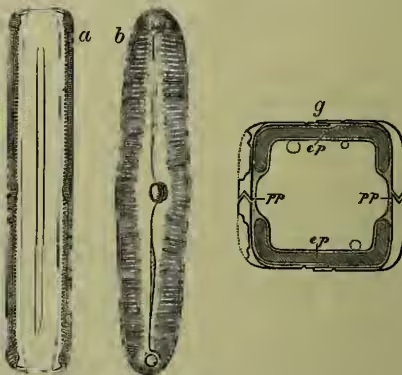
Fig. 2.
Pinnularia viridis: 1. a, Optical section through the unequal valves; b, side of one valve, showing markings and longitudinal slit.
2. Diagrammatic transverse section; pp, protoplasm containing endochrome-plates, ep; g, girdle band. Valves left unshaded, the left showing depressions due to markings. at the ends. The colouring matter may occur in minute granules, or be collected into one or two large 'endochrome-plates'; it consists of chlorophyll, masked by a closely allied yellow pigment (phycocanthin). Starch is absent; oil is frequently present, either in minute vacuoles or collected into a single large drop.
The mechanism of the peculiar creeping or rather gliding movements has long baffled investigators; these, however, are not due to diffusion currents as some have maintained, nor to the agency of any ordinary cilia or pseudopodia, but seem to be effected by means of a locomotor band of protoplasm which is said to be protruded through a longitudinal slit in the surface of the siliceous shells (see fig. 1).
The mode of multiplication is primarily by division, and is effected on the same principle as in Desmids (q.v.). Thus the two halves of the diatom are not only of unequal ages, but since the new half is always formed within the previous one, a continuous diminution of size takes place. At a certain limit, however, division stops, and rejuvenescence may occur, with formation of a resting spore; more frequently, however, this is preceded by conjugation as in desmids, though sometimes complete union may not take place. The resultant 'auxospore' has a continuous cellulose coat, but develops within it, by rejuvenescence, a two-shelled diatom of the largest size, which issues to divide in turn.
Of the 2000 species, 400 are fresh-water, the remainder marine. Their distribution is ubiquitous, and the genera and even species seem little dependent upon temperature or climate, many being apparently cosmopolite, and some having been described as occurring in glacier water, yet also in hot springs. Their minute size and resistance to drying favour their distribution in the form of dust; hence the calcination of the dust which falls upon ships in mid-ocean has been shown to yield an appreciable diatom residue. Every soil which is overflowed teems with them, notably, therefore, that of Egypt; harbour mud often contains one-fourth to one-half its volume of diatom shells, while in many parts of the world there occur strata of purely diatomaceous origin, which are frequently of vast area and considerable thickness. These are in all states of preservation and hardness, from the loose Bergmehl of Siberia and Lapland (which still contains so much undecomposed organic matter as to be mixed with flour in times of scarcity) to building stone, and even the extremely hard polishing slates of Tripoli. Diatomaceous deposits were found in Skye in 1886. The diatomite may be used for making dynamite, siliceous glazed paints, steam-pipe casings, &c. Diatoms live in enormous abundance at the surface of the sea in cold, temperate, and arctic latitudes, and the mud of the sea-bottom is hence very largely composed of the shells of dead diatoms, which are falling from the surface in a gentle but unceasing rain (see OOZE). Kieselguhr, or infusorial earth, is useful for making Dynamite (q.v.), patent-lamp wicks, for lining safes or ice-stores, antiseptic preparations, filtration, &c. See the Challenger report on the Diatomacete (1885).