Directrix.

Chambers's Encyclopaedia, Volume 4: Dionysius to Friction, p. 8
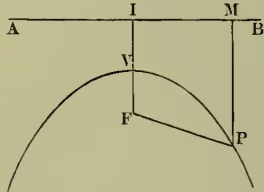
A geometric diagram illustrating the definition of a conic section. A horizontal line segment AB represents the directrix. A point F below the line represents the focus. A point P is on a curve (the conic section) such that the distance FP is to the perpendicular distance from P to the directrix (labeled as PM) in a constant ratio. A vertical line segment IF is drawn from the focus F to the directrix AB, with point I on AB. The distance IF is labeled as the focal distance. The diagram shows that the ratio FP/PM is constant for any point P on the curve.

Directrix. If a point so move that its distance from a given fixed point is to its perpendicular distance from a fixed straight line in a constant ratio, it describes a conic section, of which the fixed straight line is termed the directrix, and the fixed point the focus. The constant ratio referred to is termed the eccentricity, and its magnitude determines the nature of the conic. Thus, if in the figure AB be the directrix and F the focus, if the point P move so that its distance from F is to its distance PM from AB in a constant ratio, then P will trace out a conic section, which will be an ellipse, parabola, or hyperbola, according as the ratio in question is less than, equal to, or greater than unity—i.e. as FP is less than, equal to, or greater than PM, or FV than VI.

Source scan(s): p. 0017