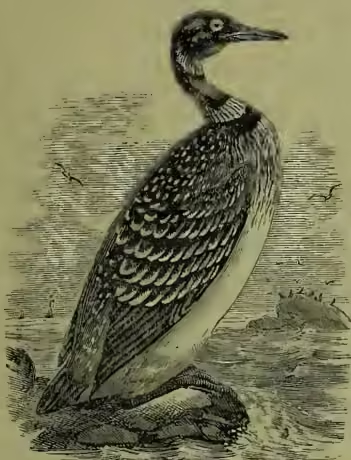
Diver, or LOON (Colymbus), a genus of birds of the family Colymbidae, emphatically oceanic, and confined to northern latitudes. They have a strong, straight, rather compressed, pointed bill, about as long as the head; a short and rounded tail; short wings; thin compressed legs placed very far back, a short hind-toe, and the other digits completely webbed. They fly well, but are particularly expert in diving. They prey upon fish, which they pursue under water, making use of their wings as well as of their legs and webbed feet in their dexterous swimming. On land they can hardly walk, and the name Loon is supposed to refer to this incapacity, and to be from the same root with lame. They nest on the islands, rocks, or shores of lochs and fiords, but except at breeding-time keep to the water. In winter they sometimes follow the rivers inland. The Great Northern Diver or Loon, also called the Immer or Ember Goose (C. glacialis), is a bird about 2½ feet long, exhibiting no little beauty of plumage; the upper parts black, spotted with white; the head black, with tints of green and blue; the belly white. In winter and in youth it is predominantly brownish-gray and white beneath. It is a winter visitant of the British coasts, even to the farthest south, and is occasionally seen in inland districts; is found in like manner in most parts of Europe, the north of Asia, and North America as far south as Texas, but it breeds chiefly in the more northern regions, as Labrador, Iceland, and Spitzbergen. Its cry is very peculiar and wild, has been likened to the howl of a wolf, and is in some countries superstitiously regarded as ominous of evil. The bird is easily tamed, and becomes very familiar.—The Black-throated Diver (C. arcticus) is another northern bird, of similarly wide distribution, but much smaller size, being only about 26 inches in length. It is found round the coasts of Britain, and occasionally breeds in the fresh-water lochs of the north of Scotland. The upper head and neck are ashen-gray, the cheeks and throat black, the general upper surface black with white spots, the under surface white with posterior black spots. In youth and winter it is blackish-brown above, and white beneath.—The Red-throated Diver (C. septentrionalis) is also found in all the northern parts of the world, is more common in Britain than either of the other species, and is the bird generally called Loon on the British coasts. In size it scarcely equals the Black-throated Diver. Its back is brownish-gray, the belly white, the throat red. In winter, like the preceding species, this diver is more soberly coloured, and without the red throat. The flesh of all the divers is dark, tough, and unpalatable. The name is sometimes extended to allied genera. See AUK, GREBE, PENGUIN, &c.