DIVING-BELL.—For all such purposes as sub-aqueous works upon the foundations of piers, bridges, &c., or the exploration and raising of sunken vessels, the efforts of the unaided diver would be almost valueless, and, accordingly, various contrivances for supplying air to the diver have been made. Roger Bacon (1240) is said, on most doubtful authority, to have invented a machine for working under water. Taisnier's description of the cacabus aquaticus, or aquatic kettle, used by two Greeks in Spain, at Toledo in 1538, in the presence of the Emperor Charles V. and a multitude of spectators, is one of the earliest reliable accounts of a diving-bell. From his description, this must have been similar in principle and construction to the modern diving-bell, but of clumsy dimensions, and wanting in efficient means of renewing the supply of air. In
1620 Lord Bacon in his Novum Organum describes the crude method in vogue in his day, in which no means of replenishing the air were employed. Towards the close of the 17th century, many attempts were made, and much capital sunk in submarine exploration, but the primitive nature of the apparatus employed rendered the various enterprises undertaken abortive. Dr Halley's diving-bell, about 1720, was a wooden chamber of about 60 feet internal capacity, open at the bottom, where it was loaded with lead, to keep it perpendicular in its descent. Strong pieces of glass were set in the upper part, to admit light. Casks filled with air, and loaded with lead, were let down with the bung-hole downwards; and from these a supply of air was drawn by means of a hose. John Lethbridge, about the same time, constructed a conical bell, into which he forced compressed air by means of bellows, enabling him to remain over half an hour beneath the surface. In 1754 Dr Richard Pococke saw a diving-bell used at the Needles to raise what they could of the wreck of a man-of-war. 'They are let down in a machine made of leather, strengthened at the knees and shoulders, and, if I mistake not, on the head, with brass. There are two leathern tubes to it—one for the air to go down and to speak by, the other to pump out the air. They stay down five minutes' (Travels through England, Camden Soc. 1889). In 1779 Smeaton employed an oblong box supplied with air by means of a pump on the surface, for repairing the bridge at Hexham, in Northumberland.
The form of diving-bell now in use was first constructed by Smeaton for work at Ramsgate, in 1788. It was of cast-iron, and weighed 50 cwt., its height feet, length the same, and width 3 feet. It sunk by its own weight, and was lighted by stout pieces of bull's-eye glass, firmly cemented in brass rings near the top. The next improvement of importance was that due to Rennie, who designed in 1813, for the works of Ramsgate Harbour, a diving-bell of cast-iron, 6 feet high, 4 feet 6 inches wide, and 6 feet long. Six bull's-eyes of glass in the top admitted light. Air was admitted through the top by a valve, and was supplied by an air-pump through a 2-inch hose. The interior of the bell was fitted with seats, chains for attaching stones, &c., and a rail for carrying tools. The bell, which weighed about 5 tons, was suspended by stout chains to a crab fixed to a truck travelling on an overhead gantry, and was successfully employed in various undertakings carried out by its designer. A large diving-bell, designed by Mr Stoney for the construction of the North Wall at Dublin, is 16 feet square at the top, and 20 feet square at the bottom, weighs 80 tons, and is used for lowering 350-ton blocks of walling. Access is gained to the bell by means of a wrought-iron shaft and air-lock, thus obviating the necessity of raising the bell. This apparatus has been both efficient and economical in working.
The air-chambers of the caissons used for founding the piers of bridges are nothing more than huge diving-bells, only they remain in position when sunk to the requisite depth, and are filled up solid with masonry (see CAISSON). At the St Louis Bridge across the Mississippi, the maximum depth attained was 110 feet, and the greatest pressure 51 lb., a pressure which proved fatal in a few instances to the workmen. The air-chambers of the caissons of the Forth Bridge were 70 feet in diameter, and 7 feet high. The work of excavation was carried on by electric light, and presented a singularly novel and weird spectacle. The maximum pressure was about 33 lb. per sq. inch above the atmosphere. The altered conditions of existence under a pressure of three atmospheres presents many points of interest. The voice sounds unnatural, and as if proceeding from another person; whistling is impossible. Effervescing drinks open flat, the pressure outside being equal to that accumulated in them. A feeling of lassitude is generally experienced on return to ordinary atmospheric conditions. The passage through the air-lock on entering, and the gradual admission of pressure, is at times, and more especially to novices, accompanied by severe pains in the ears; but with due care, and the observance of the prescribed simple expedients, these pass away. The workmen accustomed to subaqueous existence suffer no inconvenience from being below water.
The principle of the diving-bell will be easily understood by floating a piece of lighted candle or a wax match on a cork, and then covering it with an inverted tumbler, and pressing it downwards; the candle will descend below the level of the surrounding water, and continue burning for a short time, although the tumbler be entirely immersed. The reason is obvious enough: the air in the tumbler having no vent, remains in it, and prevents the water from occupying its place, so that the cork and candle, though apparently under water, are still floating, and surrounded by the air in the tumbler; the candle continues burning until the oxygen of the air is exhausted, and then it goes out, as would the life of a man under similar circumstances. If vessels full of air, like the barrels of Dr Halley, were submerged, and their contents poured into the tumbler, the light might be maintained; but this could be better done if a tube passed through the tumbler, and air were pumped from above through the tube into the tumbler.
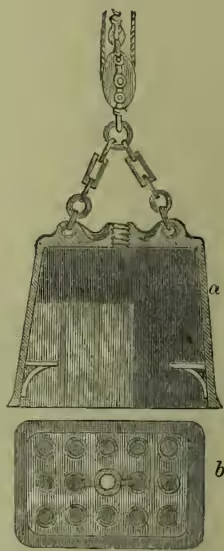
a, section showing inside;
b, top.
The modern diving-bell, which is made of cast-iron like Smeaton's, is supplied with air in this manner. It must be remembered that air is compressible, and diminishes in bulk in proportion to the pressure, so that at a depth of about 33 feet in water, it would occupy half the space it filled at the surface; if the inverted tumbler were carried to this depth, it would be half-filled with water. A considerable quantity of air has therefore to be pumped into the diving-bell, merely to keep it full as it descends; the air thus compressed exerts a corresponding pressure, and would rush up with great force if the tube were open and free. This is prevented by a valve opening downwards only. When the diving-bell has reached its full depth, the pumping is continued to supply air for respiration; and the redundant air overflows, or rather underflows, by the open mouth, and ascends to the surface in great bubbles. The diving-bell is provided with a platform or seat for the workmen, and suspended from a suitable crane or beams projecting from a barge or pier; men above are stationed to work the pumps, and attend to the signals of the bellman. These signals are simply made by striking the sides of the iron diving-bell with a hammer, and as sound is freely communicated through water, they are easily heard above. One blow signifies 'more air;' two blows, 'stand fast;' three, 'heave up;' four, 'lower down;' five, 'to eastward;' six, 'to westward;' &c. These, of course, may be modified as agreed upon. Messages are also sent up, written on a label attached to a cord.
DIVING-DRESS.—In Schott's Technica Curiosa, published in 1664, is described a lorica aquatica, or aquatic armour, which consisted of a leathern dress and a helmet to protect the diver from the water. In 1721 Halley describes a contrivance of his own of nearly the same kind; its object was to enable the diver to go out from the bell and walk about. He was to be provided with a waterproof dress, and a small diving-bell, with glass front, as a helmet over his head, which was to be supplied with air by means of a tube from the diving-bell. Kleingert, of Breslau, in 1798 devised a diving-dress, consisting of strong tin-plate armour of cylindrical form encasing the diver's head and body; the lower portion of his person being clad in stout leathern costume. A pipe conveyed air to the diver, whilst a second pipe returned the air when vitiated to the surface. This apparatus was available only for depths up to 20 feet.
The open helmet diving-dress was invented in 1829 by Augustus Siebe, and marked considerable advance on previous attempts.
This dress consisted of a copper helmet with breastplate attached, a canvas jacket being fastened to the latter. The lower part of the jacket was left open (hence the name), and the air escaped by this outlet, hence the water was only a few inches below the diver's mouth, and he had to maintain a vertical position. Leather boots loaded with lead were also worn.
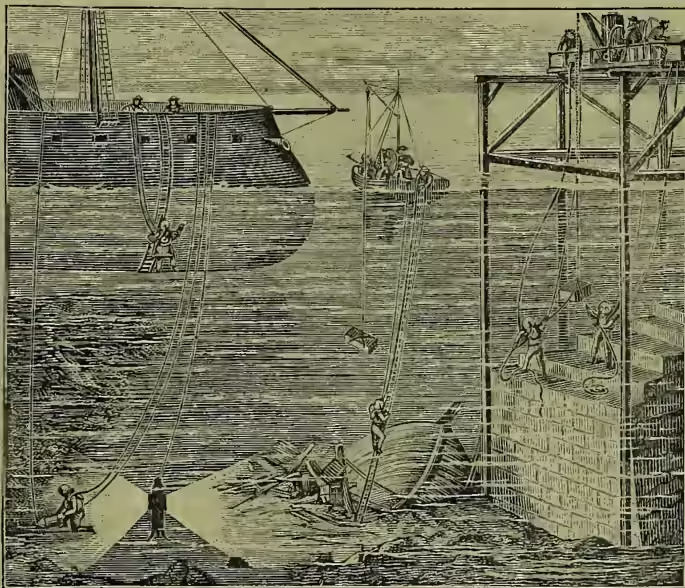
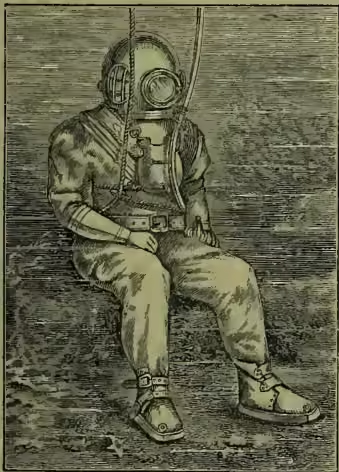
In 1839 Siebe obviated the dangers attendant on the open dress by perfecting his modern close dress—a waterproof costume covering the whole body, save the head and hands, of strong tanned twill with mineralised india-rubber collars and cuffs. The helmet is made of tinned copper with three circular glasses in front; sometimes guards are added to protect them. The front eye-piece is made to unscrew and enable the diver to receive or give instructions without removing the helmet. One or more outlet valves are placed at the back or side of the helmet to allow the vitiated air to escape. These valves only open outwards by working against a spiral spring, so that no water can enter. The inlet valve is at the back of the helmet, and the air on entry is directed by three channels running along the top of the helmet to points above the eye-pieces, enabling the diver to always inhale fresh air, whilst condensation on the glasses is avoided. The helmet is secured to the breastplate below by a segmental screw-bayonet joint, securing attachment by one-eighth of a turn. In some dresses the escape valve is regulated at will by the diver, and being placed in front of the breastplate, enabling him to vary the pressure, and even to float himself by closing the valve and inflating his dress, but except in the hands of a skilled man this may prove a source of danger. Hence many makers, when an adjustable valve is desired, substitute one which rights itself as soon as the diver's hand is removed. The junction between the waterproof dress and the breastplate is made watertight by means of studs, brass plates, and wing-nuts. The diver carries back and front weights, each about 40 lb. The boots, made of stout leather with leaden soles, weigh about 20 lb. each. The helmet weighs about 40 lb. The diver in using the dress has usually two weights of about 40 lb. each on his shoulders, and lead soles, of 15 lb. each, to his boots. A life or signal line enables the diver to communicate with those above. The air-pipe is made of vulcanised india-rubber with galvanised iron wire imbedded. The cost of a dress with all essential apparatus is about £140.
In the diving-dress invented by Mr Fleuss, and patented by him in 1880, the diver is independent of supplies of air from above. A strong copper cylinder fastened to the back of the diver carries a supply of compressed oxygen, regulated at will by a jamb screw-valve. The carbonic acid exhaled by the diver is absorbed by caustic soda in a receptacle fixed above the copper cylinder, whilst the nitrogen is breathed over and over again. In this dress, which weighs about 26 lb., and can be adjusted in a few seconds, a man may remain below the surface for several hours without harm. In clear water and at moderate depths, no light is required, but where illumination is necessary, an improved oil-lamp, invented by Siebe, supplied with air by a small force-pump, is employed. Both are and incandescent electric lights are now used for this purpose with most satisfactory results. Experiments have been made to utilise the telephone, but communication by means of a slate or ordinary signal line remains universal. Siebe states the greatest depth to which a man has ever descended to be 204 feet, equivalent to a pressure of lb. per sq. inch. Slight men of muscular build, with good circulation, sound hearts, steady nerves, and temperate habits, make the best divers.
The British Admiralty and Royal Engineers train a large staff of divers. Every vessel in the British navy of any tonnage carries apparatus and one diver. Flag-ships carry, as a rule, two divers. The German and other navies also train divers.