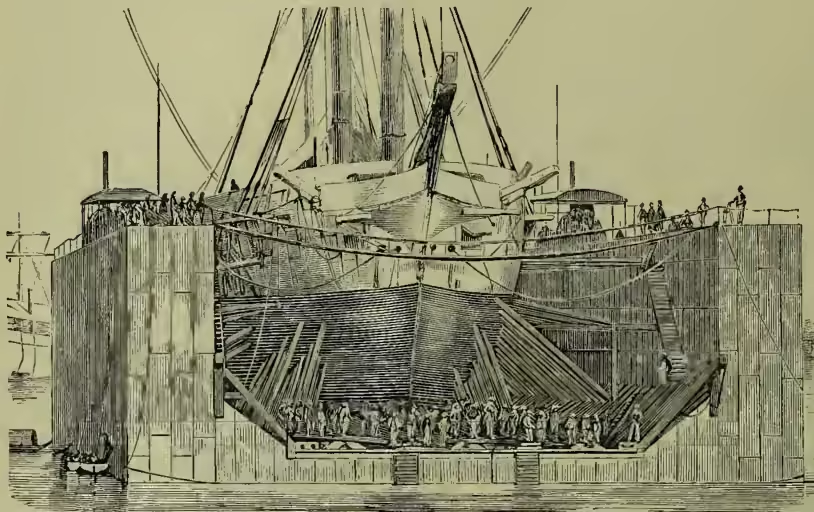
Dock Warrants are orders or authorities for the removal of goods and merchandise warehoused in the various docks. The orders are granted by the proper officer at the docks, on application of the importer, in favour of any one whom the latter shall name. Careful rules as to obtaining warrants are laid down by the East and West India Dock and the London Dock Companies. These rules are, in a great measure, followed by the other dock companies in the kingdom. Unless the rules are complied with, goods will not be delivered from the docks. Warrants may be obtained for either the whole or a part of a cargo consigned. A warrant may be assigned by the holder. A single warrant may also, at the desire of the holder, be the kind that were made of iron. Mr Thomson, of Edinburgh, designed in 1859 a great iron floating-dock for the port of Sourabaya, Java; and he determined to make every separate piece of the Sourabaya Dock from drawings, and to dispense altogether with the costly operation of building up in this country. There were upwards of 75,000 separate plates, ribs, and angle-irons, every one of them shaped, accurately punched with numerous holes, and ready to be riveted into their places. The dock was composed of five great watertight compartments; and these were divided in their longitudinal direction into five separate divisions, making in all 25 watertight compartments, any one of which could be filled or emptied at pleasure; thus affording complete command over the dock, and admitting of its being put into any required level, notwithstanding any irregularity in the distribution of the weight resting on the dock. The watertight compartments were all completely under the command of powerful centrifugal steam-pumps, so that they could be separately filled or emptied in a very short time; and thus the dock could be heeled over to one side, for the purpose of getting at the bottom for repairing or cleaning it. This tilting over could be accomplished by filling the compartment at one side, and emptying all the others.
It must be mentioned that floating-docks require engineering skill for their management, and, unless very carefully handled, are liable to serious accidents. Some have been wholly lost; one erected at Rio Janeiro proved unmanageable, and was never used; and a fatal disaster occurred in connection with one at Callao. To overcome such disadvantages, Mr Edwin Clark invented the Hydraulic Lift Graving-dock, London. It consists of a pontoon, filled with water, and sunk between two rows of divided into smaller warrants, and these also may be assigned. In case a warrant is lost, a new warrant will not be issued till the loss has been advertised, and the holder furnish the company with an engagement to indemnify them for any loss which may arise.