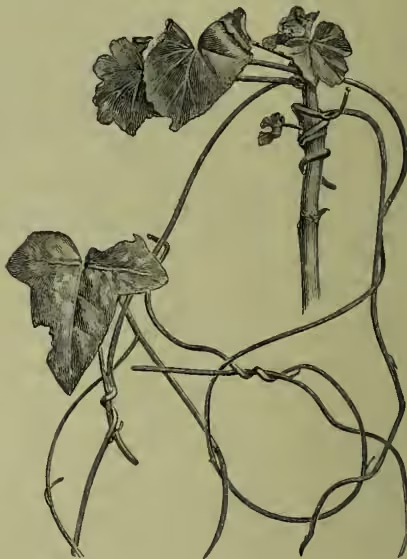
Dodder (Cuscuta), a widely distributed genus of phanerogamous parasites, usually regarded as degenerate Convolvulaceæ, and forming the type of a small sub-order Cuscutaceæ. Being entirely parasitic, they have lost all trace of leaves, even the cotyledons of the embryo being no longer distinguishable, while chlorophyll is almost completely absent. The seed germinates very late in spring, and as the seedling rises from the ground its tip soon begins to show the sweeping movements of circummutation of a climbing plant. If no host be in the neighbourhood for it to take up its quarters on, it falls to the ground, but retains its vitality for some weeks, by which time a victim may probably have germinated. As soon as it touches a living plant it twines firmly round it, and a series of small wart-like adventitious roots are developed, from the centre of each of which a bundle of suctorial cells force their way through the epidermis and cellular envelope into the bast, and press against the woody tissue of the host. The portion of the dodder stem below this attachment now dies off, and there is then no longer any connection with the ground. The growing point again circumnutes until it finds a new base of attachment upon the same or a different stem of the host, there to repeat the formation of suckers. In this way a tangled skein of threads is formed over which, late in the season, the flowers develop in dense clusters, and the ripened seeds are shaken out of the capsule by the wind, or gathered with the crop. This parasite is often very injurious, particularly in Germany, where the fields of flax, clover, and lucerne sometimes show well-marked patches completely desolated by the pest; these have simply to be mown down and buried before new seed has set; while pains must be taken to procure clover-seed pure from those of the parasite. The temperate species are all annual, but C. verrucosa and other tropical forms are perennial. It is a remarkable circumstance that Cassytha, a totally unrelated oriental genus of Lauraceæ, has not only assumed the same general mode of life and twining, leafless habit, but germinates and penetrates in a precisely similar way.