Dodo (Didus ineptus), a large bird which used to inhabit Mauritius, but became extinct some time after 1681. It appears to have been allied to the pigeons, was a little larger than a turkey, and incapable of flight. Our knowledge of the bird is derived from the reports of travellers, from pictures, and above all from the skeletons disinterred in 1866. It appears also to have been sometimes brought alive to Europe. The bill was large, longer than the head, and covered for half its length by soft naked skin. The end of the bill was hooked and turned downwards. The wings and the tail were rudimentary. The feathers seem to have been gray, with yellow on the wings and tail. The legs were short, thick, and scaly. It probably lived in the thick, tropical woods, and fed on vegetable materials.
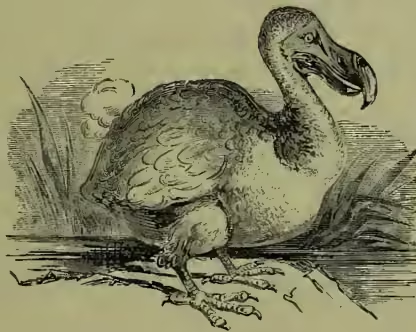
The extermination seems to have rapidly followed the Dutch colonisation of Mauritius. The bird was helpless and stupid, and withal good for eating. The hungry domestic animals brought by man doubtless helped to destroy the hapless dodo. Though a conspicuous example, the dodo is by no means the only bird which has been exterminated, in part at least, by human carelessness. The solitaire (Pezophaps solitarius) of Rodriguez is another well-known case.
There are rude figures of the dodo in several works of the 17th century, and in particular one, evidently superior to the rest, in Bontius (edited by Piso, 1658)—who calls the bird Dronte or Doduaers—which perfectly corresponds with the descriptions given of it, with a painting preserved in the British Museum, said to have been drawn in Holland from the living bird, and with a representation of it discovered by Professor Owen in 1838 in Savery's picture of Orpheus and the Beasts at the Hague, which he thinks 'must have been copied from a study of the living bird.' The skeleton has been partially reconstructed, and described by Professor Owen. Many bones of this extinct bird were discovered in 1865, when extensive marshes in the island were partially drained. There are bones at Paris, Copenhagen, and Haarlem. A foot of the dodo is amongst the valued treasures of the British Museum. In the Ashmolean Museum at Oxford are a head and foot; but the stuffed specimen to which these belonged was allowed to decay, and finally destroyed in 1755 by order of the curators. See Strickland and Melville, The Dodo and its Kindred (1848), and Professor Owen in vol. vi. of Trans. Zool. Soc.