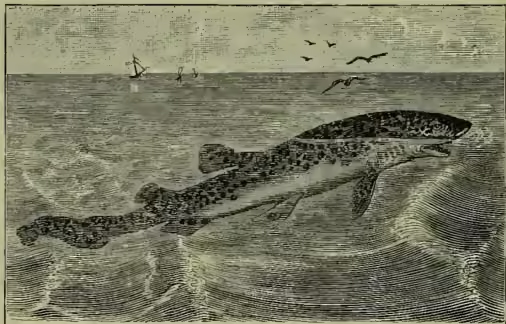
Dog-fish, the popular name for a number of cartilaginous (Elasmobranch) fishes in the shark sub-order. They belong to the genera Scylium, Pristiurus, Acanthias, &c., and have the general characters noted under Cartilaginous Fishes. (q.v.). (1) The 'rough hound,' or Lesser Spotted Dog-fish (Scyllium canicula), is common off European coasts, feeding chiefly among rocks at the bottom. It measures from 16 inches to over 2 feet in length; is reddish-gray, with brown spots above, and dirty yellow below. The eggs, which in the oviparous dog-fishes are large and few in number, are inclosed in pale yellow, horny purses, with long mooring tendrils, and are laid throughout summer and autumn. These envelopes are known as mermaids' purses, sailors' purses, or sea purses. The animals are sometimes cooked for soup, and their flesh even may be eaten. (2) The 'nurse hound,' or Larger Spotted Dog-fish (S. stellare or catulus), is a larger species, 3 to 4 feet in length, of a reddish-gray colour, with large, round, brown spots. The eggs are laid late in the year. The flesh is too coarse to be edible. The skin of both spotted dog-fishes is studded with tubercles of dentine capped with enamel, and when prepared is used as 'rubskin' for polishing. (3) The Black-mouthed Dog-fish (Pristiurus melanostomus) measures a little over 2 feet, and is of a brownish-yellow colour above, and paler below. The dark spots are large, oblong, and disposed in two rows. The snout is longer, and there is a row of small spines on each side of the upper margin of the tail. (4) The Picked Dog-fish (Acanthias vulgaris), belonging to a different family (Spinacidae), is more abundant off British coasts than any of the others. It measures about 3 feet in length, and is a voracious, prolific, hardy animal. It is not oviparous, and is said to produce young almost daily for eight or nine months a year. Its skin is not so rough as that of the spotted dog-fishes. The colour is slaty-gray or reddish-brown above, and whitish beneath. The two dorsal fins are each provided with a strong spine, which the fish uses with great accuracy as weapons. It gets a variety of names, such as bony dog, hoe, &c., and is much and justly hated by the fishermen for the damage it does to nets and lines, and for the voracity with which it attacks the shoals of herring and other food fishes. The names 'dog,' 'hound,' &c. are characteristic of all the set, but are particularly applicable to Acanthias. As many as 20,000 have been caught at a time, and their consequent destructiveness can be readily imagined. The young are born alive, two at a time, but in very rapid succession for prolonged periods. The flesh, though coarse, is sometimes eaten; and the eggs are said to be appreciated. The livers yield oil. To numerous related genera of wide distribution—e.g. Centrophorus, Spinax, Seymnus, the title dog-fish might also be applied. See CARTILAGINOUS FISHES, SHARK.